HubSpot vs GoHighLevel: The Ultimate 2026 B2B Agency Scaling Showdown
Every B2B agency founder reaches a specific, exhausting breaking point. You land three new high-ticket retainer accounts in a single week. The team celebrates on Slack, but underneath the excitement, a quiet panic sets in. You realize your current tech stack is held together by digital duct tape, Zapier webhooks that break twice a month, and prayers.
To onboard these clients, your account managers need to build three separate lead-capture funnels, hook them up to an email sequencing tool, configure text message reminders, tie everything into a pipeline tracker, and build a client-facing reporting dashboard.
If you do this in HubSpot, your upcoming software bill will give your accountant a minor heart attack. If you do this across seven different point solutions, your operational efficiency drops to zero.
This is the reality of scaling a B2B agency. You are not just managing your own business; you are managing the revenue architecture of dozens of other businesses. The tools you choose determine whether your net margins sit at a healthy 40% or get completely eaten alive by software licensing fees and manual labor.
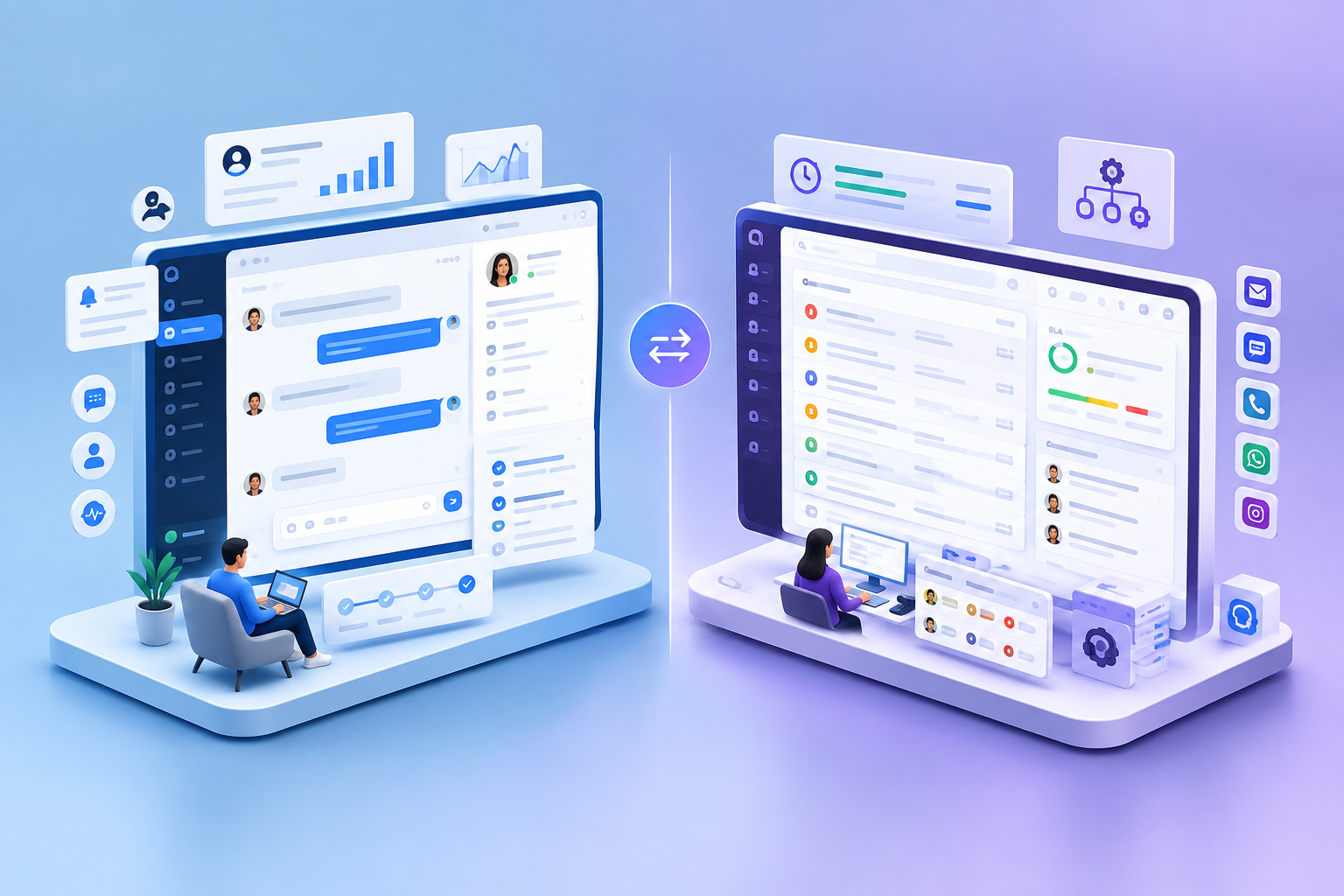
Two tech giants dominate this conversation: HubSpot and GoHighLevel (frequently called GHL). They approach the agency scaling problem from completely opposite directions. HubSpot is the polished, enterprise-grade ecosystem that commands premium authority. GoHighLevel is the disruptive, all-in-one challenger built specifically to turn agencies into software-backed powerhouses.
Let's cut through the marketing fluff and look at how these platforms actually perform when your agency is trying to scale up without breaking down.
The Fundamental Architectural Divide
To understand which tool fits your agency, you have to look at what they were originally built to do.
HubSpot started as the pioneer of inbound marketing. Over two decades, it evolved into a comprehensive Customer Relationship Management (CRM) and Revenue Operations (RevOps) ecosystem. It looks beautiful, feels intuitive, and focuses on aligning sales, marketing, and service teams within a single organization. HubSpot is built around the concept of a single corporate database.
GoHighLevel, by contrast, was built from day one for agencies. The founders looked at the typical digital agency tech stack in the late 2010s—ClickFunnels for landing pages, ActiveCampaign for emails, Twilio for text messages, Calendly for booking, and Pipeline for sales—and decided to clone all of them into a single dashboard. Crucially, GHL uses an agency-first architecture. You buy one overarching agency license, and within that license, you can spin up unlimited, completely isolated 'sub-accounts' for your clients at no extra cost.
This architectural difference changes everything about how you price your services and manage your internal operations.
The Cost Conundrum: Seat Pricing vs. Unlimited Sub-Accounts
Let's talk about the elephant in the room: pricing structures. The contrast here is stark, and it represents the biggest structural fork in the road for a growing agency.
The HubSpot Pricing Model: Premium Expansion
HubSpot operates on a traditional SaaS pricing model based on tiers (Starter, Professional, Enterprise), contact volume, and user seats.
If you want the robust automation features required to run serious B2B campaigns—like advanced behavioral triggers, custom reporting, and lead scoring—you must be on the Professional or Enterprise tiers. A typical setup involving the Marketing Hub Professional and Sales Hub Professional can easily run north of $1,200 to $1,500 per month.
Here is the real kicker for agencies: HubSpot pricing scales based on the data you hold and the people you employ. If your agency grows from 5 to 15 team members, your seat costs go up. If your clients' lead lists grow from 10,000 to 50,000 contacts, your contact tier pricing spikes. Furthermore, if you want to manage multiple clients, you either have to force your clients to purchase their own independent HubSpot portals (and grant your team partner access) or manage them inside your own portal using complex, messy custom properties and partitioning tools.
The GoHighLevel Pricing Model: Fixed Cost Leverage

GoHighLevel flips this model completely on its head. Their core Agency Pro plan sits at a predictable $497 per month.
For that flat monthly fee, GHL gives you:
- Unlimited team seats.
- Unlimited contacts.
- Unlimited funnels and landing pages.
- Unlimited sub-accounts for your clients.
Whether you have three clients or three hundred clients, your core platform licensing cost remains $497 per month. You can provision a pristine, dedicated marketing and sales portal for every single new client you sign with two clicks.
For an agency focused on scaling, this changes the financial math entirely. With HubSpot, software is a variable expense that scales up with your business. With GoHighLevel, software becomes a fixed overhead cost that drops as a percentage of revenue the larger you grow.
Marketing Automation and Funnel Building: Power vs. Agility
Both platforms claim to automate your marketing top to bottom. But the execution style matches their distinct target markets.
Campaign Orchestration in HubSpot
HubSpot's workflow builder is a work of art. It is visually clean, highly dependable, and allows for incredibly nuanced data manipulation.
For B2B agencies working with mid-market or enterprise clients, HubSpot offers hyper-sophisticated segmentation. You can build workflows that trigger based on precise criteria: a prospect viewed a pricing page three times, works at a company with over 500 employees, downloaded a specific whitepaper, and has a target Job Title matching your persona.
HubSpot also handles complex multi-branch logic beautifully. If a contact doesn't open Email 1, send them down Path A. If they open it but don't click, send them down Path B. If they click, assign a task to the account executive and update their lifecycle stage to Marketing Qualified Lead (MQL). The reporting attached to these workflows tells you exactly where leads are dropping off down to the percentage point.
High-Velocity Execution in GoHighLevel
GoHighLevel handles workflows via its 'Workflows' engine, which has evolved into a highly capable automation builder. It can handle multi-channel sequencing natively in ways that HubSpot requires third-party plugins to achieve.
Inside a single GHL workflow, you can drop an action to send an email, wait 10 minutes, send an SMS message, wait a day, drop a ringless voicemail, send a WhatsApp message, and send an internal notification to the client's sales rep via an app push notification. For agencies running local B2B lead generation, paid ads campaigns, or high-velocity outreach, this multi-channel approach is incredibly effective.
GHL also features a robust drag-and-drop funnel builder modeled heavily after ClickFunnels. It allows your team to clone high-converting landing pages instantly across different client accounts. If you design a perfect B2B lead generation funnel for a commercial cleaning client in Dallas, you can snapshot that entire account—funnels, automated follow-up sequences, pipelines, and all—and deploy it instantly for a new client in Chicago.
HubSpot can duplicate templates, but it does not have an equivalent to GHL's 'Snapshots,' which allow you to copy an entire business infrastructure in thirty seconds.
The CRM and Data Cleanliness Dilemma
Automation is only as good as the underlying data driving it. This is where the gap between these two systems widens significantly.
HubSpot's Single Source of Truth
If your agency focuses on complex B2B sales cycles—think enterprise software, medical manufacturing, or corporate logistics—HubSpot's CRM engine is unmatched. It is built on a relational database architecture that flawlessly connects Contacts, Companies, Deals, Tickets, and Custom Objects.
HubSpot shines at keeping data clean across large teams. The interface prevents sales reps from skipping steps, automatically logs emails and Zoom calls, and tracks the exact attribution revenue path from the initial Google Search click down to the closed-won contract. Its integrations with enterprise tools like Salesforce, NetSuite, or Snowflake are native and bulletproof.
GoHighLevel's Action-Oriented Pipeline
GoHighLevel's CRM is functional, but it feels more like an agile sales opportunity tracker than a deep corporate database. It handles pipelines, stages, and basic contact records perfectly fine for small-to-medium businesses.
However, it lacks the deep relational database capabilities of HubSpot. Managing complex account-based marketing (ABM) campaigns where you need to map out fifteen different stakeholders across four subsidiaries of a single parent company can become cumbersome in GHL. It is built for linear sales processes: lead comes in, lead gets booked, lead gets closed, lead gets onboarded.
White-Labeling: The Agency Growth Secret

This is the arena where GoHighLevel completely separates itself from HubSpot and traditional SaaS platforms.
HubSpot wants everyone to know they are using HubSpot. When your clients log into their reporting dashboards or look at their automation tracking, the HubSpot logo is proudly displayed. Being a HubSpot Certified Partner carries immense professional prestige, but you are ultimately selling and implementing someone else's software ecosystem.
GoHighLevel allows you to entirely erase their brand from existence. Under the Agency Pro plan, you can white-label the entire platform. You put it on your own custom domain (e.g., app.youragency.com), swap out the logos, re-skin the color palette to match your agency branding, and present the software to the world as your own proprietary technology platform.
This completely changes the positioning of your agency. Instead of selling standard marketing services that clients view as a disposable monthly expense, you are now selling a comprehensive, proprietary operational solution.
You can even leverage GHL's 'SaaS Mode' to automatically bill your clients for software access. You can charge them $297 or $497 per month just to access the app you white-labeled, creating an entirely automated, high-margin recurring software revenue stream alongside your agency services.
HubSpot offers no equivalent to this. You cannot rename HubSpot and resell it as your own software engine.
Client Onboarding and Operational Sanity
How does your life look on a Tuesday morning when your team needs to update campaigns for thirty different clients?
The HubSpot Agency Workflow
If you run your agency through HubSpot, you typically use one of two methods.
Option A: You manage all clients inside one giant enterprise portal using Business Units to keep things separate. This requires meticulous admin management to ensure Client X never accidentally sees Client Y's data.
Option B: Every client purchases their own HubSpot portal, and your team logs in via the HubSpot Partner Dashboard. This is highly secure and professional, but it means your team is constantly clicking back and forth between completely separate instances, copying assets manually, and managing a patchwork of independent user permissions.
The GoHighLevel Agency Workflow
With GoHighLevel, your account managers have a single master login. At the top of the screen, a simple dropdown menu lets them instantly switch between every single client sub-account under your agency umbrella.
Because of GHL's Snapshot feature, operational scaling becomes predictable. When you sign a new client, you don't build their systems from scratch. You select your agency's proven B2B onboarding snapshot. Instantly, the new client's sub-account populates with your vetted email nurture tracks, SMS confirmation templates, calendar booking systems, and pipeline dashboards. Your team only needs to jump in and customize the client's brand names, specific offers, and copy variations.
Making the Decision: A Strategic Evaluation Framework
To make this choice simple, let's look at a side-by-side breakdown of how these platforms score across the core metrics that matter to an agency leadership team.
| Operational Feature | HubSpot Core Capability | GoHighLevel Core Capability |
|---|---|---|
| Pricing Dynamics | Scaled per seat, per contact, and per feature tier. Higher usage drives higher monthly costs. | Flat monthly rate for unlimited sub-accounts, team members, and contacts. |
| Brand Positioning | Cobranded or fully branded as a HubSpot Certified Partner implementation. | Completely white-labeled under your own agency domain and logo. |
| Database Architecture | Relational data mapping (Contacts, Companies, Deals, Custom Objects). | Linear, action-oriented contact records and opportunity pipelines. |
| Omnichannel Messaging | Strong email; SMS and voice require third-party integrations (Twilio, Sakari). | Native SMS, email, voice drops, WhatsApp, and social chat management. |
| System Deployment | Manual template copying or individual portal configuration setups. | Snapshot system for instant duplication of full accounts and assets. |
When to Choose HubSpot for Your B2B Agency
HubSpot remains the clear winner if your agency fits into these specific operational scenarios:
- Your target market is mid-market to enterprise companies. If you are closing clients with internal marketing teams, hundreds of employees, and long, multi-stakeholder sales cycles, they will likely demand a platform like HubSpot. They want deep security compliance, complex data modeling, and seamless integrations with systems like Salesforce.
- You are focused heavily on content-driven, inbound strategy. HubSpot's blogging, SEO optimization, and deep content analytics tools are refined, elegant, and built for long-term organic growth engines.
- You want to build a consultative RevOps practice. If your agency makes money by auditing, restructuring, and optimizing the internal sales and marketing pipelines of corporate clients, HubSpot provides the professional framework required to command five-figure consulting retainers.
When to Choose GoHighLevel for Your B2B Agency
GoHighLevel is the optimal choice if your scaling strategy matches these goals:
- You serve small-to-medium businesses (SMBs) or local B2B niches. If your clients need fast leads, automated booking systems, and simple pipeline tracking without corporate complexity, GHL gives them everything they need in an accessible format.
- You want to protect and maximize your agency profit margins. By eliminating separate bills for email marketing tools, funnel builders, call tracking software, and review management apps, you can consolidate your tech stack down to a single fixed cost.
- You want to transition from a service agency to a software-enabled business. If you want to white-label a platform, package your strategic marketing frameworks directly into the software via Snapshots, and sell software access alongside your monthly retainers, GHL is built specifically to enable that business model.
Final Strategic Takeaway
Choosing between these platforms isn't about deciding which software has the longer list of features. It's about deciding what kind of business model you want to run.
HubSpot is an investment in corporate infrastructure, data integrity, and enterprise authority. It allows your agency to act as an elite guide navigating complex systems for sophisticated clients.
GoHighLevel is an investment in leverage, operational speed, and productized scale. It allows you to build your own technology ecosystem, clone your successes instantly, and escape the trap of trading hours for dollars by selling your own white-labeled software engine.
Assess your current client roster, look closely at your long-term growth targets, and pick the system that protects your team's sanity while keeping your margins as healthy as possible. For deeper software insights and analysis on finding the right infrastructure for your growing business, you can always explore the strategic buying guides over at SaaSBonus.