10 Best AI Project Management Tools for Agencies (2026 Rankings)

Every agency founder and operations director knows the exact breaking point. You land three new retainer accounts in a single week, the Slack channels start flashing red, and suddenly your seasoned account managers are spending fifteen hours a week just chasing down status updates. You did not start an agency to manage endless spreadsheets, yet here you are, watching billable utilization slip through the cracks while your team drowns in operational overhead.
The agency scaling problem used to be solved by throwing more project managers at the fire. Today, it is solved with artificial intelligence.
Choosing a project management platform is historically an exercise in frustration. You spend weeks configuring boards, only for team members to abandon them because manual updates feel like a secondary job. But the landscape has completely shifted. The best project management platforms are no longer passive databases where work goes to be logged; they are active workflow engines that predict delays, schedule tasks automatically based on team capacity, and write your client status reports for you.
We have spent months testing the leading platforms at SaaSBonus to see which systems actually handle the chaotic, multi-client nature of agency life. If you are ready to stop guessing your team capacity and start scaling predictably, here are the absolute best AI project management tools for agencies ranking this year.
The Real-World Impact of AI on Agency Operations
Before breaking down the top platforms, let's look at what AI actually does for an agency workflow. We aren't talking about simple generative text boxes that write generic task descriptions. True AI integration addresses the distinct operational friction points that drain agency margins:
- Automated Capacity Management: Instead of project managers manually checking resource allocation calendars, AI engines read task durations, deadlines, and skill sets to automatically assign work to the right creative or developer without overloading them.
- Predictive Risk Flagging: Advanced machine learning algorithms look at historical team velocity and communication patterns to alert operations leaders when a project is running a 40% risk of missing a milestone—weeks before the deadline arrives.
- Elimination of Internal Status Meetings: AI tools scan activity logs, task comments, and documents to instantly compile daily standup briefs and client-facing summaries. This eliminates hours of alignment meetings every single week.
- Contextual Knowledge Retention: Instead of hunting through three different client folders and old Slack threads for a brief, team members can query an internal workspace AI to instantly pull exact project requirements and brand guidelines.
10 Best AI Project Management Tools for Agencies
1. Teamwork.com
If your agency lives and dies by client delivery, billable hours, and tight profit margins, Teamwork.com remains a top contender. Unlike generic project management apps, this platform is engineered specifically for client work, and its recent suite of AI capabilities doubles down on operational health.
The standout feature here is the AI Project Wizard, which can take a raw client brief or Statement of Work (SOW) and translate it into a fully structured project plan with milestones, dependencies, and individual tasks within seconds. For operations teams that used to lose half a day setting up complex client workspaces, this is an incredible time-saver.
Furthermore, its AI Smart Scheduler looks across your entire roster of creatives and strategists to suggest assignments based on real-time availability and skill matching. Combined with the AI Forecaster, the platform flags projects heading into the red at 30% completion rather than at invoice time, giving you the visibility needed to preserve your agency margins.
2. ClickUp
ClickUp has built a massive footprint as an all-in-one workspace, and its proprietary neural network, ClickUp Brain, is one of the most comprehensive platform-wide AI integrations available. For agencies that want their tasks, wikis, client documents, and team communication in a unified hub, ClickUp provides massive leverage.
ClickUp Brain acts as a contextual overlay across your entire digital workspace. A creative director can ask the AI, 'What are the current blockers on the Nike campaign?' or 'Summarize the feedback from yesterday's client meeting,' and the engine will instantly scan tasks, docs, and chat history to deliver an accurate answer.
Beyond search, its automated standup tool generates daily progress summaries for individual team members, saving project managers from chasing updates. The platform also features automated workflow generation, allowing you to build complex multi-step automations simply by describing what you want in plain English.
3. Motion
Most project management tools require you to manually plan out your calendar and rearrange your day when emergencies arise. Motion takes the opposite approach. It is a completely hands-off, AI-driven auto-scheduling calendar that functions as a personal executive assistant for every member of your agency.
You simply input your tasks, add their estimated duration, assign a priority level, and set the hard deadline. Motion's algorithm instantly builds a customized daily schedule for you, weaving those tasks directly around your existing client meetings.

If a client calls an emergency workshop that blocks out your afternoon, Motion instantly reschedules your remaining tasks across the rest of your week, prioritizing high-impact deadlines. For agencies where priorities change daily, Motion minimizes the mental load of scheduling and keeps teams focused purely on execution.
4. Wrike
For large-scale or enterprise creative agencies handling dozens of complex integrated campaigns, Wrike offers exceptional structural stability and enterprise-grade machine learning. Wrike's AI capabilities are heavily focused on risk management and process optimization.
Its AI Risk Prediction model analyzes historical performance metrics and real-time activity to flag projects that are slipping out of scope. If the system notices that copy assets are taking longer to get approved than usual, it will warn the account director that the final launch date is compromised.
Additionally, Wrike features robust AI-powered proofing and approvals, helping creative teams rapidly extract action items from client feedback markup. If your agency requires rigid approval structures, complex dependencies, and cross-portfolio visibility, Wrike provides the corporate control you need.
5. Taskade
Taskade's approach to project management centers around highly customizable AI Agents and automated workflow systems. Think of it as a collaborative workspace where virtual AI teammates work alongside your human staff to handle repetitive operational tasks.
Agencies can build and deploy specific agents tailored to unique tasks—such as a Sprint Planning Agent, a Client Onboarding Agent, or a Content Pipeline Coordinator. These agents can automatically break down large goals into practical tasks, track ongoing developer velocity, and send structured updates directly to your stakeholders.
Taskade combines structured lists, mind maps, and Kanban views with a powerful system kernel that makes it easy to spin up new workflows. It is incredibly flexible, making it ideal for fast-growing agile agencies that like to build custom, automated systems without touching code.
6. monday.com
Known for its visually striking, hyper-customizable interfaces, monday.com brings its signature ease of use into the AI landscape with the monday AI Work Platform. It is an excellent match for agencies that want modern automation features without forcing their creative teams into a steep learning curve.
The system includes AI-powered columns that can automatically extract crucial information from uploaded client files, categorize tasks based on text descriptions, and even detect sentiment within communication threads. If an account manager receives a lengthy brief via document upload, the platform can parse the key deliverables directly into tracking rows.
With intuitive natural language formula builders and automated template generation, setting up custom dashboards for client reporting requires zero technical expertise. It keeps operational data highly accessible and readable.
7. Notion
Notion has transformed from a clean note-taking app into an incredibly powerful, AI-driven knowledge base and project tracker. For digital and content agencies that handle heavy amounts of documentation, research, and copywriting, Notion AI offers an unrivaled repository.
With its central database capabilities, you can house your project boards, client wikis, brand voice guidelines, and content calendars in the exact same workspace. The AI autofill feature can scan entire databases of raw client interview notes to automatically populate summary columns, tag key themes, and assign action items.
Its integrated Notion Calendar allows individuals to time-block their tasks seamlessly, while the workspace search answers specific internal questions by looking across years of documented agency institutional knowledge.
8. Asana
Asana has integrated machine learning directly into its core engine to optimize team coordination and high-level goal tracking. Its Smart Summaries and Smart Workflows are specifically geared toward keeping multi-departmental agency teams completely aligned.
Asana's AI excels at identifying historical bottlenecks within workflows. If a design team consistently stalls at the internal review stage, Asana highlights the pattern and suggests an automated routing rule to clear the hurdle.
Its goal-setting frameworks connect day-to-day creative production directly to high-level agency OKRs. This provides executives with a transparent view of how individual team outputs impact overall company performance, making resource adjustments highly strategic.
9. Jira (with Atlassian Rovo)
For software development agencies, technical product studios, and IT consulting shops, Jira remains the gold standard for sprint management. With Atlassian's new AI engine, Rovo, it introduces deep organizational search and intelligent agent assistance to technical workflows.
Rovo allows development teams to search across their entire technology stack—including GitHub, Confluence, and external chat tools—from within Jira. The AI can instantly pinpoint the root cause of an issue, draft clear work breakdown structures for complex code deployments, and fix syntax errors in complex queries.
It effectively reduces the administrative overhead that engineers typically face, allowing technical project managers to maintain highly accurate sprint velocities without micromanaging daily developer tasks.
10. Productive
Productive is an end-to-end agency management tool that balances core project management features with real-time financial tracking. Its AI features focus heavily on business intelligence, profitability, and resource scheduling.
Instead of just tracking whether a task is done, Productive connects that task directly to your client's budget, your team's cost per hour, and your ultimate profitability margin. The platform's smart scheduling tools help project managers optimize target utilization rates by calculating forward-looking capacity trends.
If your agency struggles with accurate time tracking and frequently wonders whether your fixed-fee projects are actually profitable, Productive provides the deep financial clarity necessary to keep operations healthy.

Comparison: Choosing the Best AI Platform for Your Agency Type
| Tool | Best Suited For | Key AI Highlight | Pricing Starts From |
|---|---|---|---|
| Teamwork.com | Client-centric agencies | AI Project Wizard & Profitability Forecaster | $9.99/user/month |
| ClickUp | All-in-one productivity | Unified knowledge search with ClickUp Brain | $14/user/month |
| Motion | Fast-paced, reactive teams | Fully automated calendar daily scheduling | $19/user/month |
| Wrike | Enterprise scale agency portfolios | Predictive risk flagging and scope tracking | $10/user/month |
| Taskade | Agile agencies using virtual help | Deployable AI workflow & execution agents | $6/user/month |
| monday.com | Visual tracking and simplicity | Smart column extraction & sentiment analysis | $12/user/month |
| Notion | Content & knowledge-heavy teams | Database autofill & deep knowledge retrieval | $10/user/month |
| Asana | Cross-departmental coordination | Workflow bottleneck analysis & goal tracking | $13.49/user/month |
| Jira | Software & technical dev agencies | Technical stack search and breakdown via Rovo | $9.05/user/month |
| Productive | Financial & operations managers | Target utilization & margin forecasting | Custom pricing |
Implementation Strategy: How to Roll Out an AI Project Management System Without Frustration
Switching systems or introducing new automated layers can trigger immediate pushback from an overworked team. If your creatives feel like the new AI tool is just an invasive tracking device or another complex process to maintain, adoption will stall.
Step 1: Audit Your Operational Friction Points
Do not purchase a platform simply because it has a shiny new feature. Sit down with your account directors and creative leads. Identify where the actual operational drag occurs. Is it setting up new projects? Is it pulling status reports for clients? Is it finding assets? Choose the tool that solves that specific core bottleneck.
Step 2: Establish Transparent AI Data Governance
Clearly communicate to your team how the AI works. If you are using a tool like Motion, explain that the auto-scheduler is there to protect their deep-work time blocks and prevent burnout, not to track their activity down to the exact second. If you are using ClickUp Brain, ensure your team knows that client data remains entirely secure within your workspace environment.
Step 3: Run a Controlled Pilot Program
Do not attempt to migrate your entire agency roster overnight. Select a single cross-functional team or a specific client account to test the platform for a 30-day window. Use this trial period to dial in your custom templates, test out the accuracy of the automated status summaries, and iron out any unexpected workflow bugs before rolling it out across the entire agency.
The Ultimate Verdict
The right AI project management tool depends completely on how your agency operates. If your absolute priority is protecting profit margins and optimizing client delivery, Teamwork.com offers the most targeted toolkit. For teams looking for a single unified workspace to replace multiple disconnected apps, ClickUp delivers unmatched contextual power. And if your team is simply exhausted by the daily chore of managing calendars and shifting schedules, Motion provides immediate, automated relief.
At SaaSBonus, we know that finding the perfect software stack requires looking past marketing hype to see how tools perform under real pressure. Take advantage of the free trials available on these platforms, test them with your actual agency workflows, and select the system that clears your path toward scalable growth.
Frequently Asked Questions
Will an AI project management tool replace my human project managers?
No, AI is designed to remove administrative friction, not replace human leadership. The technology handles the repetitive logistics—such as auto-scheduling, extracting data from files, and summarizing long comment threads. This actually frees up your human project managers to focus on high-level strategy, creative problem solving, client relationship management, and team leadership.
How secure is client data when using AI features in these platforms?
Most enterprise-grade project management systems like Wrike, ClickUp, and Asana partner with secure foundational models (such as OpenAI, Anthropic, or Google Gemini) and enforce strict data privacy guardrails. This means your proprietary workspace data, client briefs, and conversations are kept entirely private and are never used to train public machine learning models. Always review a platform's specific privacy compliance terms before uploading highly confidential client data.
Can AI project management tools accurately predict if an agency project will go over budget?
Yes, specialized tools like Wrike, Teamwork.com, and Productive look at historical performance metrics, actual time logged, scope adjustments, and communication speed. By comparing this real-time data to your original project parameters, the algorithms can accurately flag structural delays and budget overruns very early in the project lifecycle, allowing you to renegotiate scope before it is too late.
How long does it typically take an agency to onboard onto an AI-first project management system?
A basic migration can take anywhere from two to four weeks depending on the size of your agency. Platforms like monday.com and Notion are highly visual and can be adopted quickly, while deep platforms like Wrike or Jira require more configuration time. Using built-in features like Teamwork.com's AI Project Wizard can drastically cut down the initial workspace configuration time.
Are AI features included in standard project management software subscription plans?
Usually, advanced AI features are offered either as an add-on tier or are built into the premium business and enterprise subscription plans. For example, accessing ClickUp Brain requires adding a fee per user to an Unlimited or Business plan. It is important to look closely at the feature breakdowns of each tier to see if the specific AI models you want require an additional subscription upgrade.
Can an AI scheduling calendar like Motion handle complex creative dependencies?
Yes. While Motion functions perfectly as an individual calendar assistant, its team and business tiers allow you to set explicit task dependencies. If a designer cannot start building high-fidelity wireframes until a copywriter finishes the messaging framework, the engine will automatically lock the design task and only schedule it into the designer's calendar once the copywriting task is formally marked as complete.
Featured Image Prompt
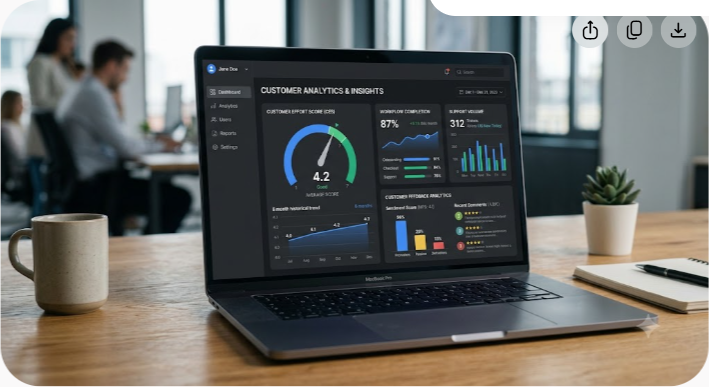
An editorial, high-tech corporate concept photograph capturing a modern creative agency office. In the foreground, a sleek minimalist desk features a large curved monitor displaying a glowing, clean digital dashboard with floating translucent UI elements, organized project timelines, and vibrant data charts. In the soft-focus architectural background, a diverse group of professional agency team members work collaboratively in a brightly lit, glass-walled conference space. The lighting is bright, clean, and professional with soft blue and cool white tones, reflecting a sophisticated, forward-thinking tech environment.