Intercom vs Freshdesk for SaaS: 2026 Comparison Guide
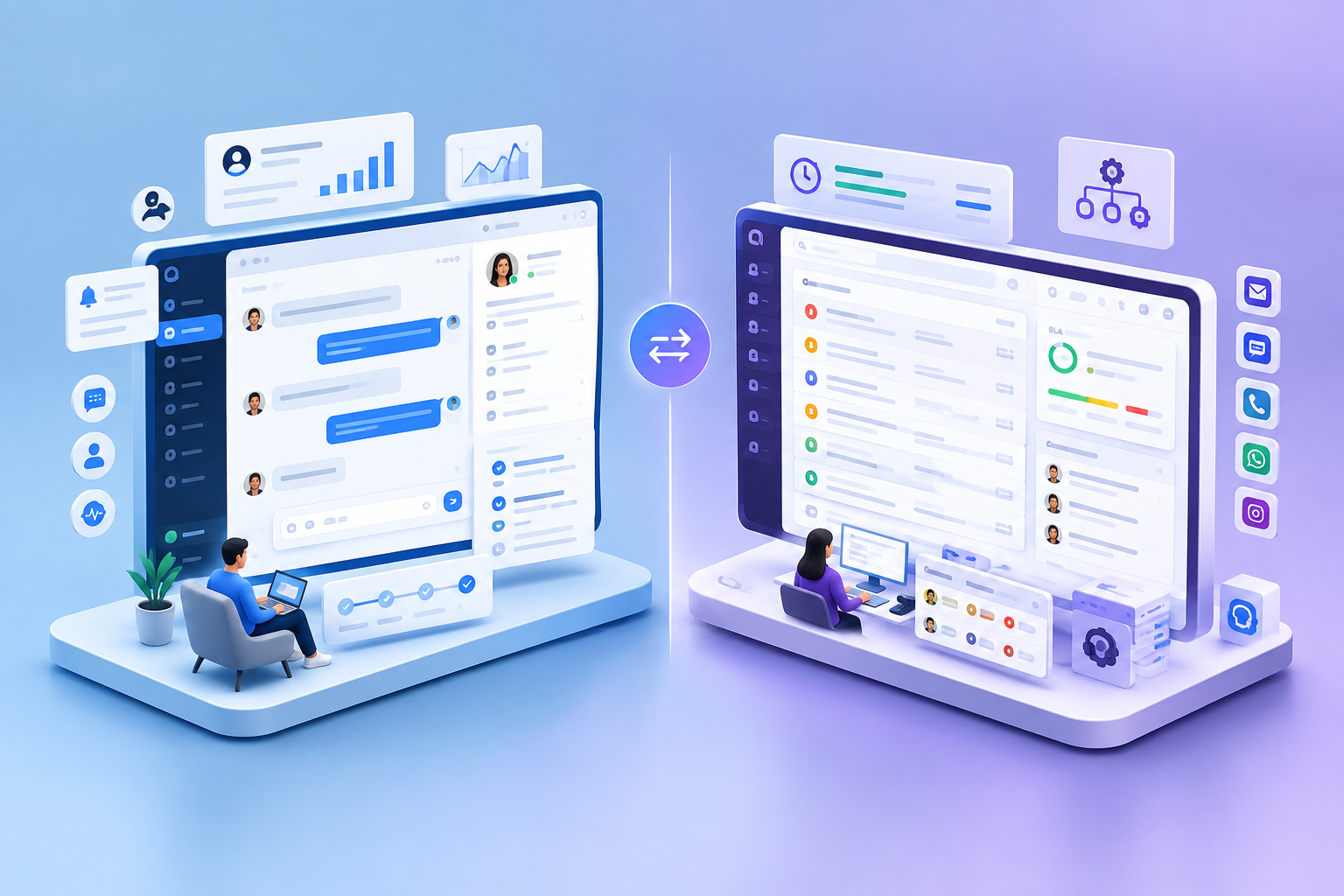
Intercom and Freshdesk can both run a SaaS support operation, but they are built around different ideas about what support should look like. Intercom puts conversations, in-app engagement, automation, and customer context at the center. Freshdesk is built around a more traditional help desk model, with structured tickets, queues, workflows, SLAs, and multichannel service.
For most SaaS companies, the better choice depends less on the size of the company than on how customers ask for help and how the support team works. A product-led SaaS company that wants to answer questions inside the application and guide users toward activation may find Intercom a natural fit. A company handling large volumes of email-based requests, formal SLAs, escalations, and department-level ticket queues may prefer Freshdesk.
There is also an important distinction between customer support and customer engagement. Intercom can connect support with onboarding and proactive messaging, while Freshdesk is generally stronger when the primary requirement is to organize, prioritize, assign, and resolve support requests at scale.
This Intercom vs Freshdesk comparison looks at the differences that matter to SaaS teams: in-app support, onboarding, AI, ticket management, automation, integrations, reporting, scalability, and total cost. Pricing and AI packaging can change, so treat quoted prices as a framework for comparing pricing models rather than a permanent price list.
Intercom vs Freshdesk: The Short Answer
If you want a SaaS support platform that sits close to the product experience, Intercom is usually the stronger choice. Its conversational approach works particularly well for product-led growth, in-app support, customer onboarding, targeted messaging, and support teams that need rich customer context while responding.
If you need a structured help desk for high-volume support, Freshdesk is often the better fit. Its ticket-centric architecture is well suited to teams that rely on queues, priorities, SLAs, routing, escalation rules, and clearly defined support processes.
A simple way to think about the choice is this:
- Choose Intercom when the support experience is part of the product experience.
- Choose Freshdesk when support operations are the primary requirement and tickets need disciplined management.
- Choose based on workflow, not feature count. Both platforms cover many of the same categories, but they approach those categories differently.
Core Difference: Conversational Support vs. Structured Ticketing
The most useful Intercom vs Freshdesk comparison starts with architecture. The platforms overlap, but their default workflows are different.
Intercom: Support Around the Customer Conversation
Intercom was designed around conversations between a company and its customers. The Messenger can live directly inside a web or mobile product, allowing users to ask questions without leaving the application.
That in-app position gives support teams access to useful customer context. Depending on the implementation and connected data, agents can work with information such as user attributes, account details, product activity, conversation history, and other customer data.
This matters when a question depends on what the customer has actually done in the product. Instead of treating every message as an isolated ticket, a support team can connect the conversation to the customer's broader journey.
The same environment can also support proactive communication, onboarding messages, help content, and targeted customer engagement. For a PLG company, that combination can reduce the number of separate tools needed around the support function.
Freshdesk: Support Around the Ticket
Freshdesk, part of Freshworks, takes a more conventional help desk approach. Customer requests are collected, converted into tickets or support interactions, categorized, assigned, prioritized, and tracked through defined workflows.
That structure becomes valuable when support volume grows and different teams need predictable processes. A support manager can define priorities, routing rules, service targets, escalation procedures, and ownership without relying on an ongoing conversational thread to organize the work.
Freshdesk also supports multiple service channels and integrations, making it a practical choice for organizations where customers contact support through email, portals, chat, and other channels.
The distinction isn't that one platform has conversations and the other has tickets. Both can support conversations and structured work. The difference is which model sits at the center of the product.
Intercom vs Freshdesk Feature Comparison
| Operational Feature | Intercom | Freshdesk |
|---|---|---|
| Primary approach | Conversational support and customer engagement | Structured help desk and ticket management |
| Strong SaaS use case | PLG, in-app support, onboarding, proactive engagement | High-volume support, SLAs, routing, and service operations |
| In-app support | Strong, with Messenger and contextual experiences | Available through Freshworks' customer engagement tools and widgets |
| Product onboarding | Strong native onboarding and engagement capabilities, depending on plan | Usually requires additional products or integrations for advanced onboarding experiences |
| AI | Fin AI Agent and AI-assisted agent capabilities | Freddy AI capabilities across automation and agent assistance |
| Ticket management | Stronger than its early conversational-only reputation, but still conversation-centric | Core strength of the platform |
| SLAs and escalation | Available through support workflows and plan-dependent capabilities | Strong help desk capability, particularly for structured service operations |
| Customer context | Strong product and conversation context when properly integrated | Strong contact, account, ticket, and custom-field context |
| Outbound engagement | Strong in-app and proactive messaging capabilities | More focused on service communications, with broader capabilities available across Freshworks products |
| Knowledge base | Integrated help content and conversational support | Strong self-service and knowledge-base functionality |
| Automation | Workflow and conversation-based automation | Ticket, routing, workflow, and service automation |
| Best fit | Product-led and experience-focused SaaS teams | Process-driven and support-operations-focused SaaS teams |
1. In-App Support and Customer Onboarding
For SaaS companies, support doesn't always begin with a ticket. A user may get stuck during setup, misunderstand a feature, or need help completing an important workflow while already inside the application.
That is where Intercom has a meaningful advantage.
Intercom for In-App Support
Intercom's Messenger can be embedded directly into the customer experience. A user can search help content, start a conversation, or interact with automated assistance without opening a separate support portal.
For teams focused on activation, the value goes beyond live chat. Intercom can connect support with targeted in-app communication and onboarding experiences. Depending on the plan and implementation, teams can use product tours, checklists, messages, and other engagement features to guide users through important actions.
Consider a project-management SaaS product. A new account creates its first workspace but never invites another team member. Instead of waiting for that customer to contact support, the company can use an in-product message to explain the collaboration workflow or point the user toward the relevant setup step.
That is a different philosophy from traditional help desk software. The goal isn't only to resolve the question. It is also to prevent predictable questions from appearing in the first place.
Freshdesk for In-App Support
Freshdesk can provide customer-facing chat and self-service experiences through the broader Freshworks ecosystem. Customers can search knowledge content, interact with support, and submit requests through supported channels.
The limitation for some PLG teams is that advanced product onboarding is not the central focus of the traditional Freshdesk ticketing experience. If your strategy depends heavily on interactive product tours, behavioral onboarding, and detailed in-app engagement, you may need additional tooling or a broader Freshworks setup.
Which Is Better for SaaS Activation?
Intercom has the edge.
It is particularly compelling when onboarding, activation, support, and product engagement need to operate together. Freshdesk can support users effectively, but teams may need more surrounding tools to create the same product-led experience.
2. AI: Intercom Fin vs. Freshdesk Freddy AI
AI is one of the most important areas to compare carefully because both vendors offer more than a simple chatbot.
Intercom's AI offering includes Fin, an AI agent designed to resolve customer questions using approved knowledge and connected capabilities. Freshworks offers Freddy AI, which supports customer-facing automation as well as agent assistance, ticket classification, summarization, suggested responses, and other service workflows depending on the product and plan.
The important question isn't simply which AI has more features. Ask three practical questions instead:
- What does the AI use as its source of truth?
- What happens when it cannot answer the question?
- How are AI interactions priced and measured?

Intercom Fin AI Agent
Fin is closely integrated with Intercom's conversational support environment. It can use a company's support content and other configured sources to answer customer questions and can hand conversations to human agents when automation isn't sufficient.
Its outcome-oriented pricing model is also worth understanding. Intercom has positioned Fin around successful outcomes rather than simply charging for every message generated. The exact commercial terms, eligibility, and definition of a billable outcome should be checked against Intercom's current pricing before purchase.
For SaaS teams, that model can be attractive because it ties AI expenditure more closely to resolved customer issues. It also makes the quality of the knowledge base especially important. Poor documentation doesn't become useful just because an AI agent can read it.
Freshdesk Freddy AI
Freddy AI takes a broader service-management approach. Depending on the Freshworks product, configuration, and plan, it can help customers find answers, automate parts of the support journey, assist agents, summarize information, and improve ticket handling.
That breadth makes Freddy useful for organizations where AI needs to operate across a formal ticketing workflow rather than only inside a conversational support environment.
Freshworks has also used usage-based packaging for some AI capabilities, so buyers should verify the current number of included sessions, add-on rates, and what counts as a session before building a budget.
Which AI Is Better?
There isn't a universal winner.
Fin is particularly attractive for conversational, product-led support. Freddy AI is particularly attractive when AI needs to complement a structured help desk.
Don't choose based on the headline AI price alone. Test both systems against your own support content. A lower cost per interaction means little if the AI escalates too many conversations or produces answers your agents need to correct.
3. Ticketing, Routing, and SLA Management
This is where Freshdesk becomes especially compelling.
A SaaS support team may need to manage billing questions, technical incidents, account changes, feature requests, security concerns, and bug reports at the same time. Once support volume reaches a certain level, organization matters as much as conversational quality.
Freshdesk's Ticketing Strengths
Freshdesk is designed for this kind of operational discipline. Teams can organize incoming requests with fields, priorities, assignments, statuses, categories, automation rules, and escalation processes.
Useful capabilities can include:
- Automated ticket assignment and routing.
- SLA policies based on defined support requirements.
- Escalation rules for overdue work.
- Collision prevention so agents don't duplicate responses.
- Custom fields for customer, product, or issue information.
- Reporting around ticket volume, response times, resolution times, and agent performance.
- Structured workflows for different support categories.
For a B2B SaaS company selling contracts with formal service commitments, this structure can be more important than a polished in-app messenger.
Intercom's Ticket and Workflow Capabilities
Intercom has expanded well beyond its original reputation as a live-chat platform. Teams can use workflows, routing, inbox management, and ticket-oriented processes for more structured support operations.
A conversation can move into a ticket-based workflow when the issue requires work from another team. For example, a billing question can be routed to finance while a technical incident goes to a specialist support queue.
The difference is still one of emphasis. Intercom tends to preserve the customer conversation as the center of the experience, while Freshdesk starts from the support operation and ticket lifecycle.
Which Is Better for Complex Support Operations?
Freshdesk wins for heavily structured support operations.
If your support organization has several tiers, formal SLAs, large queues, and strict escalation procedures, Freshdesk's help desk model is likely to feel more natural.
4. Automation and Support Workflows
Automation can reduce repetitive work, but the best automation is usually the automation customers barely notice.
A SaaS team might automatically route an enterprise account to a specialist, send a billing question to the appropriate queue, ask a customer for missing information, or suggest a knowledge-base article before an agent joins the conversation.
Intercom Automation
Intercom's automation is especially useful when customer attributes and conversation context determine what happens next. Teams can build workflows around factors such as account type, conversation topic, user information, or support intent.
That approach works well for PLG businesses. A free user with a basic product question may follow a completely different support path from an enterprise customer reporting a production issue.
Freshdesk Automation
Freshdesk approaches automation from the ticket and service-management side. Rules can assign, categorize, prioritize, notify, and escalate requests based on defined conditions.
This is valuable when the team needs consistency. If every high-priority technical ticket needs to reach a Tier 2 queue within a specific time window, a rules-driven help desk can enforce that process without relying on individual agents to remember it.
Automation Winner
Intercom is stronger for context-driven conversational automation. Freshdesk is stronger for process-driven ticket automation.
The distinction matters because both approaches can produce impressive demos while solving different operational problems.
5. Knowledge Base and Self-Service
A good help desk should prevent unnecessary tickets, not simply process them faster.
Both platforms support knowledge-base and self-service strategies, but the experience fits their broader product philosophy.
Intercom can surface help content within the conversational experience, allowing customers to search for answers before or during a conversation. That can work especially well when customers already use the Messenger inside the application.
Freshdesk has long treated knowledge management as a core help desk function. Its structured portal and self-service approach can suit organizations with large documentation libraries, formal support categories, and customers who prefer searching for an answer rather than starting a conversation.
The better platform depends on how your customers behave. If users want help without leaving the product, Intercom has an advantage. If customers routinely visit a dedicated support portal and search extensive documentation, Freshdesk is a strong contender.
6. Integrations and SaaS Customer Context
Neither platform should be judged in isolation. Your support system becomes much more useful when it can exchange information with the rest of your SaaS stack.
Typical integrations can include CRM systems, billing platforms, issue trackers, communication tools, identity systems, data warehouses, and product analytics platforms.
For example, a support agent may need to know whether a customer is on a trial, when a subscription renews, which plan they have, whether an invoice is overdue, or whether engineering has already logged the reported bug.
Intercom is especially attractive when product usage and customer engagement data need to sit close to conversations. Freshdesk is compelling when the central record is the support ticket and that ticket needs to connect with CRM, engineering, and service-management workflows.
Before buying, build a list of your ten most important integrations and test each one. A marketplace containing thousands of apps doesn't help if your three critical systems require expensive custom development.
7. Reporting and Support Management
Support leaders need more than a count of open tickets. They need to understand where customers struggle and whether the support operation is improving.
Useful metrics include:
- First response time.
- Resolution time.
- Reopened tickets.
- Backlog size.
- Contact rate by customer segment.
- Self-service usage.
- AI resolution or containment rate.
- Escalation rate.
- Customer satisfaction.
- Support volume by product area.
Freshdesk's traditional help desk architecture makes operational reporting a natural part of the platform. Managers can analyze queues, agents, SLAs, and ticket trends.
Intercom adds another dimension: conversations can be analyzed alongside customer and product context. For a PLG company, that can help connect support questions with user behavior and product adoption.
That distinction is useful. Freshdesk is often better for asking, "How efficiently is our support team processing work?" Intercom is often better suited to asking, "What are customers experiencing inside our product, and how can we respond?"
Intercom vs Freshdesk Pricing: What Should SaaS Teams Expect?

Pricing is one of the easiest parts of this comparison to get wrong because both vendors can change plans, packaging, usage limits, and AI charges over time.
Rather than treating a single published price as the final answer, compare the complete cost of ownership.
Intercom Pricing Model
Intercom's pricing generally combines a core platform subscription with plan-dependent features, seats or access models, and usage-based components for some AI or engagement capabilities.
That can make the headline seat price look higher than a conventional help desk. The comparison changes, however, if you would otherwise need separate products for in-app messaging, onboarding, product tours, and proactive customer communication.
For an early-stage SaaS company, eligibility for startup programs or promotional pricing can also materially change the first-year economics. Eligibility requirements and discounts can change, so verify the current offer directly with Intercom before including it in a financial forecast.
Freshdesk Pricing Model
Freshdesk generally uses a more familiar per-agent help desk pricing structure, with different plans adding progressively more functionality. AI capabilities and other advanced features may be packaged separately or subject to usage limits depending on the current plan.
That structure can make budgeting easier for support teams that mainly need agents, tickets, automation, reporting, and knowledge management.
However, the cheapest help desk isn't necessarily the cheapest support stack. If you need a separate onboarding platform, in-app messaging product, customer engagement system, or product analytics integration, those subscriptions belong in the comparison.
Build a Total-Cost Comparison
Instead of asking, "Which platform has the lower monthly price?", calculate:
- Number of full support seats.
- Occasional users who need limited access.
- AI usage and expected growth.
- Messaging or communication usage.
- Knowledge-base requirements.
- Required integrations.
- Onboarding and product-tour software.
- Implementation and engineering time.
- Migration costs.
- Expected support volume over the next 12 to 24 months.
A simple comparison might look like this:
| Cost Category | Intercom | Freshdesk |
|---|---|---|
| Core support platform | Plan and access dependent | Plan and agent dependent |
| AI | Usage and package dependent | Usage and package dependent |
| In-app engagement | Strong native capability | May require additional tooling depending on needs |
| Product onboarding | Stronger native options | Often requires additional tooling for advanced experiences |
| Ticket operations | Strong and improving | Core platform strength |
| Implementation | Depends on product complexity | Depends on workflow complexity |
| Total cost | Often higher for support alone, potentially broader platform value | Often attractive for traditional help desk requirements |
Important: Don't use old promotional prices or historical AI rates as procurement figures. Confirm current commercial terms, included usage, seat definitions, and add-ons with each vendor before signing a contract.
Example: Which Platform Fits a Growing SaaS Team?
Imagine a B2B SaaS company with eight support agents, a self-service knowledge base, thousands of monthly active users, and a growing enterprise customer segment.
The company gets two types of support requests.
First, individual users ask short product questions such as how to configure a dashboard or invite a teammate. These requests happen while customers are actively using the product.
Second, enterprise customers submit detailed technical issues that require several departments, defined response targets, and careful escalation.
This company could reasonably choose either platform, but the decision should depend on which workload dominates.
If most interactions are product questions and the company wants to combine support with onboarding and in-app engagement, Intercom is likely the better operational fit.
If the majority of requests are formal tickets that move between support tiers, engineering, billing, and account teams, Freshdesk may create a cleaner operating model.
There is no requirement to choose the platform with the longest feature list. Choose the one that matches the work your agents perform every day.
Common Mistakes SaaS Teams Make When Choosing
1. Choosing Based Only on the Demo
A polished demo can hide the most important operational details. Ask both vendors to demonstrate your actual workflows: a billing escalation, a technical bug, an enterprise SLA breach, an AI handoff, and a customer who needs help inside the product.
The platform that looks impressive in a generic demo isn't necessarily the one that will save your team time.
2. Comparing Seat Prices Without Comparing the Stack
A lower agent price can become less attractive if your team then needs separate software for product tours, in-app messaging, onboarding, or customer engagement.
Conversely, paying for an all-in-one platform isn't automatically efficient if your team will only use its basic support functions.
Compare the entire stack, not one line item.
3. Assuming AI Will Replace the Support Team
AI agents perform best when the underlying support operation is well organized. Clear documentation, consistent policies, good escalation paths, and accurate product information matter more than simply switching an AI feature on.
Start with repetitive, well-defined requests. Measure resolution quality and escalation rates. Expand from there.
4. Ignoring the Customer Experience
Support software is often purchased by operations teams but experienced by customers.
Ask what it feels like for a user to get help. Can they find an answer without leaving the product? Can they continue a conversation across channels? Does the agent already have the information needed to understand the issue?
These questions often reveal a better choice than a feature checklist.
5. Overbuilding the Workflow
Automation is useful until it becomes another system employees have to maintain.
Start with a small number of high-value workflows. Automate routing, repetitive requests, and predictable escalations first. Add complexity only when the team has a clear reason to do so.
Intercom vs Freshdesk: Pros and Cons
Intercom Pros
- Strong in-app customer support experience.
- Well suited to PLG and product-led onboarding.
- Rich conversational context.
- Strong proactive messaging and customer engagement capabilities.
- Fin provides a dedicated AI agent experience.
- Useful when support and product engagement need to operate together.
Intercom Cons
- Can be more expensive than a traditional help desk.
- Pricing can become complicated when usage-based components and add-ons are included.
- Some highly structured support operations may feel more natural in a ticket-first system.
- Teams may need careful configuration as workflows become more complex.
Freshdesk Pros
- Strong traditional ticketing architecture.
- Good fit for high-volume support teams.
- Structured routing, queues, workflows, and SLA management.
- Strong choice for organizations with formal service processes.
- Generally familiar to teams moving from conventional help desk systems.
- Broad integration options across the Freshworks ecosystem and third-party applications.
Freshdesk Cons
- Advanced product-led onboarding may require additional tools.
- The experience can feel more help-desk-centric than product-centric for PLG teams.
- AI and advanced functionality can add usage or plan complexity.
- Teams wanting deep in-app engagement may need a broader technology stack.
Which Is Better for Different SaaS Business Models?
| SaaS Business Model | Better Starting Point | Why |
|---|---|---|
| Early-stage PLG SaaS | Intercom | Strong in-app support and onboarding fit |
| B2B SaaS with high email volume | Freshdesk | Structured ticket handling and routing |
| Mobile-first SaaS | Intercom | Strong conversational and in-product support model |
| Enterprise SaaS with strict SLAs | Freshdesk | Mature help desk and service workflow approach |
| SaaS with heavy self-service | Either | Compare knowledge-base and automation requirements |
| SaaS with proactive onboarding | Intercom | Stronger connection between support and engagement |
| Large multidepartment service desk | Freshdesk | Ticket-centric processes and structured escalation |
| Small support team seeking one customer-engagement platform | Intercom | Support, messaging, and onboarding can sit together |
Final Verdict: Which One Should You Choose?
Choose Intercom If:
- Your SaaS product is strongly product-led.
- Customers spend significant time inside your web or mobile application.
- You want support, onboarding, and proactive engagement in the same environment.
- Customer context and in-app conversations are central to your support strategy.
- You want to use AI in a conversational support workflow.
- Reducing friction during activation is a major product goal.
Choose Freshdesk If:
- Your support operation revolves around tickets and queues.
- Email and structured support requests make up a large share of volume.
- You need detailed routing, escalation, and SLA workflows.
- Several departments regularly collaborate on customer issues.
- Predictable support operations matter more than native product engagement.
- You already have dedicated tools for onboarding, product messaging, and customer engagement.
The Bottom Line
Intercom is the better fit when customer support is part of the product experience. Freshdesk is the better fit when customer support is primarily an operational service function.
Neither platform is automatically better for every SaaS business. The right decision comes down to where your customers need help, how your agents manage that work, and which surrounding tools you already pay for.
Before committing, run a short proof of concept with real support conversations. Measure resolution time, routing accuracy, AI performance, agent adoption, customer satisfaction, and total monthly cost. Those results will tell you far more than a generic feature comparison.
Key Takeaways
- Intercom is built around conversational support, in-app engagement, and customer context.
- Freshdesk is built around structured help desk operations, ticket management, routing, and service workflows.
- Intercom generally has the stronger fit for PLG onboarding and in-product customer support.
- Freshdesk generally has the stronger fit for high-volume, process-driven support operations.
- Fin and Freddy AI should be compared using your actual support content and escalation requirements, not headline pricing alone.
- Total cost should include seats, AI usage, add-ons, integrations, onboarding tools, and implementation work.
- The best platform is the one that matches how your support team actually works.
Make the Right Software Choice the First Time
SaaS support software becomes expensive when teams buy around a platform instead of designing the stack around their actual customer journey. Before choosing Intercom or Freshdesk, map your most common support requests, escalation paths, required integrations, AI use cases, and in-app engagement needs.
Saasbonus publishes software comparisons, pricing analysis, and practical SaaS operations content for founders, product teams, and support leaders. Use those comparisons as a starting point, then validate important pricing and feature details with the vendors before making a purchasing decision.