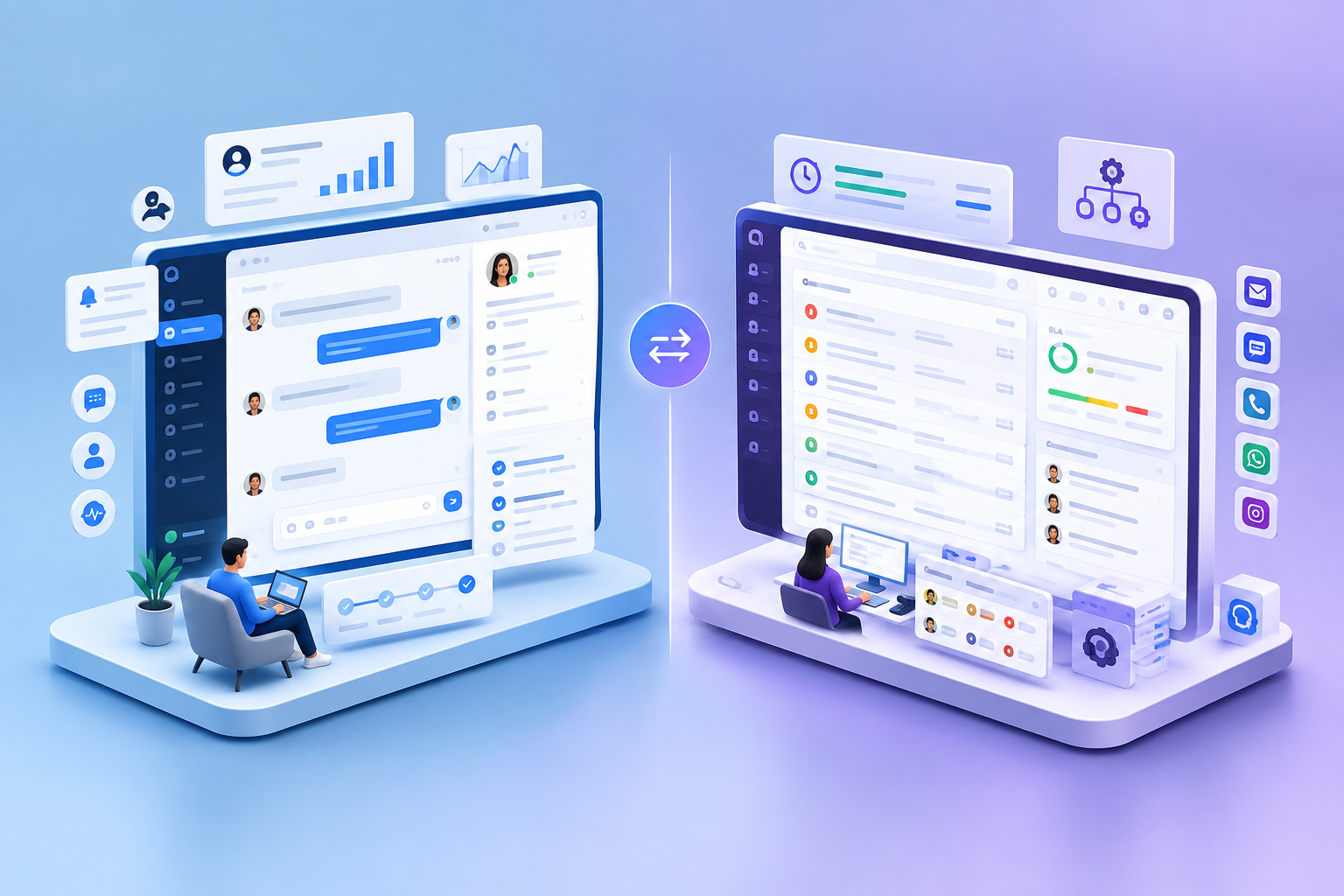
Beyond Shared Inboxes: When to Upgrade to Enterprise-Grade Support Software

You know the exact day the shared email inbox dies. It’s usually a Tuesday afternoon, right after a product launch goes slightly sideways. Your team is staring at a wall of unread messages—a mix of high-priority bugs, simple ‘how-to’ questions, and increasingly frustrated customers who just want an answer. You’ve been using a basic shared inbox setup because it was easy, it was free, and honestly, it worked. Until now.
At this moment, the illusion of simplicity evaporates. You realize that what got you to your first thousand users isn’t enough to keep them happy through your next growth phase. If you are starting to feel the cracks in your process, you are in the right place. Let’s talk about moving beyond the inbox.
The Silent Killer: When 'Easy' Becomes 'Expensive'
Shared inboxes like Gmail or Outlook group addresses are the bedrock of early-stage startups. They are familiar. They are cheap. But they have a structural limit. They are designed for communication, not for management. When you use them for customer support, you are essentially asking your team to manually organize chaos.
We see it constantly with companies scaling past the mid-market threshold. The symptoms are subtle at first. Maybe a few threads get archived accidentally. Perhaps two people start drafting the same response at the same time, leading to that awkward moment where you have to apologize to the customer for the double-tap. These seem like minor inconveniences, but they are symptoms of a larger, systemic friction. When your team spends more time managing their inbox than helping your users, you aren’t just losing time; you’re losing trust.
Sign 1: The 'Who is Doing What?' Black Hole
Think about the last time a customer followed up on a ticket. Did your team have to scramble to find who last touched that email? If you’re relying on tags, colored labels, or ‘starring’ emails, you’re playing a game of chance.
Enterprise-grade support software changes the fundamental unit of work. It moves from an ‘email’ to a ‘case’ or ‘ticket.’ This isn’t just semantic—it’s operational. A system designed for support assigns ownership. It tracks status. It provides an audit trail that doesn’t require a detective to decipher. If a rep goes on vacation, their queue doesn’t turn into a ghost town; it transitions cleanly to the next available agent. That level of continuity is non-negotiable once your volume reaches a certain scale.
Sign 2: The Data Vacuum
In a shared inbox, data is essentially trapped. Sure, you can export a CSV, but try getting a real-time view of your First Response Time (FRT), average handle time, or common issue trends by product feature. It’s a spreadsheet nightmare.

When you upgrade, you gain visibility. You stop guessing why your support volume spiked on Tuesday. You can see, objectively, that the surge was caused by a specific API error or a confusing UI update in your latest release. This data allows you to shift from being a reactive ‘firefighting’ team to a proactive ‘problem-solving’ team. This is the difference between a support department that is seen as a cost center and one that is seen as a strategic asset to the product team.
Sign 3: The Multi-Channel Fragmentation
Your customers aren’t just emailing you anymore. They are sliding into your DMs on X, posting in your community forum, and tagging you in public LinkedIn posts. If you are manually jumping between five different tabs to check these channels, you’re failing at basic efficiency.
Enterprise-grade platforms unify these streams. They create a singular timeline of a customer’s interaction history, regardless of where they reached out. When a customer reaches out via email after posting a question on your community site, the agent doesn’t need to ask, ‘Who are you and what is your issue?’ They see the full context immediately. This is the hallmark of a mature support operation.
The Psychology of the 'Support Debt'
We often talk about ‘technical debt,’ but we rarely discuss ‘support debt.’ This is the cumulative weight of unresolved customer frustration, buried inquiries, and the ‘I’ll get back to that later’ pile that never actually gets cleared.
When you stick with a shared inbox too long, your team starts to develop a psychological coping mechanism. They stop trying to provide high-touch support and start trying to clear the queue as fast as possible. This creates a ‘factory’ culture. The empathy leaves the building. Customers feel like just another ticket number. If you notice your team’s tone becoming shorter, or if they seem more focused on closing tickets than resolving issues, you have officially outgrown your current tools.
Evaluating the Cost of Change
There is a real fear, especially for founders, of the ‘bloat.’ You look at the pricing for an enterprise helpdesk and compare it to the $0 a month you are currently paying. It’s a jarring jump. But let’s look at the hidden costs.
If you have five support agents, each spending 30 minutes a day just fighting with the inbox—tagging, moving, searching, and clarifying—that is 12.5 hours of wasted productivity a week. At the average mid-market salary, you are spending hundreds of dollars a week just to maintain an inefficient workflow. That is the cost of the status quo. When you frame the upgrade through the lens of regained capacity, the ROI of a proper system becomes much clearer.
Moving from Reactive to Proactive
One of the most powerful features of enterprise support software is the ability to leverage knowledge bases and automation. In a shared inbox, if you get the same question ten times, you answer it ten times. Maybe you have a canned response stored in a notepad file. That is archaic.
A robust platform allows you to build a self-service knowledge base that integrates directly into your ticketing flow. You can use ‘macros’ or ‘smart responses’ that pull from verified documentation. Even better, you can set up automation that deflects common queries before they even reach an agent. This doesn’t mean you’re hiding from your customers—it means you are respecting their time by giving them the information they need instantly.
The Onboarding Trap
We’ve spoken to so many companies that tried to migrate to a big-name enterprise tool only to have the project stall out. They treat it like a software deployment rather than a change management process.

If you are going to make the jump, start by mapping your existing workflows. Don’t just replicate what you did in your shared inbox. Use the move as a clean-slate opportunity to refine your processes. Are your tags actually useful? Are your SLAs (Service Level Agreements) realistic? Do you need a more robust escalation path for VIP accounts? If you try to fix your broken processes by just buying new software, you’ll end up with an expensive, broken process.
Building the Business Case for Leadership
If you are the one pushing for this change, you need to speak the language of the leadership team. Don’t lead with ‘the inbox is annoying.’ Lead with ‘we are losing efficiency.’
Present data. Show them the volume of tickets over the last six months. Show them how much time is currently lost to manual organization. Highlight the potential for churn reduction when support becomes more responsive. When you can show that a $5,000-a-year software investment will save your team 20 hours a week, the budget request becomes a no-brainer. It’s not about buying a ‘fancier’ tool; it’s about investing in the scalability of your customer experience.
Selecting the Right Partner
Don’t just look at the feature list. Look at the company behind the software. Are they built for the mid-market? Do they have a clear path for when you eventually reach the enterprise stage?
Check the integrations. If your support software doesn’t talk to your CRM, your billing system, and your product analytics tool, it’s just another silo. The best platforms act as a central hub for all customer context. When an agent opens a ticket, they should see, at a glance, what the customer has purchased, when their contract is up for renewal, and how often they have experienced bugs. That context is gold.
When to Start Your Search
Don’t wait until the breaking point. If your team is hitting their limit, if you’re losing visibility, or if your customers are starting to notice the cracks, you are already behind schedule. Start the exploration phase before the next big growth spurt.
You don’t need to do a full migration in a weekend. The best teams do a pilot program. Move one small segment of your support team or one specific channel over to the new platform. Test the workflows. Get feedback from the agents who are actually doing the work. Once you’ve ironed out the wrinkles, roll it out fully.
Empathy at Scale
The ultimate goal of any support team is to retain the human connection while scaling the business. The shared inbox was a great start—it kept you close to the customers, and you could hear every heartbeat of their feedback. Moving to enterprise software isn't about moving away from that connection. It is about empowering your team to maintain that level of empathy, even when you have thousands of users.
When you get the right systems in place, you’ll find that you aren't just ‘managing tickets’ anymore. You are managing relationships. You are building a foundation that allows your support team to be a competitive advantage for your company. And that, more than any software feature, is why you make the move.
Final Thoughts on the Transition
Change is hard. We get that. The comfort of the ‘inbox’ is strong. But growth requires us to outgrow the things that once served us. If you are feeling that familiar Tuesday afternoon panic, don’t ignore it. It’s not a sign that you’re doing something wrong—it’s a sign that you’re doing something right. You’re growing. And you deserve the tools that can keep up with that ambition.
Take the time to evaluate your needs. Look at your team’s bottlenecks. And when you are ready, make the move. Your team—and your customers—will thank you for it. Now that you have the perspective to look at your support workflow with fresh eyes, ask yourself: is it time for that upgrade?