Braintrust vs PromptLayer: Best SaaS Prompt Engine (2026)
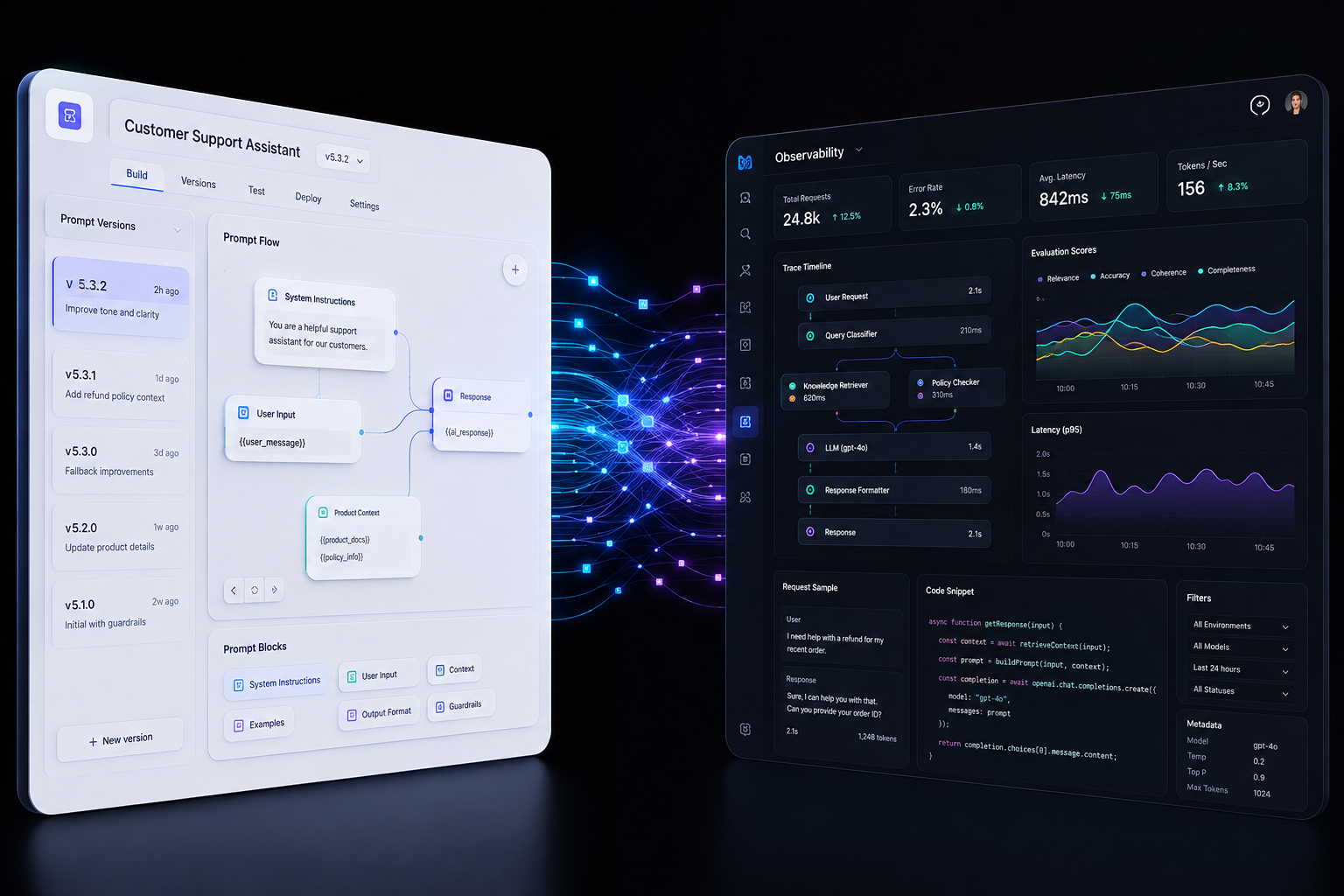
Choosing the right prompt management tool is no longer just about giving your product managers a nice text box to edit system prompts. When LLM features move from a weekend hackathon demo into core production SaaS features, your prompt engineering workflow becomes part of your primary application software architecture. Suddenly, prompt updates can break user workflows, drift response formatting, or double your OpenAI API bill overnight.
Two platforms consistently lead the conversation for SaaS teams building on LLMs: Braintrust and PromptLayer. While both tools started with the shared goal of decoupling prompt templates from source code, they have evolved into fundamentally different platforms.
Here is the bottom-line verdict if you need a decision right away:
- Choose PromptLayer if your main bottleneck is prompt creation and collaboration—giving non-technical product managers, copywriters, and domain experts an intuitive, low-code interface to build, version, and visually test prompts without pushing code.
- Choose Braintrust if your priority is engineering rigor—building complex multi-step AI agents, running automated evaluation suites in CI/CD pipelines, and enforcing strict quality gates before prompts reach production users.
In this guide, we break down how both platforms handle prompt versioning, evaluation frameworks, production observability, latency, and enterprise pricing so you can pick the right engine for your SaaS team.
Understanding the Architectural Shift in SaaS Prompt Engines
To understand why Braintrust and PromptLayer diverge, you have to look at the problems they were built to solve.
In early 2023, prompt engines were glorified key-value stores. You stored a prompt string with variables like `{{user_input}}`, fetched it via an API call, and sent it to an LLM. PromptLayer was one of the early pioneers of this pattern, operating as a lightweight proxy and prompt registry that wrapped LLM requests to track token usage, cost, and prompt revisions.
As SaaS applications matured from simple wrapper chat interfaces into multi-step AI agents, autonomous workflows, and complex Retrieval-Augmented Generation (RAG) systems, simple prompt tracking broke down. Teams did not just need to know what prompt was sent; they needed to evaluate whether the LLM output was accurate, non-hallucinatory, and correctly formatted across thousands of edge cases.
This shift gave rise to full-lifecycle evaluation and observability platforms like Braintrust. Instead of treating prompts as standalone text files, Braintrust treats prompts as code artifacts that require continuous integration, automated testing datasets, and real-time trace scoring in production.
The modern lifecycle moves in three connected stages:
- Prompt Creation and Editing: Authors build prompt templates, configure model variables, and test variations in a web or code playground.
- Evaluation and Scoring: Automated pipelines test the prompts against golden datasets, checking accuracy and response structures before deployment.
- Production Observability: Live traffic is logged, indexed, and monitored for latency spikes, token cost, drift, and user feedback.
PromptLayer concentrates heavily on stage one, while Braintrust covers all three stages with equal depth.
Core Feature Comparison: Braintrust vs PromptLayer
| Feature Domain | Braintrust | PromptLayer |
|---|---|---|
| Primary Focus | End-to-end LLM observability, evals, and CI/CD quality gates | Non-technical prompt registry, versioning, and visual editing |
| Target User | AI engineers, platform teams, software architects | Product managers, prompt engineers, non-technical collaborators |
| Prompt Versioning | Git-like SDK versioning, code-backed releases, programmatic sync | Visual UI version control, release tags, low-code interface |
| Evaluation Engine | Advanced offline/online evals, custom code scorers, LLM-as-a-judge, Loop AI agent | Cell-based playground evaluations, manual scoring, basic dataset runs |
| Production Observability | Custom Brainstore engine (sub-second queries on millions of spans/traces) | Request logging, latency tracking, usage dashboards |
| CI/CD Integration | Native GitHub Actions / CI gates to block failing prompt deployments | Webhook triggers and manual release management |
| Multi-Language SDKs | Python, TypeScript/JavaScript, Go, Ruby, C# | Python, TypeScript/JavaScript, REST API |
| Pricing Architecture | Usage-based (processed data, score executions, model credits) | Tiered seat base + per-transaction request overages |
1. Prompt Management and Collaboration Workflows

How your team creates, edits, and deploys prompts on a daily basis dictates whether a tool becomes an asset or a workflow bottleneck.
PromptLayer: Built for Non-Technical Prompt Engineering
PromptLayer shines when non-technical team members need to iterate on prompts without waiting for an engineering release cycle. Its interface feels like a dedicated workspace for prompt copywriters.
- Visual Playground: Team members can tweak system messages, adjust model parameters (temperature, top_p, frequency penalty), and test variables against sample inputs in real time.
- Visual Version Control: Prompts are assigned semantic version numbers or production tags (for example, `prod`, `staging`, `v2.1`). Moving a prompt from staging to production takes one click in the UI.
- Team Workspaces: Dedicated spaces allow product managers, domain experts, and marketers to organize prompt libraries by feature (such as `onboarding-bot` or `summary-generator`).
If your software company relies on product managers to constantly refine copy and system directives while engineers focus purely on application code, PromptLayer provides a smooth, frictionless environment.
Braintrust: Built for Code-First Engineering Teams
Braintrust approaches prompt management with the rigor of modern software engineering. While it offers a web playground for prompt testing, its real strength lies in programmatic prompt definition.
- Code-Synced Prompts: You can define prompts directly in your codebase (Python or TypeScript) or sync them programmatically via SDKs. This ensures prompts are subject to the same code review, linting, and pull request workflows as the rest of your application.
- Side-by-Side Model Comparisons: The Braintrust playground allows side-by-side execution across multiple models (such as Claude 3.5 Sonnet, GPT-4o, and Llama 3) and prompt variations simultaneously.
- Loop AI Agent: Braintrust includes an autonomous agent named Loop that actively analyzes production traces, identifies failing patterns, and suggests revised prompt instructions or generated test datasets automatically.
For engineering-led SaaS teams, Braintrust eliminates the risk of a non-technical user changing a production prompt in a UI and accidentally breaking a JSON schema required by a backend API.
2. Evaluation Frameworks and Quality Assurance
Evaluating LLM outputs is the hardest problem in building AI-native SaaS. Deterministic unit testing fails because model responses are inherently probabilistic.
Braintrust: Deep, Trace-Level Evals and CI/CD Quality Gates
Braintrust was engineered specifically around evaluation depth. It bridges offline development testing with online production monitoring.
- Comprehensive Evaluator Types: Braintrust supports deterministic scorers (substring match, JSON validation), statistical scorers (ROUGE, BLEU, Levenshtein distance), custom code evaluators, and LLM-as-a-judge patterns.
- Span and Trace-Level Scoring: In multi-step agent workflows (for example, an agent that searches a vector database, synthesizes data, and calls a third-party API), Braintrust scores individual spans inside a trace, not just the final output.
- CI/CD Quality Gates: Braintrust integrates directly into your build pipeline (such as GitHub Actions). Every time a developer opens a pull request with new code or prompt changes, Braintrust runs your eval suite against a golden dataset. If accuracy drops below your defined threshold (for instance, 92%), the build fails and blocks deployment.
- Synthetic Dataset Generation: Using the Loop agent, Braintrust helps generate edge-case test datasets directly from real production failures, turning user-reported bugs into permanent test cases.
PromptLayer: Cell-Based Testing and Playground Evals
PromptLayer provides lighter-weight evaluation mechanisms that suit straightforward LLM tasks.
- Eval Cells: PromptLayer uses an interface where users run prompts against dataset rows and score them using basic evaluators or manual human review.
- Dataset Management: You can upload CSVs or JSON files up to 1GB (on Team plans) to test prompt variations across structured test inputs.
- Limitations in Multi-Step Workflows: While PromptLayer tracks latency and request cost, it lacks deep, automated trace-level scoring for complex, multi-agent frameworks like LangGraph or AutoGen where errors cascade across multiple sub-calls.
3. Observability, Tracing, and Data Infrastructure
When thousands of users hit your SaaS AI features every minute, logging and analyzing production traffic becomes a major infrastructure requirement.
Braintrust's Custom Engine: Brainstore
Braintrust built a custom, purpose-built database engine called Brainstore specifically for AI observability data.
Traditional SQL or document databases struggle when indexing millions of nested JSON LLM traces, prompt variables, and high-dimensional scoring metrics. Brainstore delivers sub-second full-text searches and filtering across millions of production spans. This enables your team to filter production logs by exact criteria—such as searching for traces where latency exceeded 2 seconds, the model was GPT-4o, and the quality score fell below 0.7.
Braintrust also features native SDK support across Python, TypeScript, Go, Ruby, and C#, making it language-agnostic for modern enterprise microservices.
PromptLayer Logging & Proxy Architecture
PromptLayer operates primarily through an API proxy or lightweight wrapper SDKs in Python and TypeScript.

It logs every request, response, token count, cost calculation, and custom tag. Its dashboards give product managers instant visibility into which prompts are burning the most API budget and which endpoints experience high latency. However, for deep multi-tenant SaaS systems with high-throughput tracing demands across microservices, PromptLayer's filtering and analytics capabilities are less configurable than Braintrust's Brainstore.
4. Cost and Pricing Breakdown
Understanding how costs scale on both platforms prevents budget surprises as your active user base expands.
Braintrust Pricing Model
Braintrust utilizes a transparent, usage-based model structured around platform usage rather than arbitrary seat limits:
- Starter Tier ($0/month): Includes $10 in monthly model credits, 1 GB of processed data, 10,000 scored outputs, 14 days of data retention, and unlimited user seats. Perfect for small teams building an MVP.
- Pro Tier ($249/month): Includes $100-$249 in monthly model credits, 5 GB of processed data (overage at $3/GB), 50,000 score executions (overage at $1.50 per 1,000), 30 days of data retention, custom charts, role-based access control (RBAC), and priority support.
- Enterprise Tier (Custom): Custom data retention, VPC or single-tenant deployment, SOC 2 Type II compliance, HIPAA BAA agreements, and dedicated support.
Note on Braintrust Value: Offering unlimited user seats on the Starter and Pro tiers is a massive advantage for cross-functional SaaS startups, allowing engineering, product, and QA teams to collaborate without seat friction.
PromptLayer Pricing Model
PromptLayer uses a combination of base monthly subscription fees and per-transaction fees:
- Free Tier ($0/month): Up to 5 users, 2,500 requests per month, 1 workspace, 250 eval cell executions, and 10 prompts max.
- Pro Tier ($49/month): Up to 5 users, 2,500 included requests (overage at $0.003 per transaction), unlimited prompts and playgrounds, 150MB dataset storage, and $0.003 per evaluation cell execution.
- Team Tier ($500/month): Up to 25 users, 100,000 included requests (overage at $0.002 per transaction), 7,500 eval cell executions, 1GB dataset storage, and multi-workspace support.
- Enterprise Tier (Custom): Unlimited seats, deployment approvals, RBAC, HIPAA compliance with BAA, and self-hosted options on AWS, GCP, or Azure.
Note on PromptLayer Value: For small teams with low request volume who want simple prompt management, the $49 Pro tier is an affordable entry point. However, as transaction volume scales into hundreds of thousands of requests per month, transaction overage fees require careful monitoring.
Practical Decision Framework: Which Fits Your SaaS Stack?
To make your decision straightforward, evaluate your team against these four common operational scenarios.
Scenario A: Engineering-Driven AI Agents and RAG Applications
If you are building complex B2B SaaS workflows—such as automated code reviewers, legal document analyzers, or multi-step agent workflows—you need deep tracing, span-level scoring, and CI/CD quality gates.
- Verdict: Braintrust. You cannot afford to deploy prompt updates without automated regression testing across golden datasets.
Scenario B: Product-Led SaaS with High Prompt Content Iteration
If your SaaS relies on rich copy generation, personalized email drafting, or conversational UI where non-technical product managers, UX writers, and subject matter experts own prompt quality.
- Verdict: PromptLayer. Its visual workspace and low-code release tagging allow product teams to iterate rapidly without requiring developer bandwidth for every prompt edit.
Scenario C: Strict Compliance, HIPAA, or On-Premise Requirements
If you operate in healthcare SaaS, fintech, or enterprise security where customer data cannot leave your virtual private cloud (VPC).
- Verdict: Tie (Enterprise Tiers). Both platforms offer Enterprise deployment models with HIPAA BAA execution. Braintrust supports hybrid VPC and self-hosted deployments for high-volume logs, while PromptLayer provides managed single-tenant and cloud-hosted options in the EU and US.
Scenario D: Cross-Functional Teams on a Startup Budget
If you have a startup team of 10+ people (developers, product managers, QA) who all need access to inspect logs, view prompt playgrounds, and test outputs without paying $50+ per seat per month.
- Verdict: Braintrust. Its Starter and Pro tiers include unlimited users out of the box, allowing your entire company to view logs and playgrounds without seat license penalties.
How Saasbonus Helps You Navigate the LLM Stack
Building an AI-native SaaS platform requires making dozens of interconnected infrastructure choices—from choosing between vector databases like Pinecone and Qdrant, to picking speech APIs like Deepgram and AssemblyAI, to selecting your prompt observability stack.
At Saasbonus, we publish independent, hands-on architectural comparisons and operational guides to help engineering leaders and software founders pick the right tools the first time. Explore our latest teardowns to optimize your SaaS margins, improve software reliability, and streamline your AI engineering pipeline.