Dagster vs Temporal: Which Fits Data-Heavy SaaS Workflows?
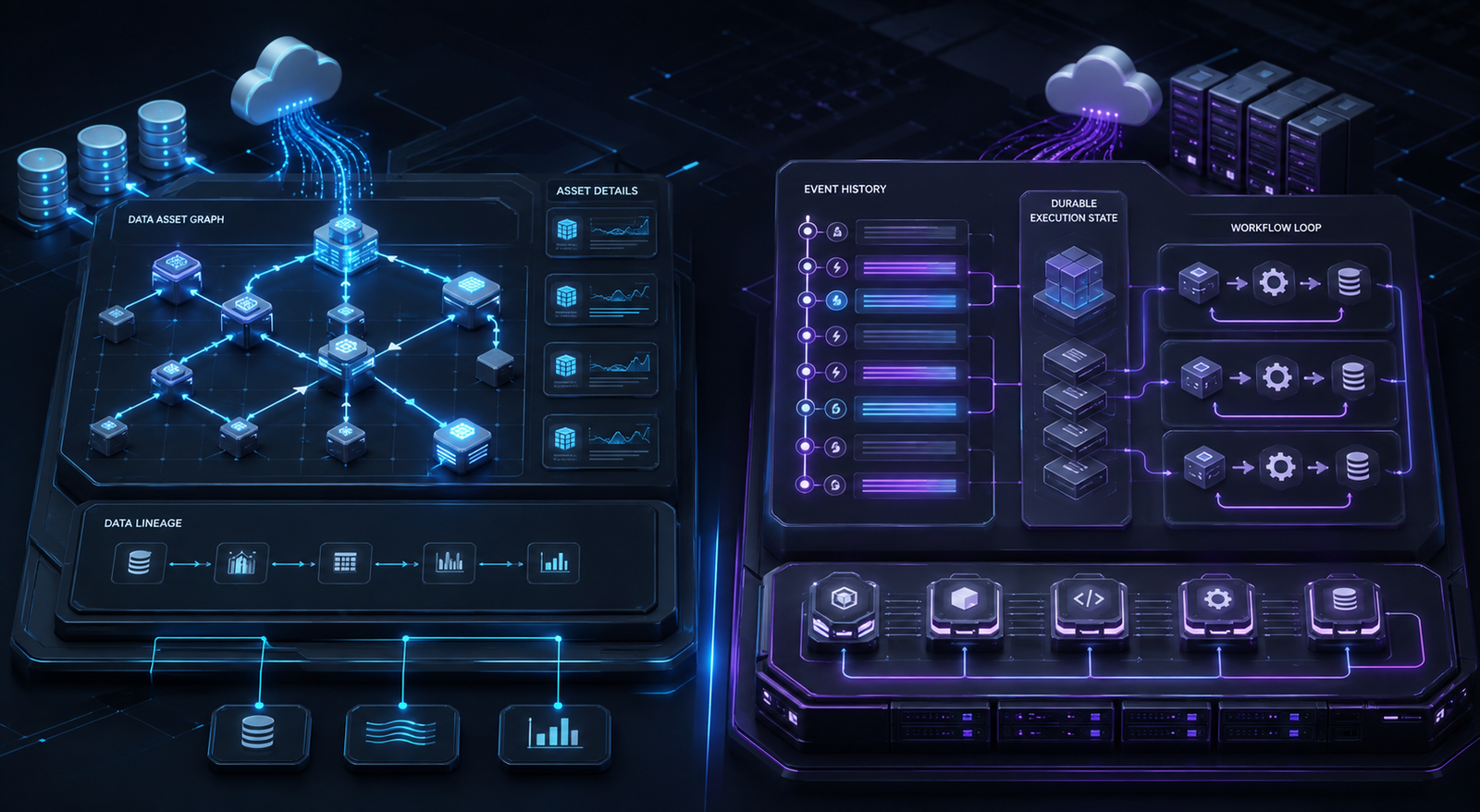
Choosing between Dagster and Temporal for a modern SaaS backend comes down to a single question: Are you orchestrating stateful application code that must never fail, or are you orchestrating data transformation pipelines that produce verifiable artifacts?
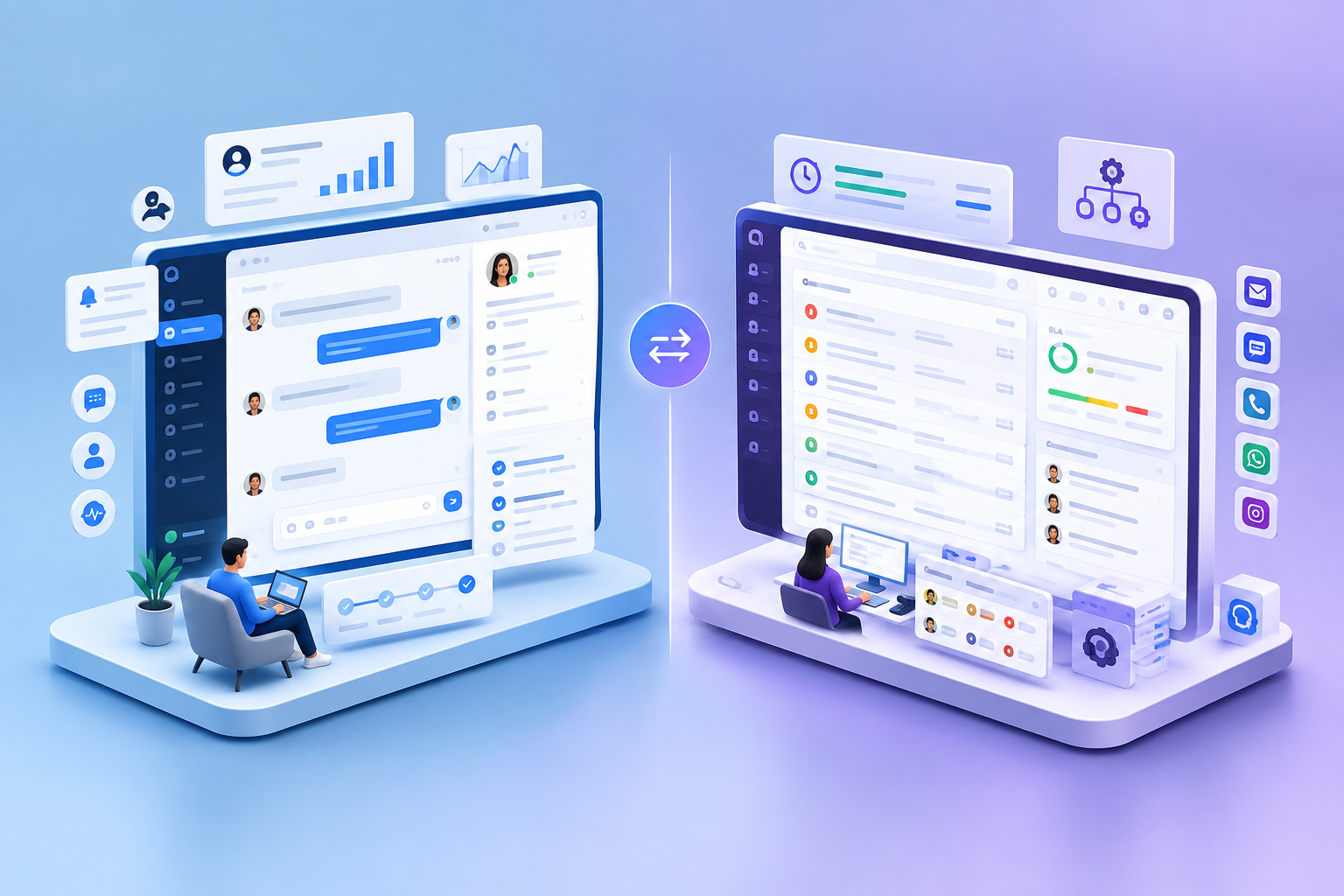
Engineers often group Dagster and Temporal together because both manage execution graphs, handle retries, and coordinate distributed tasks. However, their underlying execution models are completely different. Dagster is a data orchestrator built around software-defined assets. It focuses on data quality, lineage tracking, and schedule- or event-driven materialization. Temporal is a durable execution platform designed to make arbitrary code execution stateful, fault-tolerant, and transactional across distributed microservices.
If you pick the wrong tool, you risk building custom state persistence on top of Dagster or building custom lineage and data cataloging tools on top of Temporal. This article breaks down the architectural trade-offs, developer experiences, scaling characteristics, and operational costs of Dagster and Temporal to help you select the right engine for your SaaS architecture.
Core Abstractions: Software-Defined Assets vs. Event Sourced Workflows
To understand why these frameworks behave differently in production, you must look at their core abstractions. Every feature in both tools flows directly from how they model state and execution.
Dagster: Software-Defined Assets (SDAs)
Dagster shifts the orchestration mindset from task-centric pipelines to asset-centric data platforms. In traditional orchestrators like Apache Airflow, you write tasks that run imperative code in sequence. Dagster replaces this paradigm with Software-Defined Assets (SDAs).
An asset is a declarative description of a data object you want to produce—such as a PostgreSQL table, a Snowflake analytics model, a Parquet file on S3, or a trained machine learning model. In Dagster, you define:
- The name and schema of the asset.
- The upstream data assets it depends on.
- The Python function required to compute or update the asset.
When Dagster runs a pipeline, it is not executing a list of commands for the sake of running code. It is materializing an asset graph. Dagster tracks when each asset was last updated, checks if the data matches freshness policies, inspects data quality checks, and maintains an explicit lineage graph of how data flows through your SaaS platform. If an upstream dataset changes or becomes stale, Dagster automatically identifies which downstream assets need re-computation.
Temporal: Durable Execution and Event Histories
Temporal takes an entirely different approach. It does not know or care about data tables, schemas, or file outputs. Instead, Temporal provides durable execution for code.
In Temporal, you write standard code in Go, TypeScript, Python, Java, or .NET. You define workflows (which coordinate execution flow) and activities (which interact with external systems or perform side effects).
Temporal guarantees that your workflow function runs to completion, regardless of infrastructure failures, network partitions, worker process crashes, or deployment restarts. It achieves this durability through event sourcing. As your workflow code executes, Temporal records every state change, activity call, timer, and signal into an immutable event history stored in a persistent database (such as PostgreSQL or Cassandra).
If the server running a Temporal workflow crashes midway through step four, a new worker picks up the workflow, replays the event history to restore local variables to their exact pre-crash state, and resumes execution at step four without re-running steps one through three. To the engineer writing the workflow, it looks as if the execution process ran uninterrupted on a single immortal machine.
Primary SaaS Use Cases: Where Each Framework Belongs
Because these frameworks solve different architectural problems, applying them to the wrong SaaS domain creates unnecessary complexity.
When Dagster Fits Best
Dagster excels in data engineering, analytics infrastructure, and asynchronous batch processing where data lineage and data quality matter. Common SaaS scenarios include:
- Multi-Tenant Data Warehousing and ETL: Extracting raw event data from production databases, transforming it with dbt, and loading structured metrics into Snowflake or BigQuery for customer-facing analytics dashboards.
- AI and ML Feature Pipelines: Ingesting documents, running embeddings through vector databases, fine-tuning language models, and tracking feature freshness across thousands of customer tenants.
- Scheduled Data Syncs and Backfills: Re-indexing data, running nightly customer usage summaries, or executing historical backfills across specific date partitions with dependency awareness.
- Data Quality and Governance: Enforcing data contracts, catching schema drift before it corrupts production reports, and auditing raw data transformations.

In these workflows, the primary artifact is the data itself. Dagster gives engineering teams full visibility into what data exists, whether it is fresh, and how it was calculated.
When Temporal Fits Best
Temporal excels in transactional, long-running, and event-driven business logic where missing an execution step breaks customer trust or corrupts system state. Common SaaS scenarios include:
- Enterprise User Provisioning: Creating a tenant account, provisioning AWS infrastructure, setting up custom SSL certificates, configuring SAML SSO, and sending welcome emails over a 10-minute multi-step onboarding sequence.
- Subscription and Usage-Based Billing: Managing 30-day trial periods, handling usage meter rollups, processing credit card charges via Stripe with exponential backoff retries, and managing dunning sequences for failed payments.
- Human-in-the-Loop and Agent Workflows: Coordinating multi-step AI agent tasks that pause for hours or days waiting for user approval via Slack or email webhook before continuing execution.
- Microservice Sagas and Distributed Transactions: Booking resources across three microservices where a failure at step three requires running explicit compensation logic to undo steps one and two.
In these workflows, the primary artifact is the state of execution. Temporal guarantees that the state machine reaches its target end state regardless of network outages or process crashes.
Developer Experience and Technical Ecosystems
Developer velocity depends heavily on how easily engineers can write, unit test, and debug workflows locally before shipping code to staging or production.
Dagster Developer Experience
Dagster is designed for modern Python engineering teams. It relies on standard Python type signatures, decorators, and lightweight local dev tooling.
Running dagster dev in your terminal starts a local web server and UI on your machine. It gives you immediate visual access to your full asset graph, run histories, configuration schema, and sensor status. When you modify Python asset code, Dagster hot-reloads instantly without restarting the local server.
Testing in Dagster is straight-forward because assets are pure Python functions. You can pass mock inputs into an asset function and verify its outputs using standard pytest suites without spinning up external orchestration daemons, databases, or Docker containers. Dagster also includes I/O managers that let you transparently switch storage layers—for example, writing asset outputs to local DuckDB files during local testing and to Snowflake or S3 in production without changing your core business code.
However, Dagster is heavily centered around Python. If your SaaS stack is written entirely in Go, Java, or TypeScript, integrating Dagster requires maintaining a dedicated Python worker service to run your orchestration logic.
Temporal Developer Experience
Temporal offers full polyglot SDK support. You can write workflows and activities natively in TypeScript, Go, Python, Java, or .NET. This makes Temporal feel like a natural extension of your main backend code rather than a separate data engineering framework.
Temporal provides a local CLI and server distribution that runs as a lightweight process or Docker container. You interact with Temporal using native programming language constructs. However, writing workflow code in Temporal requires adhering to strict determinism rules:
- No non-deterministic random number generation inside workflow functions.
- No direct system clock checks (you must use Temporal's time functions instead).
- No direct HTTP requests or database I/O inside workflow functions (all I/O must be isolated inside activities).
- No mutable global state shared across workflow iterations.
These constraints exist because Temporal enforces durability by replaying workflow code from the beginning. If your workflow code generates a random UUID or fetches a changing timestamp during a replay, the execution state diverges from the event log, causing a non-deterministic execution error.
Testing Temporal workflows requires learning the framework's test environment. Temporal provides specialized testing harnesses that simulate time passing. You can test a workflow that includes a 30-day sleep timer in milliseconds during an automated CI/CD pipeline run. This makes Temporal exceptionally strong for testing complex time-dependent business workflows.
Observability, Metadata, and Data Lineage
Observability means different things to data engineers and backend software engineers. Dagster monitors data states, while Temporal monitors execution states.
Dagster: Deep Asset Lineage and Metadata Capture
Dagster's UI is built around the asset graph. It gives you a global view of all data entities in your system and their relationships.
When an asset materializes, Dagster records rich metadata directly alongside the run logs:
- Row counts and byte sizes.
- Schema changes over time.
- Custom performance metrics (such as model accuracy or execution drift).
- Markdown reports, data samples, and data quality check results.
If a data pipeline breaks, Dagster allows you to trace the failure directly upstream. You can immediately see which specific raw data table was updated with corrupt values, which downstream models were impacted, and which datasets remain safe to serve to users. Dagster also supports freshness policies, allowing you to set alerts if a critical asset (like a customer billing rollup) has not been materialized in the past 6 hours.
Temporal: Complete Execution State Visibility
Temporal's UI is built around workflow executions and event histories. It shows you every running, completed, timed-out, or failed workflow instance across your system.
When you open a workflow in the Temporal UI, you see:
- The complete event history stream (every activity scheduled, started, completed, or retried).
- Exact input payloads and return values for every step.
- Current local variable states, pending timers, and active child workflows.
- Stack traces for running workflows, showing the exact line of code currently executing.
Temporal allows you to send queries to a running workflow to retrieve its internal state on demand, or send signals to mutate its state while it executes. However, Temporal does not track data schemas, table lineage, or dataset freshness. If your activity writes 10,000 rows to Postgres, Temporal knows that the activity returned successfully, but it has no visibility into what data was written or how that table connects to other tables in your database.
Scalability, Fault Tolerance, and Infrastructure Architecture
Both platforms are built to handle large enterprise scale, but their underlying operational architectures require different trade-offs.
Dagster Architecture and Operational Footprint
Dagster uses a decoupled control plane and compute architecture. Its core system components include:
- Webserver: Serves the GraphQL API and the UI.
- Daemon: Handles schedules, sensors, run queuing, and backfill coordination.
- Storage: A relational database (typically PostgreSQL) that stores run history, asset event logs, and metadata.
- User Code Workers: Isolated environments where your actual pipeline code executes.
In Dagster, your business logic runs in user code deployments completely isolated from the orchestration control plane. You can deploy code workers as Kubernetes pods, ECS tasks, or serverless containers. If your code worker runs out of memory or encounters a fatal crash, the Dagster daemon detects the worker failure, records the failure state in Postgres, and re-executes the run according to your retry configuration.
Dagster easily scales to handle millions of asset materializations per day. However, because it is designed around batch schedules, event sensors, and asset graphs, it is not optimized for high-throughput, sub-second microservice event loops.
Temporal Architecture and Operational Footprint
Temporal is built from the ground up for high-throughput, low-latency stateful orchestration. Its architecture consists of:
- Temporal Cluster: A cluster of stateless services (Frontend, History, Matching, and Worker services).
- Persistence Store: A high-performance persistence layer (PostgreSQL, MySQL, or Cassandra).
- Worker Processes: Your application code hosting workflow and activity definitions, polling Temporal Task Queues for work.
Temporal uses task queues and long-polling mechanisms. Workers connect to the Temporal Cluster, pull pending tasks from queues, execute the code locally, and return the execution results back to the cluster.
Because the Temporal Cluster is stateless and offloads state persistence to database transaction logs, a Temporal cluster can scale to thousands of concurrent workflow executions per second with sub-100-millisecond scheduling latency. If a worker process crashes mid-activity, the cluster detects the lost heartbeat and immediately reassigns the task queue item to another worker.
However, self-hosting a production-grade Temporal cluster requires significant operational platform engineering. You must manage database write throughput, tune task queue partitions, monitor history service latency, and manage database persistence bloat caused by high-frequency event histories.
Dagster vs Temporal: Side-by-Side Architectural Comparison
The following table outlines the key architectural differences between Dagster and Temporal:
| Feature | Dagster | Temporal |
|---|---|---|
| Primary Focus | Asset-centric data orchestration and metadata tracking | Durable execution of arbitrary, stateful code |
| Core Unit of Work | Software-Defined Asset (SDA) | Workflow and Activity |
| Language Support | Python-native (strongest integration) | Polyglot (Go, TypeScript, Python, Java, .NET) |
| Execution Guarantee | Task-level retry, sensor-driven execution | Durable event-sourced execution with state replay |
| State Model | External data artifacts (tables, files, models) | Internal workflow history and variable state |
| Data Lineage | Native, detailed column- and table-level lineage | None (requires external catalog tools) |
| Testing Paradigm | In-memory function execution and mock asset I/O | Deterministic time-skipping test environments |
| Primary Users | Data engineers, analytics engineers, ML teams | Software engineers, backend/platform teams |
| Self-Hosted Ops | Moderate complexity (Webserver, Daemon, Postgres) | High complexity (Cluster services, Cassandra/Postgres) |
| Managed Offering | Dagster Cloud (Serverless or Hybrid) | Temporal Cloud (Usage-based cluster management) |
The SaaS Decision Framework: Choosing the Right Engine
When evaluating Dagster and Temporal for a data-heavy SaaS backend, engineering leaders often fall into the trap of looking for a single orchestrator to manage everything. In practice, the decision depends on where the execution lives relative to your customer-facing production path.
Use Dagster If:
- You are building internal or customer-facing data platforms, analytics dashboards, or reporting engines.
- Your pipelines primarily interact with data warehouses (Snowflake, BigQuery), data lakes, dbt, or vector databases.
- You need automated data quality checks, schema drift protection, and data freshness monitoring.
- Your engineering team works primarily in Python and wants rapid local development with hot-reloading code environments.
- You need to know exactly how data assets were computed, who modified them, and whether downstream models are up to date.
Use Temporal If:
- You are orchestrating core backend application logic, user signups, multi-step provisioning, or payment billing cycles.
- Your application is built using microservices written in multiple languages (like Go or TypeScript).
- You are executing distributed transactions across multiple internal or third-party APIs that require strict retry guarantees and saga compensation logic.
- You are building AI agent workflows that run asynchronously, pause for human approval, and resume days later.
- You cannot afford a single lost or partially executed state step when a server crashes.
The Hybrid Architecture: Running Dagster and Temporal Together
For complex, data-heavy SaaS products, the most powerful architecture is often not choosing one over the other, but using both tools where they naturally belong.
In a hybrid SaaS architecture:
- Temporal acts as the Application Orchestrator. It manages high-frequency, user-facing events, subscription billing cycles, multi-tenant workspace provisioning, and API callbacks. When a user requests a heavy batch report or data sync, Temporal triggers the request and delegates the heavy data processing to the data platform.
- Dagster acts as the Data Orchestrator. It ingests raw tenant data, executes transformations in your data warehouse, manages dbt models, checks data freshness, and materializes customer analytics tables. Once the data asset is materialized, Dagster sends a webhook or GraphQL event back to Temporal.
- Temporal resumes its application workflow, notifying the user via email or updating the SaaS web UI that their analytics export is ready for download.
This separation keeps your application logic durable and responsive while giving your data team deep lineage, observability, and data governance.
At Saasbonus, we evaluate software infrastructure choices by testing real production trade-offs. Balancing operational complexity against long-term maintenance costs is critical when selecting developer platforms. Choosing the right tool for the job upfront prevents costly infrastructure refactoring as your engineering team scales.
Final Architectural Summary
Neither Dagster nor Temporal is universally superior; they are optimized for different problems. Dagster models the state of your data. Temporal models the state of your execution.
If your SaaS team is building reliable microservice infrastructure, user onboarding sequences, or transactional workflows, Temporal is the ideal durable execution platform. If your team is building scalable analytics pipelines, feature stores, dbt transformation layers, or data-driven applications, Dagster offers the best asset-centric data orchestration framework on the market today.