Devin AI Review: Can It Truly Replace Junior Engineers?
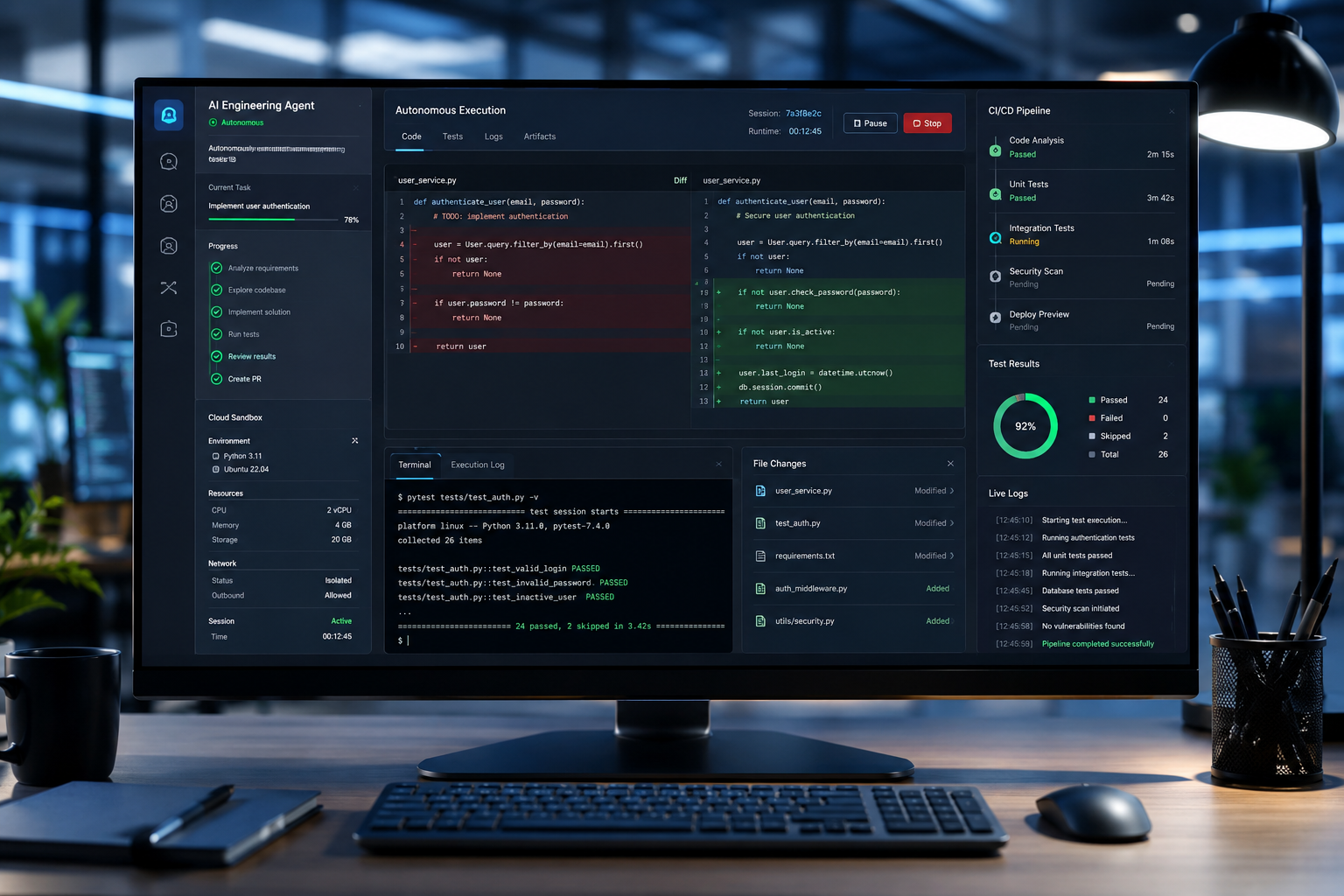
Cognition AI’s Devin merged over two-thirds of its generated pull requests across enterprise engineering teams, up from roughly 34% in early testing. That single metric illustrates how quickly autonomous coding agents are improving—and why engineering leaders and entry-level developers are asking the exact same question: Can Devin AI truly replace junior software engineers?
The direct answer is no, Devin cannot fully replace a human junior software engineer. However, it reshapes the entry-level role so fundamentally that keeping junior developers focused purely on mechanical, repetitive coding tasks is no longer a viable strategy.
In this review, we cut through marketing claims to analyze how Devin AI performs on production code bases, where its agentic architecture breaks down, what it costs in practice, and how forward-thinking engineering organizations are integrating it into their workflows.
What Is Devin AI and How Does It Work?
Unlike inline autocomplete assistants or IDE extensions that suggest the next function signature as you type, Devin AI operates as an autonomous software engineering agent. Developed by Cognition AI, Devin runs inside a cloud-hosted sandbox equipped with a shell terminal, code editor, headless browser, and long-horizon planning engines.
When you assign a task to Devin through Jira, GitHub, or Slack, it executes a continuous execution loop rather than simply streaming response text:
- Context Discovery: Devin clones your repository, parses configuration files, searches for relevant class definitions, and consults online documentation or external API specifications.
- Plan Generation: It constructs an explicit multi-step execution strategy, breaking complex issues into discrete sub-tasks.
- Runtime Execution & Testing: It edits code files, runs shell scripts to install dependencies, executes test runners, and inspects build or compiler tracebacks directly in its terminal.
- Self-Correction Loop: When a test fails or a build breaks, Devin analyzes the stack trace, adjusts its implementation, and retries the build automatically.
- Pull Request Submission: After validating the solution against local tests, it submits a Pull Request with inline comments, documentation edits, and execution summaries.
This architecture means Devin operates less like an editor plugin and more like an asynchronous remote contributor who works off-hours and submits PRs for senior developers to review.
Devin AI Capabilities vs. Junior Software Engineers
Evaluating whether an AI agent can replace a developer requires separating raw syntax execution from collaborative engineering.
| Capability Dimension | Junior Software Engineer | Devin AI Agent | Performance Advantage |
|---|---|---|---|
| Execution Speed | Moderate (4–8 hours per task) | Fast (15–45 minutes per task) | Devin AI |
| Parallel Capacity | Single-threaded (1 ticket at a time) | Multi-threaded (Runs dozens of agent tasks) | Devin AI |
| Contextual Onboarding | Takes 2–6 weeks to learn codebase | Maps multi-million line repos instantly | Devin AI |
| Ambiguity Handling | Asks clarifying questions to PMs | Takes literal inputs; makes assumptions if vague | Junior Engineer |
| In-Flight Requirements Shift | Adapts when specs change mid-sprint | Struggles if instructions shift mid-task | Junior Engineer |
| Security & Business Rules | Learns compliance & domain logic | Risk of introducing subtle security bugs | Junior Engineer |
| Cost Structure | $70,000–$120,000 base salary + benefits | $500/month base + variable compute units | Devin AI |
Where Devin AI Outperforms Human Speed
Devin excels at predictable, high-volume, well-scoped maintenance work. Enterprise pilots demonstrate substantial efficiency gains across several core areas:
- Codebase Framework Migrations: Upgrading dependency suites across microservices (such as migrating Java versions, updating legacy ORMs, or converting module systems). Teams routinely complete migrations in a fraction of the manual time.
- Static Analysis Remediation: Clearing security and quality backlogs from tools like SonarQube or Veracode. Devin reads vulnerability reports, fixes offending patterns, verifies local builds, and submits PRs.
- Unit Test Coverage Expansion: Elevating test coverage across legacy systems by generating unit tests, mocking edge cases, and verifying assertions.
- Data Pipeline Scaffolding: Drafting CRUD handlers, setting up ETL transformations, and writing boilerplate validation schemas.
Where Devin AI Fails
Despite high execution speeds, Devin encounters clear failure modes:
- Vague or Underspecified Instructions: If you ask a human engineer to 'improve checkout UX responsiveness,' they consult design systems and product owners. If you give Devin the same input, it makes arbitrary edits that pass syntactically but disrupt user experience.
- Mid-Task Scope Changes: Human developers pivot when acceptance criteria change during a sprint. Devin struggles when requirements shift after execution starts, often looping or overwriting valid work.
- Cross-System Architecture Decisions: Devin lacks the reasoning required for complex distributed systems, domain-driven boundary definitions, and organizational trade-offs.
- Soft Skills and Alignment: Engineering requires trade-off negotiation, stakeholder communication, and customer empathy—areas where autonomous software agents offer no solution.
Real-World Performance: The PR Merge Rate Evolution
The clearest indicator of an AI agent's production value is its unassisted Pull Request merge rate—the percentage of AI-generated PRs accepted into production by human engineers.
- Early Releases: ~13.8% SWE-bench score; approximately 34% PR merge rate in early trials.
- Current Benchmarks: Over 67% PR merge rate across active corporate client workloads.
This improvement stems from better repository context mapping and improved runtime recovery loops. Early versions stalled when build tools produced non-standard errors, whereas updated agent architectures use persistent repo memory files to validate code before opening PRs.
However, a 67% merge rate also indicates that 1 out of every 3 PRs generated by Devin is rejected or requires manual intervention. Rigorous code review remains essential.
Pricing Analysis: $500/Month Base vs. Developer Compensation
Cognition structures Devin's commercial model around base platform access and compute consumption:
- Base Seat Fee: $500 per month per active agent workspace.
- Usage Allocations: Includes an initial allocation of Agent Compute Units (ACUs) covering token usage and sandboxed runtime.
- Average Cost Per Completed Task: $2.00 to $30.00, depending on execution time, token volume, and task complexity.
Cost Breakdown: Devin AI vs. Junior Engineer
- Junior Developer (US Average): ~$85,000 base salary + ~$25,000 benefits and overhead = ~$110,000 per year ($9,166/month).
- Devin AI Instance: $500 base + ~$1,000 heavy usage compute = ~$1,500 per month ($18,000 per year).
Direct cost comparisons favor Devin by a significant margin for pure execution volume. However, this calculation overlooks a critical factor: Devin requires senior developer supervision. If a senior engineer earning $180,000 per year spends 30 minutes reviewing and correcting a flawed Devin PR, that review time incurs real overhead. Poorly specified prompts that result in failed long-running tasks waste both compute budgets and senior engineering capacity.
Tool Comparison: Devin AI, Cursor, and Claude Code
Selecting the right AI tooling depends on your team's operational setup.
| Tool | Category | Autonomy Level | Average Cost / Task | Primary Application |
|---|---|---|---|---|
| Devin AI | Autonomous Cloud Agent | Asynchronous Autonomy | $2.00 – $30.00 | Large-scale migrations, ticket backlogs, test suites |
| Cursor | AI-Native IDE | In-Line Interactive Assist | $20 / month flat | Daily interactive development, refactoring, solo devs |
| Claude Code | Terminal-Based Agent | Command Line Semi-Autonomy | $0.50 – $5.00 | Rapid CLI scripts, targeted edits under 30 minutes |
For developers who prefer writing code interactively inside their editor, Cursor offers an immediate, low-latency workflow. For teams looking to delegate asynchronous background tasks via Jira or GitHub while engineers focus on design, Devin provides a dedicated execution model.
Operational Blueprint: Integrating Devin into Engineering Teams
High-performing engineering teams do not use Devin to eliminate entry-level positions. Instead, they treat Devin as a virtual assistant paired with existing engineers.
Effective integration follows four practical steps:
- Explicit Task Specification: Write detailed acceptance criteria, list affected file paths, and define concrete edge cases before dispatching tasks to Devin.
- Targeted Scope Assignment: Assign Devin well-bounded tasks—such as updating schema definitions, patching dependency CVEs, or refactoring data access layers—rather than broad feature requests.
- Strict PR Review Protocols: Review every Devin-generated PR with the same scrutiny applied to human code submissions. Run automated CI pipelines and static analysis tools before merging.
- Evolving Junior Roles: Transition junior developers from writing basic boilerplate to managing AI agent pipelines, drafting technical specifications, auditing generated PRs, and learning system architecture earlier in their careers.
The Final Verdict: Replacement or Evolution?
Can Devin AI truly replace junior software engineers?
No. Software engineering extends far beyond writing code syntax—it involves understanding user problems, navigating organizational constraints, and designing maintainable systems under ambiguous requirements. Devin cannot attend product planning meetings, resolve architectural trade-offs, or build deep domain context.
What Devin does eliminate is the low-complexity, repetitive portion of entry-level engineering workloads. Hiring junior developers solely to write basic CRUD endpoints, manually update packages, or clear minor bug backlogs is no longer cost-effective.
The junior engineers who thrive going forward will be those who master directing AI agents, conducting rigorous code reviews, writing clear technical specifications, and focusing on system architecture from day one.
For additional software reviews, engineering tool breakdowns, and strategic technology guides, explore our resources at Saasbonus.