Groq vs Together AI: Best Inference Engine for LLMs?
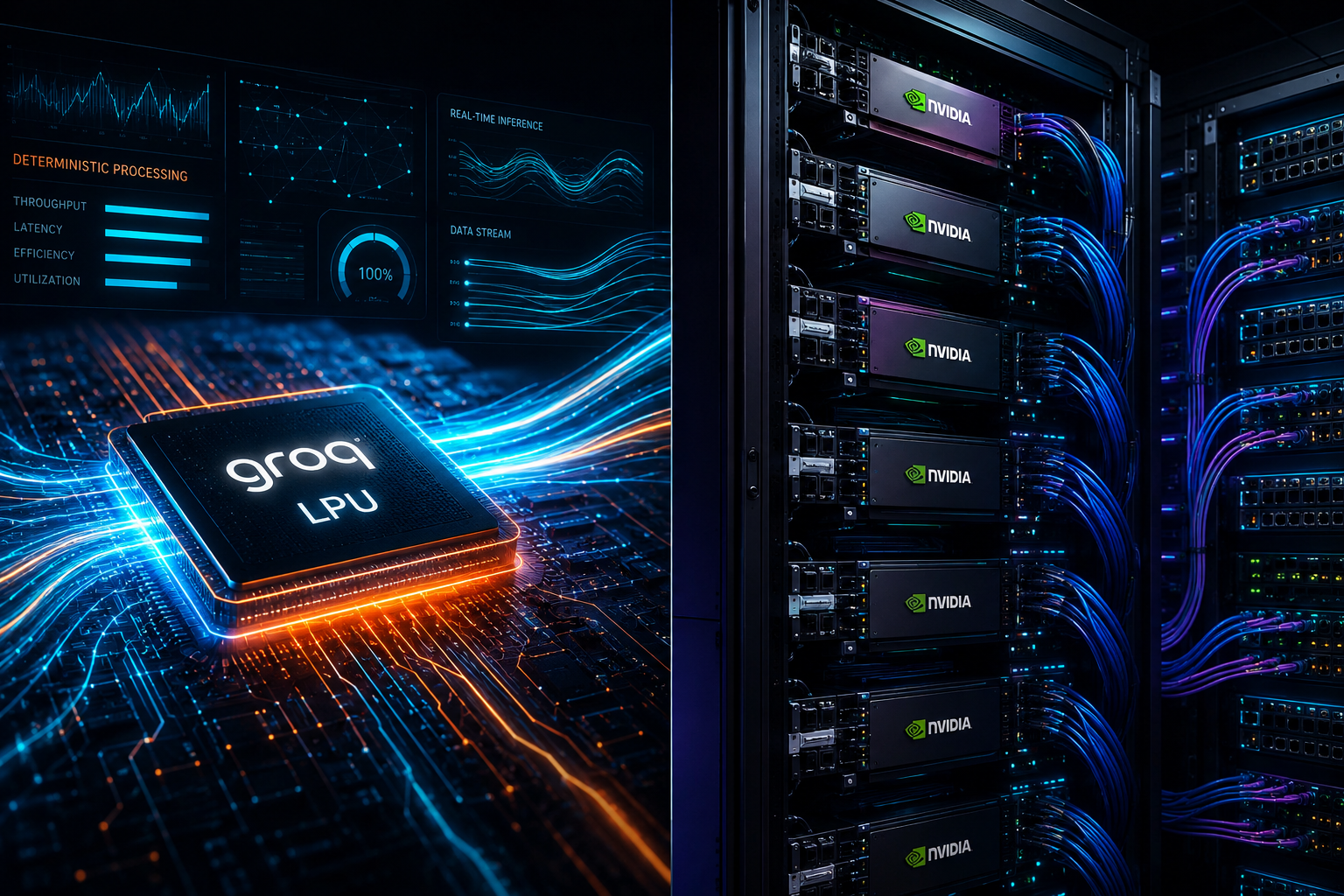
Groq delivers unmatched single-stream speed with time-to-first-token under 200 milliseconds and throughput topping 750 tokens per second on Llama 3.3 70B, making it the clear choice for real-time voice and sub-second chat applications. Together AI dominates on flexibility, offering over 100 open-weight models, native LoRA fine-tuning, and dedicated H100 instances for enterprise workloads that require isolated SLAs and broad architectural choice.
When scaling a generative AI product from prototype to production, your choice of inference infrastructure dictates your two most sensitive metrics: user-perceived latency and unit economics. For engineers building agentic workflows, conversational copilot tools, or automated customer support, raw API response times are no longer just performance statistics—they directly drive user engagement and churn.
Selecting between Groq and Together AI isn't a cosmetic choice between dashboard interfaces. It is a fundamental architectural decision between custom silicon engineered strictly for deterministic tensor streaming and an elastic cloud of high-density graphics processing units optimized for model breadth and training workflows.
The Silicon Reality: LPU vs. GPU Architecture
To understand why Groq and Together AI perform differently under production loads, you must examine the underlying hardware driving each API endpoint.
Groq Language Processing Unit (LPU)
Traditional Graphics Processing Units (GPUs) were designed for massive parallel computing, initially for graphics rendering and later adapted for matrix multiplication in deep learning. However, autoregressive Large Language Model (LLM) inference is inherently sequential. Generating token $N+1$ requires reading every weight of a 70-billion-parameter model from memory, creating a severe memory bandwidth bottleneck.
Groq solves this bottleneck by bypassing conventional High Bandwidth Memory (HBM) entirely. Instead, Groq's Language Processing Unit (LPU) uses static random-access memory (SRAM) baked directly onto the chip die. Because SRAM is integrated adjacent to the compute units, memory bandwidth reaches multiple terabytes per second—orders of magnitude faster than external HBM3e stacks.
Furthermore, Groq utilizes a deterministic hardware architecture. There are no dynamic branch predictors, hardware schedulers, or unpredictable cache misses. The Groq compiler plans every instruction, memory movement, and chip-to-chip communication step at compile time. When a request hits a Groq cluster, the latency profile is completely fixed and deterministic.
Together AI Elastic GPU Cloud
Together AI builds its platform on top of high-performance NVIDIA GPU clusters, utilizing H100, A100, and L40S accelerators interconnected with high-speed InfiniBand networking. Rather than building custom silicon, Together AI optimizes the software stack surrounding industry-standard GPUs.
Their infrastructure relies on advanced software-level optimizations, including custom CUDA kernels, paged attention memory management, FlashAttention, continuous batching, and speculative decoding. By dynamically clustering GPUs, Together AI can load hundreds of distinct open-weight models, scale instances up or down based on incoming traffic, and allocate dedicated compute capacity to enterprise accounts.
While GPUs face memory bandwidth constraints during single-stream token generation compared to SRAM, they offer immense raw memory capacity. An 8-card H100 node provides 640 gigabytes of HBM3 memory, allowing Together AI to host massive models like DeepSeek V3/V4, Qwen 2.5 72B, and long-context variants that cannot easily fit into SRAM-constrained LPU clusters without complex multi-chip scaling.
Latency and Throughput Benchmarks: TTFT vs. TPS
In production LLM evaluation, overall response latency breaks down into two distinct phases:
- Time-To-First-Token (TTFT): The time elapsed between sending the API request and receiving the very first token byte back. This measures prompt processing and prefill speed.
- Tokens Per Second (TPS / Throughput): The rate at which the model streams subsequent output tokens once generation starts.
Time-To-First-Token (TTFT) Performance
For interactive applications such as voice agents, autocomplete systems, and real-time search, TTFT is the dominant factor in perceived responsiveness. A high TTFT causes a noticeable pause before any visible activity occurs on the user interface.
Under single-stream workloads running Llama 3.3 70B, Groq consistently records median TTFT figures between 100 and 200 milliseconds. Because the LPU's SRAM instantly loads model weights and processes prompt context without queuing overhead, prompt ingestion occurs almost instantaneously.
Together AI records median TTFT values between 300 and 600 milliseconds on comparable 70B parameter models. While sub-500ms TTFT is fast compared to standard cloud GPU implementations, it is visibly slower than Groq's instant-on response.
Generation Throughput (Tokens Per Second)
Once generation begins, the user's perception shifts to generation speed. The average human reads text at approximately 4 to 6 words per second (roughly 6 to 8 tokens per second). However, for applications where the model generates code blocks, JSON payloads, or multi-step reasoning steps before returning a final answer, high generation throughput is vital.
On Llama 3.3 70B, Groq delivers sustained generation throughput between 390 and 750 tokens per second depending on total system load and batch configurations. At 500 tokens per second, a full 1,000-token structured response streams in just 2 seconds.
Together AI streams Llama 3.3 70B at 150 to 400 tokens per second on serverless endpoints. While 250 tokens per second feels blazingly fast for human-facing text chat, it is roughly half the raw throughput generated by Groq's dedicated LPU execution paths.
High Concurrency and Scaling Bottlenecks
Where the benchmark dynamic shifts is under heavy concurrent load. Groq's LPU clusters achieve their extreme speed by assigning dedicated SRAM compute units to active streams. As concurrent requests surge into thousands of simultaneous streams, Groq's serverless endpoints can experience strict rate limits or queuing delays once hardware capacity is fully saturated.
Together AI's GPU infrastructure leverages continuous batching and horizontal cluster scaling. As request concurrency rises, GPU clusters distribute the prompt processing and generation workload across dynamic server pools. For massive asynchronous batch jobs or enterprise applications with high request concurrency, Together AI's GPU infrastructure scales seamlessly.

Model Catalog Depth and Ecosystem Support
Speed is meaningless if the provider does not host the exact model your system prompt and application logic require.
Groq: Curated High-Speed Inventory
Groq maintains a lean, highly curated catalog of roughly 20 to 30 production models. Converting a new open-weight architecture to run on Groq's LPU requires custom hardware-level compilation and weight placement across SRAM chips. As a result, Groq focuses exclusively on industry-standard flagship open-weight families:
- Meta Llama 3.3 (8B, 70B) and Llama 3.2 Vision variants
- Mistral / Mixtral architectures (Mixtral 8x7B, 8x22B)
- Google Gemma 2 series
- Open-source reasoning models (such as GPT-OSS variants)
If your software stack is standardized on Meta's Llama 3.3 70B or Google's Gemma 2, Groq provides the fastest hosted environment available. However, if your RAG pipeline relies on specialized niche models, non-standard architectures, or brand-new open-weight releases on day zero, Groq may not support them.
Together AI: The Open-Source Library
Together AI acts as an expansive repository for open-source AI, hosting over 100 distinct model checkpoints across text, code, vision, image generation, and audio. Because GPUs execute standard PyTorch and vLLM runtimes without needing specialized silicon re-compilation, Together AI quickly deploys new model releases.
Together AI's catalog includes:
- DeepSeek series (including DeepSeek V3, DeepSeek R1, and DeepSeek V4)
- Qwen 2.5 and Qwen 3.5 model families (7B through 72B, plus specialized coding variants)
- Mistral NeMo, Mistral Large 2, and Codestral
- Domain-specific fine-tunes for medical, legal, and software engineering use cases
- Specialized multimodal architectures, including FLUX for image synthesis and Whisper for transcription
If your enterprise pipeline relies on DeepSeek V3/V4, Qwen 2.5 Coder, or custom domain models, Together AI provides native endpoint support where Groq currently cannot.
Fine-Tuning, Custom Models, and Training Workflows
For many engineering teams, generic off-the-shelf base models are insufficient. High-value enterprise SaaS products frequently rely on domain-specific fine-tuning to enforce JSON schemas, adopt brand voice, or execute specialized logic.
Groq: Inference-Only Execution
Groq is strictly an inference engine. You cannot run training jobs, supervised fine-tuning (SFT), or Low-Rank Adaptation (LoRA) training on Groq's hardware.
To bring a custom model to Groq, you must fine-tune the model weights on third-party GPU infrastructure (such as Anyscale, AWS EC2, or Lambda Labs), export the final merged weights, and apply for enterprise onboarding so Groq's engineering team can compile the model for LPU deployment. For early-stage startups and rapid iteration, self-serve fine-tuning on Groq is simply not available.
Together AI: End-to-End Fine-Tuning Platform
Together AI provides a complete lifecycle platform for open-source models. You can upload proprietary training datasets, run supervised fine-tuning (SFT) or LoRA adapter training directly through their API, evaluate test checkpoints, and immediately deploy the fine-tuned adapter to serverless or dedicated endpoints.
Together AI's fine-tuning pipeline offers several major engineering advantages:
- Serverless LoRA Serving: Instead of deploying dedicated hardware for every custom fine-tuned model, Together AI uses dynamic LoRA stacking. The base model remains loaded in GPU memory while custom adapter weights are dynamically swapped during request execution, significantly lowering hosting costs.
- Full-Weight Fine-Tuning: Enterprise teams can run full parameter training runs across multi-node H100 clusters with customized learning schedules.
- Seamless Weight Export: Models trained on Together AI are not locked into the platform. You can export weights in standard Safetensors format at any time.
Pricing, Unit Economics, and Dedicated Endpoints
Understanding the pricing models of both providers is critical for projecting your monthly API expenditure as user activity grows.
Serverless Token Rates
On shared serverless endpoints, both platforms charge per million tokens processed. Pricing is split between input prompt tokens and generated output tokens.
For standard flagship models available on both platforms (such as Meta Llama 3.3 70B), pricing is remarkably competitive:
- Groq Llama 3.3 70B: $0.59 per 1M input tokens / $0.79 per 1M output tokens
- Together AI Llama 3.3 70B: $0.54 per 1M input tokens / $0.54 per 1M output tokens (serverless standard)
At 10 million output tokens per month, the price difference between the two platforms is less than $3. Therefore, at low to moderate production volumes, per-token pricing should not dictate your infrastructure choice. Instead, decision factors should focus on target latency, model selection, and control requirements.
Discounts and Cost Optimization
Both platforms offer structural discounts for specific workload patterns:
- Groq Batch API: Offers a 50% discount on token costs for non-real-time asynchronous processing jobs with completion windows between 24 hours and 7 days.
- Groq Prompt Caching: Halves the input token price on supported models when system prompts or long context passages are reused across consecutive requests.
- Together AI Batch API: Provides up to 50% reduced pricing for bulk evaluation datasets and offline data processing pipelines.
Dedicated Provisioned Capacity
When scaling beyond roughly 150 million tokens per month, serverless per-token billing can become less economical than reserving dedicated hardware. Furthermore, regulated enterprise applications frequently require private compute isolation to satisfy compliance and security requirements.
Together AI excels in this category by providing self-serve dedicated GPU endpoints starting at approximately $6.49 per hour for dedicated H100 capacity. With dedicated endpoints, you pay a fixed hourly rate for reserved GPU hardware. You gain isolated compute resources, zero noisy-neighbor interference, guaranteed throughput, and custom auto-scaling rules.
Groq operates primarily as a managed serverless platform. Enterprise customers can secure reserved capacity agreements through custom sales contracts, but self-serve dedicated deployment configuration is not natively built into their standard self-service portal.
Production Engineering Trade-offs: Compliance, Reliability, and Rate Limits
Deploying AI systems in production requires evaluating hardware limits, rate handling under traffic spikes, and platform reliability.
Rate Limits and Burst Handling

Groq enforces strict tier-based rate limits measured in Requests Per Minute (RPM) and Tokens Per Minute (TPM). On standard developer tiers, TPM limits can be reached quickly during unexpected traffic bursts. When rate limits are hit, Groq returns immediate HTTP 429 errors. To handle production spikes reliably, engineering teams must implement exponential backoff algorithms or establish paid developer tier guarantees.
Together AI uses elastic request handling that dynamically adjusts based on sustained usage patterns. While serverless requests can experience brief queue delays during global cluster spikes, traffic rarely encounters hard drop-off barriers. For production workloads with tight SLA requirements, Together AI recommends provisioning a dedicated endpoint, which provides fixed, unthrottled capacity.
API Compatibility and Migration
Both Groq and Together AI provide drop-in OpenAI-compatible REST APIs and SDK clients. Switching your application logic from OpenAI to either provider requires changing only two parameter variables in your initialization code:
```python
Switching to Groq
from openai import OpenAI
client = OpenAI( base_url="https://api.groq.com/openai/v1", api_key=groq_api_key )
response = client.chat.completions.create( model="llama-3.3-70b-versatile", messages=[{"role": "user", "content": "Summarize this contract."}] ) ```
```python
Switching to Together AI
from openai import OpenAI
client = OpenAI( base_url="https://api.together.xyz/v1", api_key=together_api_key )
response = client.chat.completions.create( model="meta-llama/Llama-3.3-70B-Instruct-Turbo", messages=[{"role": "user", "content": "Summarize this contract."}] ) ```
However, minor schema differences exist. For instance, Groq enforces strict limits on sampling parameters (such as constraining the `n` parameter to 1). Together AI supports standard sampling parameters, custom stop sequences, and logprobs across almost all hosted models.
Groq vs. Together AI: Feature Comparison Matrix
The table below details the architectural and operational differences between Groq and Together AI across primary production metrics:
| Feature / Metric | Groq | Together AI |
|---|---|---|
| Primary Architecture | Proprietary LPU (SRAM-based silicon) | NVIDIA GPU Clusters (H100 / A100 / L40S) |
| Time-To-First-Token (TTFT) | ~100–200ms (Ultra-fast) | ~300–600ms (Standard fast) |
| Generation Throughput (TPS) | ~390–750+ tokens/sec (Llama 3.3 70B) | ~150–400 tokens/sec (Llama 3.3 70B) |
| Latency Determinism | Extremely high (Fixed hardware timing) | Variable (Subject to GPU cluster queues) |
| Model Catalog Size | 20–30 curated open-weight models | 100+ open-source models |
| Model Ecosystem | Llama 3.x, Mixtral, Gemma 2, GPT-OSS | DeepSeek, Qwen, Mistral, Llama, FLUX, etc. |
| Fine-Tuning Support | None (Inference-only platform) | Native (SFT, LoRA, DPO fine-tuning API) |
| Dedicated Deployment | Enterprise sales process only | Self-serve dedicated GPUs from $6.49/hr |
| Serverless Pricing (Llama 70B) | $0.59 / $0.79 per 1M tokens (in/out) | $0.54 / $0.54 per 1M tokens (in/out) |
| Batch Processing Discount | 50% discount on async batch API | 50% discount on batch endpoints |
| Multimodal Support | Text + Llama 3.2 Vision | Text, Vision, Image (FLUX), Audio (Whisper) |
| Primary Target Use Case | Real-time chat, voice agents, code completion | Custom models, fine-tuning, broad catalog |
Strategic Decision Framework: Which Should You Pick?
Choosing the optimal inference engine depends on your application's core performance requirements and engineering constraints.
Choose Groq If:
- Latency Is Your Primary Feature: You are building real-time voice AI agents, live code-completion engines, or conversational search assistants where sub-200ms TTFT is essential.
- Your Stack Runs on Mainstream Open Weights: Your application logic is standardized on Meta's Llama 3.3, Mixtral, or Gemma 2.
- You Want Fixed Throughput Speeds: You need predictable generation speed without tuning GPU deployment parameters.
- You Want Zero Infrastructure Overhead: You prefer a managed, serverless API endpoint that requires no GPU management.
Choose Together AI If:
- You Require Model Diversity: Your stack depends on specialized architectures like DeepSeek V3/V4, Qwen 2.5 Coder, or domain-specific open models.
- Fine-Tuning Is Central to Your Strategy: You need to train, evaluate, and host custom LoRA adapters or full-weight fine-tuned models.
- You Need Dedicated Hardware Isolation: You require private H100 GPU instances with predictable monthly pricing and fixed SLAs.
- You Build Multimodal Workflows: Your application processes text, generates images, and transcribes audio through a unified provider API.
Implementing a Dual-Provider Fallback Architecture
In enterprise production environments, relying on a single inference provider creates a single point of failure. If an API provider experiences a regional outage, hardware maintenance, or localized rate-limiting, your application will face degraded service or downtime.
Because both Groq and Together AI expose OpenAI-compatible REST interfaces, implementing a multi-provider fallback pattern requires minimal engineering effort. By routing primary latency-sensitive traffic to Groq and instantly falling back to Together AI during 429 rate-limit or 5xx server errors, you preserve sub-second response times while ensuring enterprise resilience.
Here is a production-ready Python implementation using a dual-provider router pattern:
```python import os import time from openai import OpenAI, APIError, RateLimitError
class DualInferenceRouter: def __init__(self): self.groq_client = OpenAI( base_url="https://api.groq.com/openai/v1", api_key=os.getenv("GROQ_API_KEY") ) self.together_client = OpenAI( base_url="https://api.together.xyz/v1", api_key=os.getenv("TOGETHER_API_KEY") )
def generate_completion(self, prompt, system_prompt="You are a helpful assistant."): messages = [ {"role": "system", "content": system_prompt}, {"role": "user", "content": prompt} ]
Primary Route: Groq for ultra-low latency LPU streaming
try: start_time = time.time() response = self.groq_client.chat.completions.create( model="llama-3.3-70b-versatile", messages=messages, temperature=0.2, max_tokens=1024 ) elapsed = time.time() - start_time print(f"Success via Groq LPU in {elapsed:.3f}s") return response.choices[0].message.content
except (RateLimitError, APIError) as e: print(f"Groq API unavailable or rate limited ({str(e)}). Failing over to Together AI...")
Secondary Route: Failover to Together AI GPU infrastructure
try: start_time = time.time() response = self.together_client.chat.completions.create( model="meta-llama/Llama-3.3-70B-Instruct-Turbo", messages=messages, temperature=0.2, max_tokens=1024 ) elapsed = time.time() - start_time print(f"Success via Together AI Failover in {elapsed:.3f}s") return response.choices[0].message.content
except Exception as failover_error: print(f"Failover execution failed: {str(failover_error)}") raise failover_error
Usage Example
if __name__ == "__main__": router = DualInferenceRouter() output = router.generate_completion("Explain the difference between SRAM and HBM in hardware design.") print("Output Preview:", output[:150]) ```
This architecture guarantees that your user experience remains responsive during traffic surges while utilizing Groq's high-speed execution paths under normal operating conditions.
Final Architectural Takeaways
The choice between Groq and Together AI comes down to your primary product constraint. If ultra-low latency is your core requirement, Groq's SRAM-based LPU architecture is unmatched for high-speed token generation. If model selection, custom fine-tuning pipelines, or dedicated GPU deployments are critical, Together AI offers the necessary flexibility and infrastructure depth.
Evaluating infrastructure platforms and selecting software tools is one of the most consequential decisions for modern engineering teams. At Saasbonus, we provide independent, hands-on reviews, side-by-side performance comparisons, and architecture guides to help engineering leaders choose the right software stack the first time.