Helicone vs Langfuse: Best LLM Monitoring Tool in 2026?
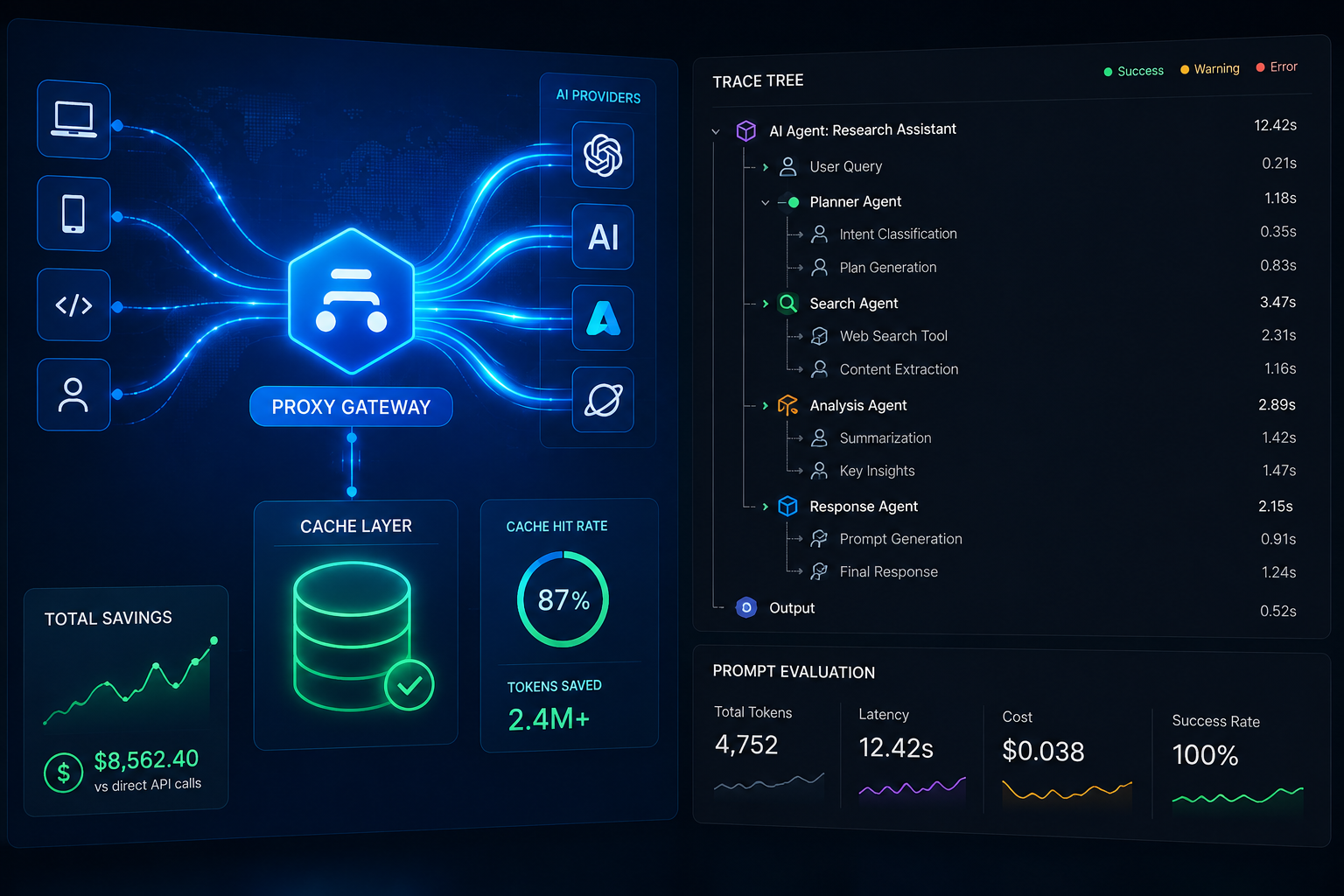
Choosing between Helicone and Langfuse comes down to a fundamental architectural decision: do you want an edge proxy gateway that logs LLM calls and slashes latency via semantic caching, or do you want an SDK-first, open-source platform built for full multi-turn agent tracing, prompt management, and evaluations?
If you need zero-code proxy integration, instant cost breakdown dashboards, and immediate API savings, Helicone is the fastest path from zero to production visibility. However, if you are building complex multi-step AI agents, need open-source MIT-licensed self-hosting for strict data sovereignty, and require built-in prompt versioning and automated eval suites, Langfuse is the clear winner.
Here is the exact breakdown of how these two LLM observability leaders compare across architecture, tracing capabilities, developer experience, and real-world costs.
Core Architecture: Proxy Gateway vs. SDK Tracing
The fundamental difference between Helicone and Langfuse lies in how data leaves your application and reaches the monitoring dashboard. This architectural fork dictates your latency overhead, integration complexity, and the depth of debugging telemetry you can capture.
Architectural Flow Overview
- Helicone (Proxy Gateway Architecture): Client Application -> Helicone Edge Gateway Proxy -> Model Provider (OpenAI, Anthropic, or custom endpoint). The edge proxy handles request processing and forwards logs asynchronously to a ClickHouse analytics engine.
- Langfuse (SDK / OpenTelemetry Telemetry Architecture): Client Application with Langfuse SDK -> Model Provider APIs directly. The SDK streams asynchronous OpenTelemetry telemetry batches in the background directly to the Langfuse backend and database.
How Helicone Works
Helicone primarily functions as an AI gateway and reverse proxy. To integrate it, you change your LLM client's `baseURL` to target Helicone's Cloudflare-backed edge worker, passing your target provider API key in a custom header.
Because Helicone sits directly in the HTTP request path, it intercepts payload headers, latency timings, token counts, and completion outputs before forwarding them to the LLM vendor. It processes request logs asynchronously into a ClickHouse backend, ensuring that logging failure never blocks production API calls. The proxy setup gives you instant features like edge-level rate limiting, request retries, and semantic caching before the request ever reaches OpenAI or Anthropic.
How Langfuse Works
Langfuse operates via an SDK-first, OpenTelemetry-native architecture. Instead of routing raw network packets through an intermediate proxy, you install the native Python, TypeScript, or framework-specific SDK (such as LangChain, LlamaIndex, or Vercel AI SDK).
Your application calls LLM providers directly. In the background, the Langfuse SDK wraps function executions, asynchronous calls, and tool invocations, streaming structured JSON trace trees back to the Langfuse instance via asynchronous HTTP batches. This means zero added network latency between your server and the LLM provider, and it allows you to capture deeply nested execution graphs, non-LLM Python functions, vector database lookups, and human-in-the-loop annotations.

Feature Breakdown: Tracing, Prompts, and Evaluations
Monitoring an LLM application requires more than just tracking HTTP status codes. You need visibility into model drift, prompt quality, execution paths, and evaluation scores.
Deep Agent Tracing vs. Request-Level Logging
- Helicone: Operates primarily at the HTTP request level. It logs individual model completions with extreme precision—capturing latency distributions, token usage, custom user tags, and cost per request. However, connecting a 5-step agent execution flow requires manually stitching custom request IDs across multiple API calls.
- Langfuse: Built specifically for multi-turn conversational agents and complex RAG pipelines. It renders execution graphs as hierarchical trace trees. You can inspect exact inputs, retriever contexts, tool calls, and final completions step by step. If an agent hallucinated in step 4 because of a poorly retrieved chunk in step 2, Langfuse pinpoints the precise sub-span failure.
Prompt Management and Versioning
- Helicone: Does not offer dedicated prompt management UI workflows. Prompt updates happen directly inside your code repositories, with Helicone serving purely as the downstream analytics viewer.
- Langfuse: Includes a fully featured prompt management engine. Developers can draft, test, version, and deploy prompts directly through the Langfuse UI or API. You can link specific prompt versions directly to production trace runs, allowing you to run side-by-side A/B tests across different prompt iterations without redeploying backend code.
Model Evaluations and Quality Control
- Helicone: Focuses on user feedback collection (such as thumbs-up/thumbs-down scoring via API) and basic request scoring. It lacks an end-to-end evaluation runner or dataset management pipeline.
- Langfuse: Provides an evaluation framework supporting LLM-as-a-judge scoring, heuristic evaluation metrics, and human annotation workflows. You can build golden datasets, run automated evaluations against test suites, and track quality scores (faithfulness, toxicity, answer relevance) over time.
Comparison Summary Table
| Feature / Dimension | Helicone | Langfuse |
|---|---|---|
| Primary Architecture | Reverse Edge Proxy Gateway | SDK / OpenTelemetry Integration |
| Integration Time | 2 minutes (One-line URL change) | 10-15 minutes (SDK wrapper setup) |
| Tracing Depth | Request / Completion level | Deep multi-step hierarchical trace trees |
| Semantic Caching | Native (Reduces LLM API costs by 20-40%) | Not natively supported |
| Prompt Management | No native UI prompt versioning | Native UI versioning, staging, and A/B testing |
| Evaluations & Datasets | Basic user scoring / Feedback API | Full Eval suite (LLM-as-a-judge, Datasets) |
| Self-Hosting License | Available (Docker / Helm charts) | 100% Open Source (MIT License, Docker) |
| OpenTelemetry Native | Partial | Fully OpenTelemetry Native |
| Free Tier | Generous request-based free tier | Unlimited self-hosted; generous cloud free tier |
Performance, Caching, and Cost Optimization
LLM infrastructure bills can scale unpredictably. The way these two platforms manage performance and cost reduction represents one of their starkest differentiators.
Helicone's Killer Feature: Semantic Caching
Helicone's proxy architecture enables a feature that SDK-only tools cannot replicate natively: Semantic Caching.
When a user submits a query, Helicone checks its vector cache to determine if a semantically equivalent query was processed recently. If a high-similarity match exists, Helicone returns the cached response instantly from the edge—bypassing the target LLM provider entirely.
For high-volume customer support bots, FAQ agents, or repetitive internal tooling, semantic caching routinely cuts LLM API costs by 20% to 40% while reducing response latency from 1,500ms down to sub-50ms.
Storage Architecture and Database Scaling
- Helicone relies on ClickHouse, a columnar database built for high-throughput log ingestion and rapid analytical queries across billions of tokens. This allows Helicone Cloud and self-hosted instances to handle thousands of requests per second without database lock-ups.
- Langfuse utilizes PostgreSQL (along with ClickHouse for large-scale analytics in modern deployments) and Redis. PostgreSQL makes self-hosting extraordinarily simple for early-stage teams—you can launch Langfuse on a single small server using Docker Compose in under five minutes.

Self-Hosting and Data Sovereignty
For enterprises operating under strict privacy frameworks like HIPAA, SOC 2, or GDPR, routing user prompts and model completions through third-party cloud servers is often non-negotiable.
Langfuse for Complete Data Ownership
Langfuse was built open-source-first under the liberal MIT License. You can run the complete Langfuse platform on your own local machines, AWS ECS, GCP Cloud Run, or Kubernetes clusters with zero feature restrictions or enterprise paywalls. Prompts, raw embeddings, and completions remain inside your private Virtual Private Cloud (VPC), satisfying compliance requirements for medical, legal, and financial applications.
Helicone Self-Hosting Options
Helicone also offers self-hosted deployments via Docker and Helm charts. However, because its architecture involves multiple microservices—including Cloudflare Workers or local proxy proxies, ClickHouse, and Kafka for high-volume message queues—setting up and maintaining a self-hosted Helicone cluster requires significantly more DevOps bandwidth than running a single Langfuse container.
Pricing Comparison
Both platforms offer transparent tier structures, but their billing metrics differ significantly.
Helicone Pricing Model
- Free Tier: Includes generous monthly request limits (typically around 10,000 to 50,000 logged requests), making it free for hackathons and early prototypes.
- Pro Tier: Starts around $20 to $79/month depending on volume, with usage-based scaling for additional requests.
- Enterprise Tier: Custom pricing with dedicated ClickHouse instances, SSO, and custom SLAs.
Langfuse Pricing Model
- Self-Hosted (Open Source): 100% Free forever. No artificial limits on users, traces, or projects.
- Langfuse Cloud (Free Tier): Offers generous monthly trace units (e.g., up to 50,000 observations/month) with full feature access.
- Langfuse Cloud (Pro/Team): Starts around $50/month, scaling based on the volume of ingested trace spans and observations.
Which Tool Should You Choose?
To pick the right tool for your engineering team, evaluate your current architecture against these primary scenarios:
Choose Helicone If:
- You want the absolute fastest setup: You can point your base URL to Helicone and start seeing latency, token, and cost dashboards in under two minutes without writing new code.
- Reducing LLM API costs is your top priority: You want built-in semantic caching and edge proxy rules to prevent duplicate API queries from draining your budget.
- Your application relies on direct single-turn API calls: You are building straightforward chat widgets, text summarizers, or extraction pipelines that do not require multi-step agent chaining.
Choose Langfuse If:
- You are building complex AI agents: You use LangChain, LlamaIndex, AutoGen, or custom agent loops and need to debug multi-step execution chains and tool calls.
- You need strict open-source self-hosting: You operate in a regulated industry and must host your entire observability stack inside your own VPC under an MIT license.
- You want an end-to-end LLM engineering suite: You need prompt versioning, playground testing, automated dataset evaluation, and human feedback annotation in one consolidated workflow.
Accelerate Your SaaS Growth with Saasbonus
Building cutting-edge AI applications requires the right infrastructure stack—from model providers and vector databases to LLM observability tools like Helicone and Langfuse.
At Saasbonus, we help engineering teams and SaaS founders discover software reviews, benchmark developer tools, and unlock exclusive pricing deals on premium SaaS platforms. Whether you are scaling your LLM backend or optimizing your SaaS stack, explore our latest independent tool comparisons to save hours of dev time and thousands in software spend.