How to Localize Content for 3+ Global Product Lines (Without Melting Your Operations Budget)
You are sitting in a quarterly marketing operations review, staring at a spreadsheet that looks less like a growth strategy and more like a financial threat. Your company just greenlit the expansion of three distinct product lines into Europe, LATAM, and APAC. The growth team is ecstatic. The product managers are celebrating. But as the person holding the content ops map, you are doing some basic math that leads straight to a panic attack.
Traditional wisdom says that if you expand into three new regions with three different product lines, you need to multiply your content budget, your headcount, and your production timeline by three. If you spent $50,000 on core content development last quarter, the spreadsheet says you now need $150,000 just to keep pace internationally.
That is how operations budgets melt. It is also how brilliant global expansions stall out before a single localized landing page goes live.
At SaaSBonus, we spend our days dissecting software workflows, testing internal tools, and helping scaling companies avoid the common tech stack traps that drain capital. The reality of modern global expansion is simple: you cannot solve a scaling problem by throwing raw headcount or legacy translation agencies at it. You solve it by building a localization engine that separates content volume from operational cost.
Let's walk through the exact blueprint for localizing three or more global product lines simultaneously, keeping your sanity intact, and ensuring your budget survives the transition.
The Three-Product Trap: Why Traditional Localization Breaks Down
When you scale from a single product in a single market to multiple product lines across disparate regions, your complexity doesn't grow linearly. It grows exponentially.
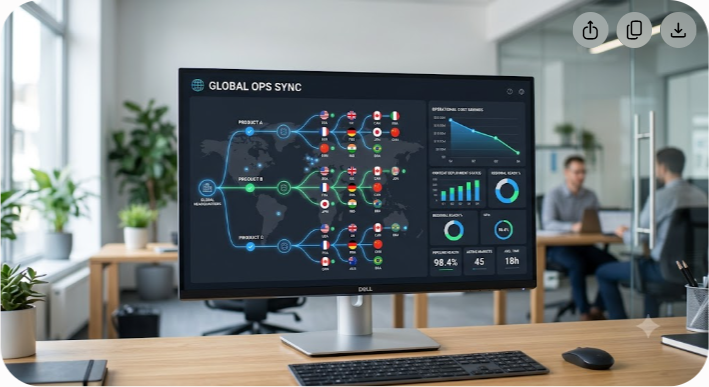
Consider what happens behind the scenes. Product A is a high-velocity self-serve tool targeting developers in Germany. Product B is an enterprise-tier platform aimed at financial directors in Brazil. Product C is a mid-market solution for HR teams in Japan. Each product has its own buyer personas, unique value propositions, compliance requirements, and feature release cycles.
If you treat localization as a simple translation task, your workflow quickly descends into chaos:
- The Content Swarm: Your content managers spend half their week chasing freelance translators across six different time zones via email and Slack.
- Context Blindness: Translators work inside isolated spreadsheets without seeing the UI layout, resulting in translated buttons that break the frontend design.
- Glossary Drifts: The core technical term for Product A gets translated three different ways across four pages, destroying your international SEO foundations.
- The Dev Bottleneck: Engineers are forced to manually copy and paste JSON strings or HTML blocks out of content management systems every time a marketing campaign updates.
To build a framework that scales without draining your budget, you have to shift your perspective. You aren't managing text; you are managing a supply chain.
Step 1: Establish Your Core Architecture (The Tiered Localization Matrix)

Every piece of content you create does not deserve the same level of investment. Trying to perfectly human-localize every single blog post, knowledge base article, and product UI microcopy string across three separate product lines is the fastest way to declare operational bankruptcy.
Instead, you must sort your global content into three distinct tiers based on business value, conversion impact, and lifecycle longevity.
Tier 1: High-Impact, High-Nuance (Human transcreation)
- What it includes: Core homepage copy, product landing pages, pricing grids, high-intent Google Ads, and main value proposition videos.
- The Strategy: This is where you allocate your premium budget. You hire native-speaking copywriters who understand the local cultural nuances, regional compliance realities, and emotional triggers. You aren't just translating words; you are rebuilding the narrative for that specific market.
Tier 2: Educational & SEO Growth (Hybrid AI + Human Review)
- What it includes: Top-of-funnel blog posts, long-form guides, case studies, and high-volume organic search plays.
- The Strategy: You lean heavily on advanced machine translation or large language models trained on your specific brand guidelines. Once the initial draft is generated, a local editor or regional marketer reviews the piece for tone, flow, and technical accuracy. This reduces production costs by up to 60% while maintaining editorial control.
Tier 3: High-Volume, Low-Perishability (Automated with Dynamic Glossaries)
- What it includes: Technical documentation, help center articles, API guides, and community forum threads.
- The Strategy: Complete automation driven by automated translation engines connected to your live product glossaries. You only trigger a human review if a page hits a specific traffic threshold or receives poor user feedback ratings.
| Content Type | Localization Method | Budget Allocation | Primary Goal |
|---|---|---|---|
| Tier 1 (Core Assets) | Human Transcreation | 60% | Conversion & Brand Trust |
| Tier 2 (SEO & Blogs) | Hybrid (AI + Post-Edit) | 30% | Traffic & Lead Gen |
| Tier 3 (Docs & Help) | Automated (Glossary Enforced) | 10% | Support Deflection |
By categorizing your assets before a single line of copy is translated, you protect your budget for the pages that actually drive pipeline.
Step 2: Unify Your Brand Source Truth (The Global Glossary Asset)
Imagine running an international campaign for Product A where the core feature name means 'flexible scheduling' in the US, but the automated translation turns it into 'unstable timetabling' in France. It sounds comical, but it happens daily when teams lack a unified linguistic source of truth.
Before you activate new regional pipelines, you need to build a centralized, living glossary for each product line. This file should live inside your Translation Management System (TMS) and connect directly to your content production tools.
Your glossary must define three critical elements:
- Brand Terms to Never Translate: Product names, proprietary features, and specific company trademarks (e.g., keeping a feature name like 'SaaSBonus Radar' uniform globally).
- Industry-Specific Terminology: The exact technical translation for complex words in your space, preventing translators from guessing context.
- Tone and Style Directives: A brief, actionable set of rules for each market. For instance, German B2B content typically requires a formal tone (Sie), whereas Spanish marketing material can often be more casual (Tú).
When your translation engine or your human agency plugs into this centralized source of truth, revision cycles drop drastically. You no longer waste weeks passing PDFs back and forth because a regional manager didn't like the specific word chosen for an app menu option.
Step 3: Architecting an Automated, API-Driven Content Stack

If your current localization process requires anyone on your team to manually download a CSV file from Webflow or WordPress, email it to a translation vendor, wait five days, and then manually upload the translated text back into your CMS, your system is fundamentally broken. You are paying a hidden tax in human error and lost time.
To manage three distinct product lines without inflating your headcount, you need an integrated tech stack that moves data automatically.
[Central CMS / Repo] ??(Webhook Trigger)??> [Translation Management System (TMS)] ? ??????????????????????????? ? ? [AI Translation Engine] [Human Review Dashboard] ? ? ??????????????????????????? ? [Localized Live Environment]
Here is how the automated workflow flows in a mature content operation:
- The Trigger: A content creator marks an English landing page for Product B as 'Approved for Translation' inside your headless CMS.
- The Transfer: A webhook fires, sending the structured JSON content blocks directly into your Translation Management System.
- The Processing: The TMS parses the text, checks it against your global glossary, applies machine translation for Tier 2/3 assets, or assigns it to a pre-vetted human translator for Tier 1 pages.
- The Deployment: Once approved within the TMS, the system pushes the localized text back to the CMS through an API, automatically generating the new regional URL structure (e.g., /es/product-b) and updating the proper SEO hreflang tags.
This architecture eliminates manual data entry entirely. Your content team focuses on creative execution and optimization, while the software handles the structural heavy lifting.
Step 4: Structuring the Slimline Localization Team
You do not need to hire a massive in-house team of bilingual project managers to run an efficient global operation. Instead, aim for a lean, central hub-and-spoke organizational structure.
The Core Content Ops Lead (In-House)
This individual owns the tech stack, manages the budget, monitors the TMS automation loops, and tracks system-wide performance metrics. They don't need to speak five languages; they need to understand data architecture and process engineering.
Regional Validation Partners (Contractors or On-Demand Agency)
Rather than employing full-time regional marketing leads in every target country, partner with fractional, native-speaking editors. Their sole responsibility is to review your automated Tier 2 output and ensure it aligns with local market expectations. They spend their time editing and refining, not writing from scratch.
This lean approach keeps fixed overhead incredibly low. When market conditions shift or a specific product line needs to pause expansion, you can easily dial back your variable freelance review spend without navigating painful organizational downsizings.
Step 5: Measuring Efficiency and Tracking ROI
To prove to your leadership team that your content operations aren't just an expense line item, you need to track metrics that show real business impact. Focus your reporting on three core key performance indicators:
- Cost Per Word Localized: Track this metric across your distinct content tiers. As your automation loops mature and your glossaries expand, your average cost per word should drop continuously.
- Time-to-Market (TTM): The number of days it takes from publishing a core product announcement or campaign page in your native market to launching it across all global properties.
- Organic Search Velocity: Monitoring how quickly your localized URLs rank for core regional keywords, ensuring your technical international SEO infrastructure is operating perfectly.
Maximizing Scalability with the Right Technology
Scaling multiple product lines across international borders doesn't require an enterprise-sized budget. It requires clear operational boundaries, strategic asset tiering, and an integrated technical infrastructure. By removing manual friction points and treating your content operation like an efficient supply chain, you can easily grow your global pipeline while protecting your bottom line.
If you are currently evaluating translation management tools, headless CMS setups, or content automation platforms to help power your global growth, check out our comprehensive, hands-on software reviews at SaaSBonus. We break down the pricing models, operational limitations, and core integrations of the market's leading tools so you can build a resilient tech stack the first time around.