How to Reduce Anthropic Claude API Costs in Production
The Hidden Multiplier in Your Anthropic API Bill
Output tokens on the Claude API cost exactly five times more than input tokens across every model tier. If your production AI application generates verbose responses, you are paying a 500% premium on every extra word.
Most engineering teams attempt to fix spiraling LLM bills by truncating user inputs or switching entirely to smaller models. However, context trimming only touches the cheaper side of the equation, and downgrading model quality usually breaks core product features.
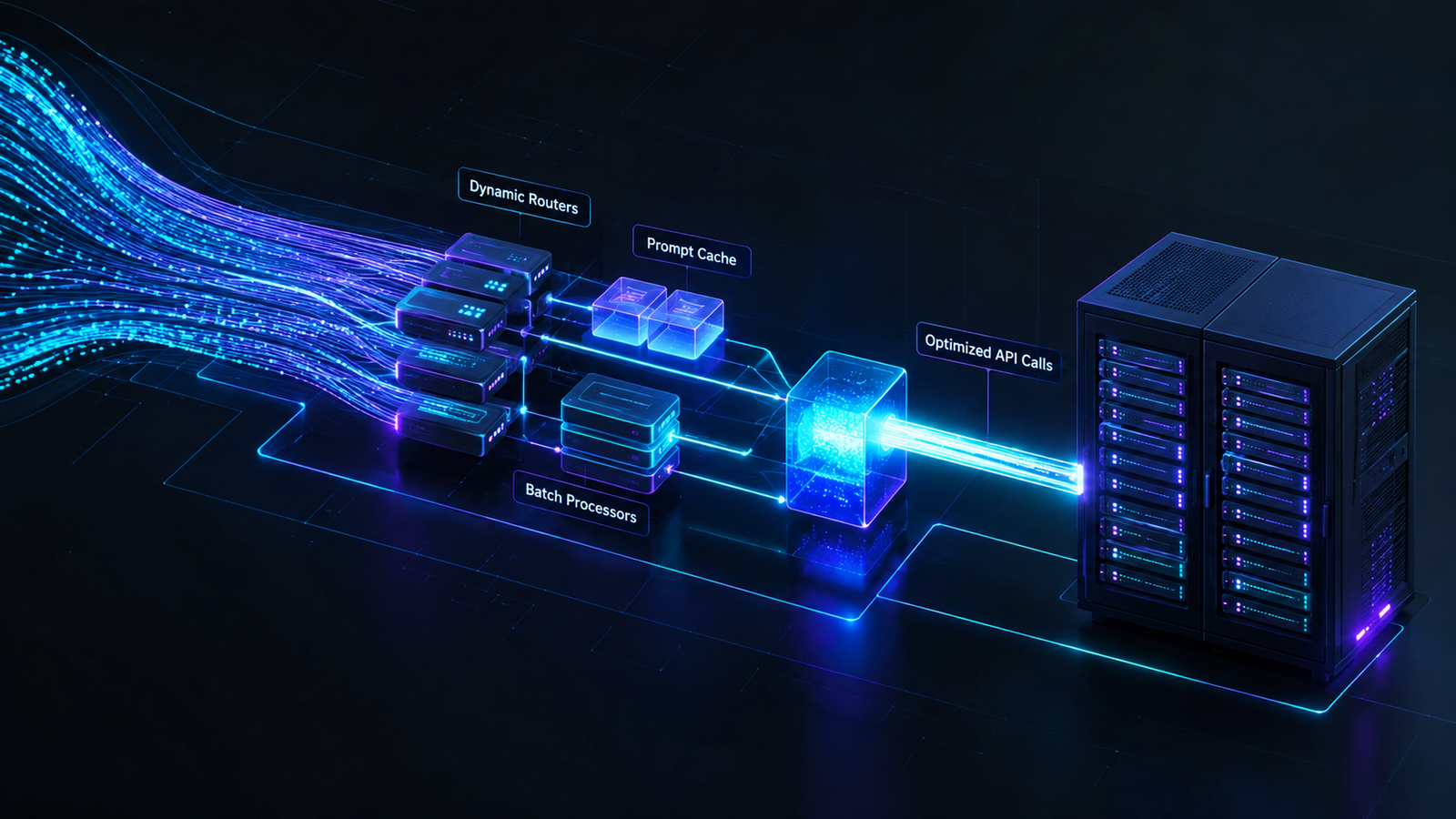
Cutting Anthropic API costs in production without destroying application accuracy requires treating LLM calls like any other database or network resource. By combining prompt caching, tier routing, structural token compression, and asynchronous batching, you can cut month-end token costs by 70% to 90% while maintaining high output precision.
Understanding the Claude Pricing Matrix
Before refactoring your API layer, you must analyze how Anthropic bills for model usage. Anthropic charges per million tokens, split into input, cached input, and output categories.
| Model | Standard Input / 1M | Cached Input / 1M | Standard Output / 1M | Primary Production Use Case |
|---|---|---|---|---|
| Claude Haiku 4.5 | $1.00 | $0.10 | $5.00 | High-volume routing, classification, data extraction |
| Claude Sonnet 5 | $2.00 | $0.20 | $10.00 | Production coding, general agentic logic, workflow automation |
| Claude Opus 5 | $5.00 | $0.50 | $25.00 | Complex multi-step reasoning, architectural planning |
| Claude Fable 5 | $10.00 | $1.00 | $50.00 | Specialized, long-horizon deep reasoning tasks |
Notice the pattern: standard output tokens are consistently five times the price of standard input tokens. Furthermore, cached input tokens deliver a 90% discount over standard input. These two properties define where your engineering effort yields the highest return.
Strategy 1: Implement Anthropic Prompt Caching
Prompt caching is the single most effective lever for reducing input token spend. When your application repeatedly sends long system prompts, documentation blocks, OpenAPI specifications, or codebase context, Anthropic allows you to cache those static prefixes on their servers.
How Prompt Caching Economics Work
Writing to the cache incurs a slight upfront surcharge (1.25x for a 5-minute cache; 2.0x for a 1-hour cache). However, subsequent reads from that cache cost just 10% of standard input rates.
Your break-even point occurs on the second request. If a system prompt is reused three or more times within the cache lifespan, you immediately net positive savings.
For example, in a standard request pipeline sending a 10,000-token system prompt alongside a 200-token user query, Anthropic bills the call as 10,200 standard input tokens. Under a cached pipeline, the initial run caches the 10,000-token system block. Every subsequent run bills those 10,000 tokens at the 90% cached discount rate, charging standard rates only for the new 200-token query.
Where to Place Cache Control Blocks
To maximize cache hits, group static data at the very beginning of your messages array. Anthropic matches caches from top to bottom. If dynamic content (such as a timestamp or user ID) is inserted above a static documentation block, the cache breaks.
Structure your API payload sequence strictly as follows:

- Static System Instructions: Core agent personality, rules, and JSON schemas.
- Static Knowledge Base: Large context blocks, policy documents, or repo structures.
- Tools Array: Standardized function calling definitions.
- Dynamic Context: Conversation history and user-specific message variables.
Place the `cache_control` marker on the last item of your static block. This ensures everything up to that point is stored as a single contiguous cache entry.
Strategy 2: Dynamic Model Routing
Sending 100% of production traffic to a flagship model like Claude Opus 5 or Sonnet 5 is an expensive anti-pattern. Up to 60% of user queries in typical SaaS applications—such as greeting handling, intent classification, entity extraction, or formatting checks—do not require advanced reasoning.
Building a Two-Tier Model Router
Instead of making monolithic API calls, deploy a lightweight gateway router using Claude Haiku 4.5. Haiku costs $1.00 per million input tokens—at least 50% cheaper than Sonnet and 80% cheaper than Opus.
Here is how a production router handles incoming tasks:
- Intent Classification: Haiku evaluates the incoming user request and classifies its complexity into low-complexity tasks (simple retrieval, classification) versus high-complexity tasks (deep code synthesis, multi-step agent reasoning).
- Execution Routing: Low-complexity requests complete directly inside Haiku at $1.00 per million input tokens. High-complexity queries route up to Sonnet or Opus.
- Fallback Escalation: If Haiku returns an ambiguous output or fails validation, retry the request automatically on Sonnet.
By routing 50% of routine traffic to Haiku 4.5, enterprise applications usually drop their blended input cost per query by 40% overnight without touching output quality on complex edge cases.
Strategy 3: Output Token Compression
Because output tokens cost five times more than input tokens, controlling answer length delivers dramatic financial return. LLMs tend to be unnecessarily verbose, adding conversational filler like "Sure, I can help with that! Here is the analysis you requested:" before delivering actual data.
Enforcing Zero-Preamble Responses
Eliminate conversational prefixing directly in your system prompt. Explicit system instructions reduce token count while speeding up latency (Time To First Token and total generation time).
Add these constraints to your system prompt:
- "Respond directly without introductory greetings, conversational framing, or concluding summaries."
- "Return data strictly in minified JSON format without markdown code blocks unless requested."
- "Use concise, direct bullet points instead of long paragraphs."
Calibrating Max Output Limits
Always pass the `max_tokens` parameter on every API call. If an unconstrained model enters a repetition loop or generates overly enthusiastic long-form text, it will continue generating until reaching default model limits (often 4,096 to 64,000 tokens). Set strict output ceilings based on your expected UI rendering constraints.
Strategy 4: Offload Non-Urgent Workloads to the Batch API
If your production workloads do not require immediate sub-second HTTP responses, you should never pay standard API rates. Anthropic's Message Batches API offers a flat 50% discount on all input and output tokens for asynchronous jobs processed within 24 hours.
Comparing Standard vs. Batch Pricing
| API Mode | Sonnet Input / 1M | Sonnet Output / 1M | Processing Guarantee |
|---|---|---|---|
| Standard API | $2.00 | $10.00 | Real-time (milliseconds) |
| Batch API | $1.00 | $5.00 | Asynchronous (up to 24 hrs) |
| Batch + Prompt Caching | $0.10 | $5.00 | Asynchronous + Cached Prefix |
Ideal Candidates for Batch Processing
- Nightly database indexing, vector embedding metadata extraction, or document tagging.
- Automated code reviews on pull requests submitted after hours.
- Asynchronous report generation, bulk translation, and customer feedback sentiment processing.

Crucially, Batch API discounts stack with Prompt Caching. Combining both mechanisms reduces cached input token costs by an astonishing 95% compared to real-time, un-cached API calls.
Strategy 5: Stop Context Bloat in Multi-Turn Conversations
In chat interfaces and autonomous agents, context grows linearly with every conversation turn. By message 30, you are re-sending 25,000 tokens of past dialogue just to obtain a 50-token answer. The total cost of the request scales quadratically relative to conversation length.
Implementing Sliding Windows and Summarization
Do not pass unmanaged conversation arrays directly to Claude. Use these context management architectures:
- Sliding Window: Retain only the system prompt and the last N turns (e.g., last 6 messages). Drop older turns from the API request array while preserving them in your persistent database.
- Rolling Summarization: When conversation length crosses 10 messages, trigger a background task using Claude Haiku 4.5 to summarize messages 1 through N into a 150-word state summary. Replace those older turns with the summary block.
- Semantic Retrieval (RAG): For long-running agents, store user context in a vector database or key-value store. Retrieve only the specific context keys necessary for the active request rather than dumping entire user histories into the prompt.
Strategy 6: Optimize Tool Use and Function Calling Schemas
Tool calling is a massive contributor to hidden API costs. When you pass 15 complex tool definitions with intricate JSON schemas inside every request, those definitions are billed as input tokens on every turn—even if Claude uses none of them.
Cleaning Up Tool Definitions
- Minify Tool Descriptions: Avoid verbose paragraphs inside field descriptions. Keep JSON schema descriptions tight and functional.
- Dynamic Tool Injection: Do not pass your application's full suite of tools on every request. Based on user intent, inject only the 2 or 3 tools relevant to the current conversation step.
- Combine Caching with Tools: Anthropic allows caching tool definitions. Place tool arrays directly inside your static cached prefix so you pay full price for tool definitions only once per cache window.
Common Mistakes That Inflate Production Bills
Even experienced engineering teams fall into architectural traps that quietly double or triple their Anthropic invoice.
1. Breaking the Cache with Non-Deterministic Inputs
Inserting variables like `current_timestamp`, `user_location`, or `session_id` near the top of the prompt invalidates prompt caching for every single request. Always move dynamic variables to the bottom of the input sequence.
2. Over-Reliance on Extended Context Windows
Claude supports massive context windows. However, stuffing 100,000 tokens of raw documentation into a prompt because the model can handle it is financially irresponsible. Retrieval-Augmented Generation (RAG) remains significantly cheaper and faster than sending massive context blocks on every turn.
3. Ignoring Retries and Timeout Traps
When an API call times out at the application layer, client SDKs often auto-retry. If your application sends duplicate 50,000-token prompts simultaneously, you get billed for both calls. Set strict client-side timeouts, implement exponential backoff with jitter, and deduplicate requests at your API gateway layer.
The Optimal Cost Optimization Blueprint
To achieve maximum efficiency, execute cost reduction in five structured phases across your production pipeline:
- Workload Classification: Determine if an incoming request requires synchronous delivery. If asynchronous, route immediately to the Batch API for an automatic 50% rate discount.
- System Prompt Structuring: Group static instructions, system documentation, and tool definitions at the front of the request body. Apply the `cache_control` header to secure a 90% discount on input tokens.
- Model Tier Selection: Use a lightweight Haiku 4.5 gateway to evaluate request difficulty. Direct simple queries to Haiku ($1.00/1M input) and escalate complex tasks to Sonnet 5 or Opus 5 ($2.00–$5.00/1M input).
- Context Window Pruning: Truncate past conversation turns using a 6-message sliding window or compress historical messages into a brief summary using a background Haiku task.
- Output Enforcement: Pass strict `max_tokens` parameters and instruct the system prompt to eliminate greetings and preamble, cutting expensive output token usage by up to 50%.
By layering these controls, a production workload processing 10,000 interactions per day can reduce monthly spend from $5,000 down to under $800 while maintaining identical production standards.
Scaling AI Infrastructure Sustainably
Optimizing Anthropic API costs isn't about compromising output quality—it's about removing architectural waste. By auditing your token usage, enforcing prompt caching, routing simple queries to lighter models, and leveraging batch processing, you transform unpredictable AI expenses into a lean, predictable cost structure.
If you are evaluating AI toolchains, monitoring platforms, or developer infrastructure to keep production SaaS margins healthy, explore detailed cost breakdowns, benchmark verdicts, and software comparisons at Saasbonus.