Koyeb vs Render (2026): Best Serverless SaaS Platform?

Choosing between Koyeb and Render isn't a simple aesthetic debate over dashboard UI—it's an architectural trade-off between bare-metal microVM performance and integrated developer convenience. While Render provides an ecosystem of managed databases, background workers, and Redis caches that feel like Heroku, Koyeb's Firecracker-powered microVM runtime delivers sub-second cold starts, native multi-region deployments, and bandwidth rates up to 73% lower than Render's.
If you are building a modern, latency-sensitive SaaS application that serves a global user base, Koyeb's infrastructure yields lower latency and significantly lower infrastructure bills at scale. Conversely, if your engineering team wants an all-in-one platform where cron jobs, worker processes, key-value stores, and Postgres sit under a single billing account with minimal configuration, Render remains a compelling option.
Architectural Foundations: Bare Metal MicroVMs vs. Virtualized Cloud Containers
To understand how Koyeb and Render handle production workloads, you must look beneath the deployment dashboard at their underlying virtualization technology.
Application Layer Architecture
Client & Ingress Layer: User requests hit the ingress network, handling DNS resolution and TLS termination.
Koyeb Runtime Path: Requests route directly to bare-metal infrastructure executing AWS Firecracker MicroVMs over a global Anycast edge network.
Render Runtime Path: Requests pass through regional cloud load balancers into virtualized cloud environments (AWS/GCP) managed by Kubernetes container orchestration.
Koyeb: Bare-Metal Infrastructure Powered by Firecracker
Koyeb runs directly on high-performance bare-metal servers bypassing public cloud hypervisors. The platform leverages AWS Firecracker—the open-source microVM hypervisor designed specifically for serverless workloads.
Every service deployed on Koyeb executes inside its own isolated microVM. This model delivers key technical benefits:
Hardware-Level Isolation: Unlike standard Docker containers running on a shared host OS, Firecracker microVMs provide dedicated virtualized hardware boundaries.
Sub-Second Cold Starts: Instances boot in under 250 milliseconds, eliminating the multi-second cold-start latency common in traditional container setups.
Direct Hardware Access: Devoid of nested hypervisor overhead, CPU-bound workloads execute at near-bare-metal efficiency.
Render: Kubernetes and Container Orchestration on Public Cloud
Render abstracts public cloud infrastructure (primarily AWS and GCP) behind a unified management layer. When you deploy a Web Service or Background Worker on Render, your code runs inside containerized environments managed by Kubernetes.
While this abstraction provides stability and access to AWS services, it comes with architectural trade-offs:
Double Virtualization: Code runs inside a container on top of a cloud VM instance, introducing overhead during CPU-intensive tasks.
Container Spin-Up Latency: Free-tier services or scaled-down instances experience spin-up times ranging from 10 to 45 seconds when cold.
Single-Region Silos: Every service instance is tied to a single cloud datacenter unless you manually duplicate infrastructure and manage external routing.
Global Multi-Region Networking & Service Mesh
As your SaaS user base expands across North America, Europe, and Asia, routing all API requests through a single US-East region degrades user experience and hurts Net Revenue Retention (NRR). How Koyeb and Render approach multi-region deployment is one of their starkest differences.
Koyeb's Native Global Mesh
Koyeb was designed from day one as a globally distributed platform. When deploying a service on Koyeb, you do not create separate instances per location. Instead, you specify your target deployment regions (e.g., Washington D.C., Frankfurt, Tokyo) within a single service definition.
Request Ingress: A user request in Tokyo hits Koyeb's Anycast Edge DNS.
Edge Node Routing: The nearest Koyeb Edge Node in Tokyo processes the incoming request.
Local Execution: If a local MicroVM instance is active, it serves the lowest latency response immediately.
Inter-Service Communication: Private microservices across regions communicate over an encrypted WireGuard mesh without exposure to the public internet.
Key networking capabilities include:
Built-in Anycast Edge Network: Incoming HTTP requests automatically route to the nearest geographical Point of Presence (PoP).
Private Service Mesh: Services communicate securely across regions using an encrypted WireGuard mesh without routing over the public internet.
Global Load Balancing: If an instance in one region fails, traffic fails over to the next closest region automatically.
Render's Regional Isolation Model
Render approaches regional availability through isolated deployments. To deploy a SaaS application across both North America and Europe on Render, you must:
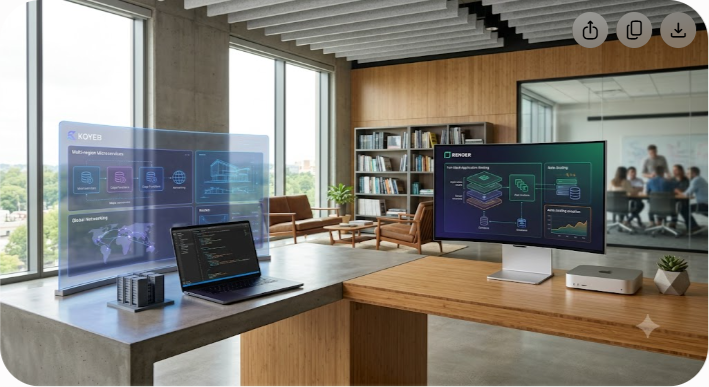
Spin up a separate Web Service in Oregon/Ohio (US) and another in Frankfurt (EU).
Configure external Anycast routing (such as Cloudflare Enterprise or Fastly) to distribute traffic between the two region URLs.
Manage separate database connections or set up external multi-region replication.
Furthermore, Render's private network features do not extend across regions. A worker service in Frankfurt cannot talk to a private service in Oregon over Render's internal network; traffic must traverse the public internet or an external VPN tunnel.
Developer Experience, Build Pipelines, and CLI Workflows
Engineering velocity depends on deployment friction. Both platforms offer Git-backed automation, but their deployment engines operate differently under the hood.
Git and Docker Integration
Koyeb: Supports direct deployment from GitHub and GitLab repositories using buildpack detection (Node.js, Python, Go, Dockerfile, etc.). Additionally, Koyeb allows direct deployment of pre-built Docker containers from any container registry (Docker Hub, GitHub Container Registry, Amazon ECR, Quay).
Render: Supports Git-driven deployments via GitHub and GitLab. Render builds apps using Cloud Native Buildpacks or custom Dockerfiles located in your repository. However, Render does not support deploying arbitrary pre-built Docker images directly from external registries without linking a repository.
Infrastructure as Code (IaC)
Both platforms provide IaC capabilities, but their approaches align with different engineering patterns:
Render Blueprints (render.yaml): Render uses a declarative YAML file stored in your root directory to define services, environment variables, cron jobs, and database instances. It is intuitive for small teams transitioning off Heroku.
Koyeb Terraform & Pulumi Providers: Koyeb offers official Terraform and Pulumi providers alongside a native CLI and YAML workflow. This makes Koyeb easier to integrate into enterprise DevOps pipelines that standardize on Terraform for infrastructure state management.
Managed Services Comparison: Postgres, Caching, and Background Workers
Building a SaaS product requires more than raw compute instances. You need databases, background queues, and caching layers.
Feature / Service Koyeb Render Primary Compute MicroVM Web Services & APIs Web Services, Private Services Virtualization Firecracker MicroVMs Docker / Kubernetes Containers Deployment Sources Git repos & External Docker Registries Git repositories (Buildpacks/Dockerfile) Global Load Balancing Built-in 250+ Edge Locations Static sites only (Requires Cloudflare for APIs) Inter-Service Mesh Cross-region WireGuard Mesh Region-isolated private networks Managed Postgres Serverless Postgres (Neon integration) Native Managed Postgres (PITR, HA) Managed Redis / Key-Value External integration (Upstash, Redis Cloud) Native Managed Key-Value (Redis) Background Workers Supported via Instance scale / Worker services Dedicated Background Worker instances Cron Jobs Native Scheduled Executions Native Cron Job Services GPU Acceleration Nvidia RTX 4000, L4, A100, H100, H200 Not supported on standard plans Bandwidth Overage $0.04 per GB $0.15 per GB Free Egress Allowance 100 GB / month 5 GB to 25 GB / month (Hobby/Pro) Render's Native Ecosystem
Render's major strength is its native ecosystem. You can declare a web app, a managed PostgreSQL database, a Redis instance, and a Celery/BullMQ worker in a single render.yaml file.
Managed Postgres: Render provides dedicated PostgreSQL instances ranging from 256MB RAM up to 32GB RAM. Features include point-in-time recovery (PITR), automated daily backups, and high-availability standby instances.
Managed Key-Value (Redis): Native Redis instances can be provisioned instantly inside your private network, providing low-latency queueing and caching.
Background Workers & Cron Jobs: Dedicated worker instances run continuously without exposing public HTTP endpoints, while cron jobs execute on precise schedules.
Koyeb's Best-of-Breed Integration Strategy
Koyeb focuses heavily on high-performance compute and networking, choosing to partner with database providers rather than building proprietary managed database engines.
Serverless Postgres: Koyeb provides integrated serverless PostgreSQL powered by Neon. This enables instant autoscaling, database branching for feature environments, and scale-to-zero pricing for non-production databases.
Redis & Caching: For Redis, Koyeb recommends pairing services with Upstash or managed Redis providers via private peering or low-latency cloud connections.
Native AI & GPU Workloads: Unlike Render, Koyeb offers native GPU instances (NVIDIA RTX 4000, L4, A100, H100, H200) billed by the second. This allows SaaS applications to run LLM inference, embedding generation, or image processing pipelines directly alongside their API web services.
Cold Starts, Autoscaling, and Performance Benchmarks
For a SaaS application, API responsiveness directly impacts user conversion and SEO performance.
Platform / State Typical Cold Start Range Koyeb MicroVM 0.15s - 0.35s Render Web Service (Active) 0.80s - 1.50s Render Free / Suspended Container 15.0s - 45.0s MicroVM vs Container Autoscaling
Autoscaling behavior differs across both platforms:
Koyeb: Scales instances dynamically based on concurrent requests, CPU utilization, or memory consumption. Because Firecracker microVMs initialize in milliseconds, Koyeb scales up instantly to handle traffic spikes. When traffic drops, instances scale down smoothly, down to zero if configured for serverless workloads.
Render: Autoscaling is available on Pro and Scale workspace plans. Render monitors CPU and memory thresholds, scaling instances horizontally. However, because container initialization requires pulling image layers and initializing Kubernetes pods, scaling events take longer to react to sudden traffic surges.
Detailed Pricing Breakdown & Total Cost of Ownership (TCO)
SaaS founders are often caught off-guard by cloud bill creep. Understanding how Koyeb and Render calculate monthly costs requires breaking down compute, workspace subscriptions, and bandwidth fees.
Workspace & Plan Fees
Render Pricing Structure:
Hobby ($0/mo): 1 user, 5 GB bandwidth, basic services.
Pro ($25/mo flat): Unlimited team members, 25 GB bandwidth, priority build queues.
Scale ($499/mo flat): Unlimited members, 1 TB bandwidth, SOC 2 compliance support, custom roles.
Plus individual per-second charges for every Web Service, Worker, Postgres, and Redis instance.
Koyeb Pricing Structure:
Free Tier ($0/mo): 1 free web service (512MB RAM, 0.1 vCPU), 1 free Postgres DB (5 hours active time), 100 GB free egress.
Pro ($29/mo): Includes $10 compute credit, 10 team members, custom domain management, business-hours support.
Scale ($299/mo): Includes $100 compute credit, 50 team members, 99.9% uptime SLA, Slack channel support.
Compute billed per second based on exact hardware usage.
Compute Instance Cost Comparison
Comparing equivalent instance specifications reveals major price differences at medium-to-large scales.
Spec Level Koyeb Instance Spec & Cost Render Instance Spec & Cost Cost Difference Small / Starter 1 vCPU, 1 GB RAM, 10 GB NVMe ($10.71/mo) 0.5 vCPU, 512 MB RAM ($7.00/mo) Koyeb gives 2x RAM + CPU for +$3.71 Standard Tier 2 vCPU, 2 GB RAM, 20 GB NVMe ($21.42/mo) 1 vCPU, 2 GB RAM ($25.00/mo) Koyeb gives 2x CPU for $3.58 less Medium Tier 4 vCPU, 4 GB RAM, 40 GB NVMe ($42.85/mo) 2 vCPU, 4 GB RAM ($85.00/mo) Koyeb is 49.5% cheaper with 2x CPU Large Production 8 vCPU, 8 GB RAM, 80 GB NVMe ($85.70/mo) 4 vCPU, 8 GB RAM ($175.00/mo) Koyeb is 51% cheaper with 2x CPU Extra Large 8 vCPU, 16 GB RAM, 80 GB NVMe ($85.71/mo) 8 vCPU, 32 GB RAM ($450.00/mo) Render scales exponentially at high tiers Bandwidth and Egress Costs: The Hidden Bill Scaler
For SaaS applications delivering media, raw API payloads, or heavy JSON datasets, outbound bandwidth fees can eclipse compute costs.
Koyeb: Includes 100 GB free egress/month across all plans. Bandwidth beyond 100 GB costs $0.04 per GB.

Render: Includes 25 GB free egress/month on the Pro plan. Bandwidth beyond quota costs $0.15 per GB—nearly 4 times higher than Koyeb.
Cost Scenario: Scaled SaaS App with 5 TB Monthly Egress
Let's model a production SaaS setup consuming 5,000 GB (5 TB) of egress bandwidth per month:
Koyeb Egress Calculation:
Free Allowance: 100 GB
Billable Egress: 4,900 GB x $0.04 = $196.00
Render Egress Calculation:
Free Allowance (Pro Plan): 25 GB
Billable Egress: 4,975 GB x $0.15 = $746.25
Monthly Bandwidth Savings on Koyeb: $550.25 / month ($6,603 / year)
Real-World Case Studies: When Each Platform Wins Scenario A: Early-Stage B2B Micro-SaaS (Winner: Render)
A team of two founders building an AI form builder needs a React dashboard, a Python FastAPI backend, a Celery task queue, and a Postgres database.
Why Render wins here:
Low Setup Overhead: The team can declare all four services in a single render.yaml file within two hours.
Unified Dashboard: Monitoring logs, database backups, and queue worker health happens in one dashboard without configuring external connections.
Predictable Initial Bill: A Starter web app ($7) + Basic Postgres ($6) + Starter worker ($7) costs roughly $20/month total.
Scenario B: Multi-Region SaaS API with High Concurrency (Winner: Koyeb)
A fast-growing analytics SaaS serves client SDKs across North America, Europe, and Asia, processing 15 million daily API calls with strict latency SLAs.
Why Koyeb wins here:
Global Low-Latency Routing: API endpoints deploy simultaneously across Washington, Frankfurt, and Tokyo using Koyeb's multi-region routing.
Sub-Second Scaling: Traffic spikes are absorbed instantly by Firecracker microVMs without request queuing.
Massive Compute & Bandwidth Savings: Running 4 Medium instances (4 vCPU / 4 GB RAM) plus 2 TB of bandwidth costs ~$247/month on Koyeb versus ~$770+/month for an equivalent setup on Render.
Security, Compliance, and Data Sovereignty
Enterprise SaaS buyers inspect security posture during vendor procurement. Here is how Koyeb and Render handle compliance:
Koyeb Compliance & Security
SOC 2 Type II & ISO 27001 Certified: Provides formal security controls for enterprise customer audits.
GDPR & EU Data Sovereignty: Headquartered in France with native European datacenter options, allowing EU SaaS companies to keep customer data strictly within European jurisdictions without transmitting metadata through US hyper-scalers.
MicroVM Kernel Isolation: Hardware-level separation prevents container escape vulnerabilities from affecting co-located tenants on bare metal.
Render Compliance & Security
SOC 2 Type II & ISO 27001 Certified: Standard compliance certifications available across workspace tiers.
HIPAA Compliance: Available on Scale and Enterprise plans with a Signed Business Associate Agreement (BAA). Note that HIPAA compliance incurs a compute surcharge on Render.
GDPR Compliance: Supported, though regional PostgreSQL deployment in Germany requires disabling automatic cloud backups to meet strict local data retention rules.
Common Infrastructure Pitfalls to Avoid on Serverless PaaS
Transitioning your SaaS to a serverless PaaS comes with operational hurdles regardless of which platform you select. Avoid these frequent mistakes:
Ignoring Egress Charges in Financial Models: Compute costs look cheap on pricing tables, but high API response sizes, image delivery, or data exporting can multiply your bill by 4x if you choose a platform with $0.15/GB bandwidth fees.
Hardcoding Single-Region Database URIs: If your API compute is distributed globally on Koyeb but connects to a single primary database in N. Virginia, regional responses will lag due to database network roundtrips. Use read-replicas or serverless database connections close to your compute nodes.
Relying on Local Disk Persistence: Neither Koyeb nor Render microVM/container instances guarantee state persistence across redeployments. Store user uploads in object storage (AWS S3, Cloudflare R2) and session data in Redis.
Failing to Configure Connection Pooling: Serverless autoscaling can quickly spawn dozens of concurrent instance workers, exhausting database connection limits. Always use connection poolers like PgBouncer or Prisma Data Proxy.
Decision Framework: Which Platform Should You Choose?
To make the final decision for your engineering roadmap, review these core scenarios:
Choose Koyeb If:
You require ultra-low latency global routing with native multi-region deployments.
You are running CPU-intensive, high-concurrency, or GPU/AI inference workloads.
You want to deploy pre-built Docker containers directly from Docker Hub, GitHub, or ECR.
You want to minimize egress bandwidth costs at scale.
Your team needs strict EU data residency and bare-metal hardware isolation.
Choose Render If:
You want a Heroku-like developer experience where all web services, background workers, databases, and cron jobs live in one console.
You require native managed PostgreSQL with Point-in-Time Recovery (PITR) out of the box.
You need HIPAA compliance for healthcare SaaS applications.
Your application architecture is single-region and does not require complex edge load balancing.
Maximizing Your SaaS Infrastructure Savings with Saasbonus
Picking the right cloud platform is only the first step in optimizing your SaaS burn rate. At Saasbonus, we help engineering teams and founders unlock exclusive cloud credits, infrastructure discounts, and hands-on software benchmarks.
Whether you are deploying Firecracker microVMs on Koyeb or setting up managed stacks on Render, you can extend your runway by taking advantage of verified startup credit programs. Both Koyeb and Render offer up to tens of thousands of dollars in infrastructure credits for eligible early-stage startups.
Before provisioning your next production deployment, visit Saasbonus to explore active platform deals, detailed software comparisons, and architectural guides designed to help you build faster while keeping your monthly cloud spend in check.