Lago vs Stripe Billing: Best Usage-Based Billing Platform?
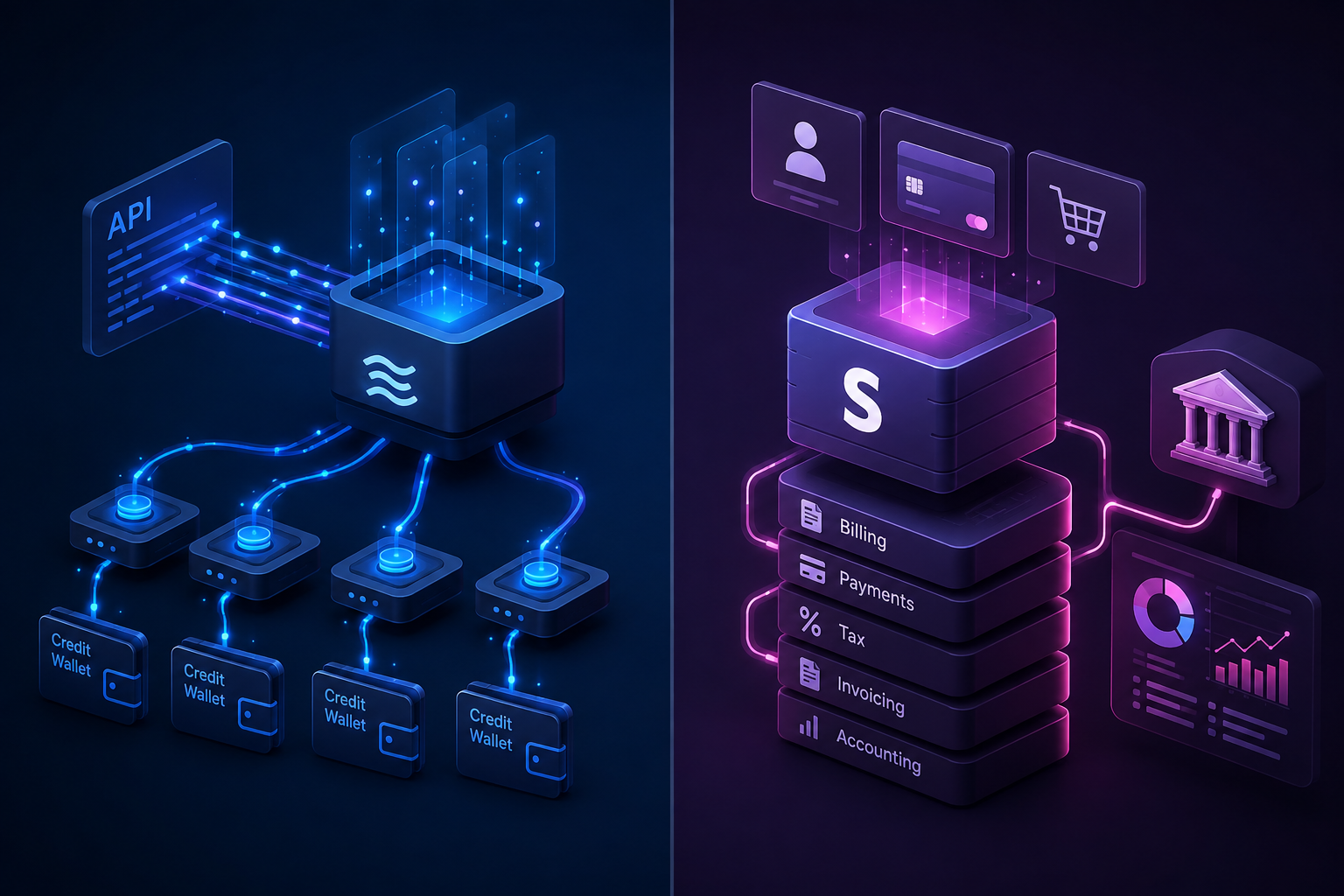
Choosing between Lago and Stripe Billing for usage-based billing comes down to a fundamental architectural decision: do you want an open-source, decoupled metering engine that runs on any payment gateway, or an all-in-one payment and billing platform tightly integrated into Stripe's ecosystem?
If your SaaS relies on high-frequency consumption events like AI token counts, API request volumes, or compute duration, Lago is the better architectural choice. It gives engineering teams raw event ingestion pipelines, flexible aggregation rules, and complete data ownership without locking you into a single payment processor. Conversely, if your product uses standard monthly seats or basic metered tiers, Stripe Billing remains the fastest path to market, offering unified payment processing, automated tax handling, and zero infrastructure maintenance.
Building a usage-based monetization stack is no longer as simple as sending a monthly subscription charge. As SaaS business models shift from flat seats to consumption metrics, the underlying billing architecture must ingest millions of usage events, aggregate them into billable units, enforce prepaid wallet balances, and handle payments across global jurisdictions. Here is an in-depth, hands-on comparison of Lago and Stripe Billing to help engineering and finance leaders select the right platform.
The Fundamental Architectural Difference: Decoupled Engine vs. Unified Ecosystem
To understand why Lago and Stripe Billing feel fundamentally different to build on, you must look at how each platform defines the boundary between billing logic and payment processing.
Stripe Billing treats usage-based billing as a feature set built directly on top of Stripe Payments. In the Stripe model, customer identity, payment methods, invoices, usage records, and bank settlements live inside the same proprietary cloud environment. This tight coupling creates a seamless developer experience if you use Stripe for everything, but it binds your billing logic to a single merchant processor.
Lago operates as a dedicated billing infrastructure layer that sits between your application and your payment service providers. Lago handles event ingestion, metering, pricing rating engines, customer wallets, and invoice generation, but delegates payment execution to third-party gateways like Stripe, Adyen, GoCardless, or Moov. This separation ensures that changing payment processors or splitting transactions across regional gateways never requires rebuilding your billing engine or altering customer usage history.
Open-Source Self-Hosting vs. Proprietary Cloud SaaS
Lago's core architecture is open-source under the AGPLv3 license, allowing engineering teams to run the entire billing stack on their own cloud infrastructure, Kubernetes clusters, or isolated virtual private clouds. For B2B SaaS companies serving enterprise, government, or healthcare clients, self-hosting solves severe data residency and compliance bottlenecks. Usage metrics containing sensitive operational data never leave your controlled environment.
Stripe Billing is exclusively a closed-source cloud SaaS. You cannot self-host Stripe Billing, inspect its underlying database queries, or modify its rating engine. Every API call, usage record submission, and invoice state change depends on Stripe's availability and platform terms.
How Usage Metering and Event Aggregation Compare
In consumption-based pricing, the metering engine is the core database of record. It must accept raw usage events from your application backend, filter or transform them according to your business logic, and compute billable totals accurately.
Lago: Event-Driven, High-Volume Ingestion
Lago was designed specifically for high-cardinality, high-frequency event ingestion. It provides dedicated ingestion endpoints capable of receiving millions of usage events per minute via REST APIs, SDKs, or streaming pipelines like Kafka, Redpanda, AWS Kinesis, and S3 batch loads.
Every event ingested by Lago contains a unique transaction identifier, a timestamp, a customer external ID, and a JSON payload of arbitrary attributes (such as model_name, token_type, region, or execution_time_ms). Lago processes these events against configurable billable metrics using multiple aggregation strategies:
- Sum: Totals an attribute value over the billing cycle (such as total gigabytes processed).
- Max / High-Water Mark: Tracks the peak usage value reached during a period (such as maximum active concurrent connections).
- Count: Increments a counter for every logged event (such as total API calls made).
- Unique Count: Counts distinct attribute values within a period (such as unique active user IDs logged during the month).
- Weighted Average: Aggregates metrics weighted by time duration (such as provisioned memory allocated per hour).
- Progressive and Custom SQL Aggregations: Allows advanced rating calculations where rate limits or pricing tiers trigger based on historical usage curves.
Because Lago maintains an independent time-series store for raw events, you can recalculate past usage, backfill missing events, or preview pricing model changes across historical data without corrupting finalized invoices.
Stripe Billing: Subscription-First with Metering Add-Ons
Stripe Billing historically approached consumption pricing through subscription meter items. You create a meter in Stripe, assign an aggregation rule (such as sum, count, max, or last value during period), and report usage events through the Stripe Events API or Meter Events API.
While Stripe Billing handles standard metered subscriptions effectively, high-cardinality or dimensional usage pricing presents architectural hurdles. If you charge different rates based on nested event attributes (for example, charging $0.002 per input token for LLM Model A and $0.015 per output token for LLM Model B), creating separate subscription items or meters in Stripe quickly becomes unwieldy.
To address this gap for complex enterprise consumption models, Stripe acquired Metronome. Stripe now frequently routes high-volume enterprise usage routing and dimensional contract management toward Metronome integration patterns. For teams evaluating pure Stripe Billing today, complex dimensional aggregation requires writing custom pre-aggregation worker nodes in your own infrastructure before sending distilled numbers to Stripe's meter endpoints.

Pricing Mechanics and Contract Customization
B2B SaaS pricing rarely stays simple. As deals scale, enterprise sales teams demand hybrid pricing models, prepaid commitments, minimum spend thresholds, custom overage rates, and multi-currency wallets.
Prepaid Credits and Digital Wallets
Prepaid credit models are essential for AI and infrastructure platforms because they eliminate bad debt risk by collecting cash upfront. Customers purchase a block of credits (for example, $5,000 for 5,000,000 credit units) and consume them as they run workloads.
Lago includes native support for prepaid credits and customer wallet balances. It manages automatic credit drawdowns, auto-recharge triggers (buying $1,000 more when the wallet drops below $100), multi-currency credit conversions, and credit expiration schedules. When a customer's wallet empties, Lago emits real-time webhooks, allowing your application to gracefully throttle service or notify the account owner.
Stripe Billing supports customer balance adjustments and credit notes, but native prepaid consumption drawdowns with automated auto-top-up workflows require custom code or additional modules like Stripe Customer Balance and custom Webhook listeners.
Flexible Billing Models Matrix
Both platforms support standard subscription pricing, but their capabilities diverge as billing logic grows more complex.
- Fixed Monthly/Annual Subscriptions: Supported natively on both Lago and Stripe Billing.
- Per-Unit Usage (Flat Rate per Unit): Supported natively on both platforms.
- Graduated and Volume Tiering: Supported natively on both platforms.
- Package Pricing (e.g., $50 per 10,000 API calls): Native on Lago; supported on Stripe via usage pricing tiers.
- Dimensional Multi-Attribute Pricing: Native on Lago via custom event payloads; limited on base Stripe Billing without custom pre-processing or Metronome.
- Prepaid Wallet Drawdowns: Native feature in Lago; requires custom engineering or external add-ons on Stripe Billing.
- Minimum Commitments and True-Ups: Built-in workflow in Lago; requires manual invoice adjustments or custom logic on Stripe Billing.
- Multi-Gateway Routing: Fully supported on Lago; not supported on Stripe Billing (strictly locked to Stripe Payments).
Detailed Comparison Matrix: Lago vs Stripe Billing
| Feature / Metric | Lago (Open Source / Cloud) | Stripe Billing |
|---|---|---|
| Architectural Model | Decoupled Billing Infrastructure | Unified Payment & Billing SaaS |
| Codebase Transparency | Open-source core (AGPLv3) | Proprietary closed-source |
| Deployment Options | Self-hosted (Docker/K8s) or Lago Cloud | Cloud SaaS only |
| Payment Gateway Support | Multi-gateway (Stripe, Adyen, GoCardless, etc.) | Locked exclusively to Stripe Payments |
| Event Ingestion Throughput | High-throughput streaming (Kafka/Kinesis integration) | Standard API rate limits; pre-aggregation required |
| Metering Aggregation | Sum, Count, Max, Unique, Weighted, Progressive | Sum, Count, Max, Last (Base Billing) |
| Multi-Attribute Pricing | Native JSON payload filtering & rating | Requires pre-calculated metrics before API submission |
| Prepaid Wallets & Credits | Native wallet engine with auto-refill hooks | Customer balance tracking; manual/custom workflows |
| Tax Calculation Engine | Integrated with TaxJar, Anrok, Vertex | Integrated natively with Stripe Tax |
| Revenue Recognition | Exportable raw billing logs; accounting sync | Native integration with Stripe Revenue Recognition |
| Data Ownership & Residency | Complete control on self-hosted instances | Data stored on Stripe cloud infrastructure |
| Setup Speed for Simple Products | 1 to 2 days (requires developer setup) | Hours (no-code portal and simple SDKs) |
Developer Experience, API Design, and Infrastructure Ownership
For engineering teams, the decision between Lago and Stripe Billing alters the daily codebase maintenance burden and system architecture.
Stripe Billing: Fast Integration Standard
Stripe's developer documentation, client libraries, and testing environments remain a high benchmark for developer tools. If your team needs to implement basic credit card checkout, recurring subscription tiers, and simple seat management, Stripe allows you to ship in a single afternoon using pre-built UI components like Stripe Checkout and the customer portal.
Stripe manages infrastructure scaling, database indexing, PCI compliance, and webhooks delivery automatically. You never need to monitor database performance, manage Redis queues for billing workers, or worry about billing pipeline uptime.
Lago: Developer Freedom with Operational Responsibility
Lago provides modern REST APIs, GraphQL interfaces, and SDKs in TypeScript, Python, Ruby, Go, and Java. Its UI is clean, intuitive, and designed for both developers and finance teams to configure plans, inspect billable metrics, and monitor usage logs.
However, choosing Lago's open-source, self-hosted edition means your engineering team assumes operational ownership of the billing stack. You are responsible for:
- Provisioning and scaling PostgreSQL database clusters for persistent billing records.
- Maintaining Redis instances for real-time caching and job queues.
- Monitoring message queues (Kafka, Redpanda, or RabbitMQ) to ensure usage events are never dropped during traffic surges.
- Managing system updates, security patches, and database migrations.
If your engineering team lacks dedicated DevOps bandwidth or prefers managed infrastructure, Lago Cloud offers a fully managed SaaS alternative that eliminates self-hosting overhead while retaining multi-gateway independence and open-source API compatibility.
Payment Gateway Independence vs. Ecosystem Convenience
One of the most consequential strategic factors in this comparison is payment processor lock-in.
Why Decoupling Matters for Scale
When a SaaS company grows significantly in Annual Recurring Revenue, relying on a single payment processor introduces structural liabilities:
- Processing Fee Margins: Standard payment processing fees (typically 2.9% + $0.30 per transaction) become a massive line item. Having the ability to route high-value enterprise invoice payments through ACH, SEPA, or lower-cost regional processors like Adyen or local merchant acquirers can save tens of thousands of dollars annually.
- Geographic Expansion: Merchant acceptance rates vary significantly across regions. Operating in Europe, Latin America, or Asia-Pacific often requires local acquiring banks or specialized payment methods (such as iDEAL, Pix, or local direct debit) that perform poorly when forced through a single international gateway.
- Account Risk and Redundancy: If a single processor flags your account, freezes funds, or experiences an outage, your entire business revenue stream halts. A decoupled billing engine like Lago allows you to implement failover gateways or split payment volumes without redesigning customer subscriptions.
The Advantage of Stripe's Integrated Ecosystem
While Stripe locks you into its processing rails, it repays you with unrivaled ecosystem convenience. Building on Stripe Billing gives you immediate access to:
- Stripe Tax: Automatically calculates, collects, and reports sales tax, VAT, and GST across dozens of countries without third-party integrations.
- Stripe Radar: Machine-learning-powered fraud prevention built directly into the payment flow.
- Stripe Billing Radar & Smart Retries: Automated machine learning models that retry failed recurring credit card payments at optimal times, recovering delinquent revenue.
- Stripe Revenue Recognition: Automated accounting compliance that matches deferred revenue with delivered service cycles without manual spreadsheet reconciliations.
With Lago, achieving this level of automation requires connecting third-party tools (such as Anrok or TaxJar for tax, and specialized revenue recognition software for accounting).

Total Cost of Ownership (TCO) and Pricing Mechanics at Scale
When evaluating software platforms, you must look beyond initial monthly software pricing and calculate total cost of ownership across engineering, processing fees, and usage volume fees.
Stripe Billing Pricing Structure
Stripe Billing charges a percentage-based fee on top of standard payment processing charges:
- Base Billing Fee: Typically 0.5% to 0.8% of billed volume for recurring and metered invoices.
- Payment Processing Fees: Standard 2.9% + $0.30 per card transaction (with lower rates for ACH/wire transfers and volume enterprise discounts).
- Add-On Costs: Stripe Tax adds an additional fee per transaction, Radar costs extra per charge, and Revenue Recognition adds an additional basis-point fee on tracked revenue.
At low billing volumes, percentage-based pricing is cost-effective because you pay nothing when you have no revenue. However, as your SaaS reaches high billing volumes, paying 0.7% purely for billing software orchestration (excluding payment processing fees) translates to tens of thousands of dollars annually just for the billing layer.
Lago Pricing Structure
Lago separates software license costs from payment processing fees completely:
- Open-Source Self-Hosted (AGPLv3): Free software license. Your cost is limited to raw infrastructure cloud computing expenses (AWS/GCP servers, PostgreSQL, Redis) and the internal engineering time required to maintain the deployment.
- Lago Cloud (Starter / Scale / Enterprise): Transparent tier-based pricing or custom enterprise plans based on tracked usage events and feature modules rather than taking an uncapped percentage cut of total revenue.
- Payment Processing Fees: Negotiated directly with your payment processors (Stripe, Adyen, Moov). Because Lago does not markup processing, you retain full leverage to negotiate lower merchant fees as volume scales.
For high-revenue, high-transaction-volume SaaS companies, running Lago on self-hosted infrastructure or Lago Cloud frequently yields a dramatic total cost reduction compared to paying stacked percentage-based fees across payment processors.
Common Architectural Mistakes to Avoid in Usage-Based Billing
Implementing usage-based billing introduces technical edge cases that flat subscription setups never encounter. Avoid these frequent engineering and operational traps:
1. Tight Coupling of Billing Code to Core Application Business Logic
Writing billing check conditions directly inside core application services (for example, inserting check statements inside an API route) creates technical debt that makes changing billing logic nearly impossible.
Solution: Use an entitlements and metering abstraction layer. Your application code should only report raw events to an ingestion endpoint and check entitlement flags. Let your billing engine handle rating, threshold checks, and usage limits in the background.
2. Dropping Ingestion Events During Traffic Spikes
Sending HTTP API calls to your billing engine synchronously during critical application request paths introduces latency and risk. If the billing engine experiences a delay, your core application slows down or crashes.
Solution: Decouple event tracking from billing execution. Implement an asynchronous queue using Kafka, RabbitMQ, or AWS SQS. Buffer usage events in your infrastructure and batch-transmit them to your billing engine asynchronously.
3. Ignoring Backfilling and Historical Rating Adjustments
Buggy client code might accidentally send duplicated usage events or misreport metrics for three days before engineering notices. If your billing platform cannot backfill or re-rate historical events safely, correcting customer invoices becomes a manual effort.
Solution: Ensure your metering stack supports event deduplication keys (idempotency keys) and raw event re-indexing. Lago's architecture retains event logs, making it straightforward to recompute periods without manually recalculating balances.
4. Overcomplicating Pricing Tiers Before Reaching Product-Market Fit
Designing a multi-tiered, dimensional usage model with eight variables before validating customer willingness to pay creates unnecessary system complexity.
Solution: Start with simple usage metrics (such as total compute hours or flat API request blocks). Use a flexible billing engine that allows modifying rating rules in the dashboard without rewriting application tracking code when pricing strategy changes.
Practical Decision Framework: Which Platform Should You Choose?
To make an immediate decision, evaluate your engineering priorities, billing complexity, and growth stage against these core criteria.
Choose Lago If:
- You rely heavily on usage-based, consumption, or hybrid pricing models with high event cardinality (such as AI tokens, GPU compute seconds, or high-frequency API calls).
- You need to support prepaid credits, auto-recharging digital wallets, and custom minimum commitments out of the box.
- You require open-source self-hosting for strict data privacy, SOC 2, HIPAA, or regional data sovereignty compliance.
- You want to avoid payment gateway lock-in, enabling multi-gateway processing across Stripe, Adyen, and regional processors to reduce payment fees.
- You want predictable infrastructure costs that do not scale as an uncapped percentage tax on your gross revenue.
Choose Stripe Billing If:
- Your SaaS model relies primarily on standard monthly or annual recurring seat subscriptions, with occasional basic metered overages.
- You want a complete, zero-maintenance, all-in-one stack that handles payments, billing, automated global tax compliance (Stripe Tax), and fraud prevention (Radar) in one dashboard.
- You need to launch quickly with minimal developer resources using pre-built checkout portals and hosted invoice links.
- Your processing volume is early-stage to mid-stage, where convenience and rapid time-to-market outweigh long-term percentage fee optimization.
- You do not require self-hosting or data sovereignty compliance beyond standard SaaS cloud security standards.
Final Verdict and Summary
Both Lago and Stripe Billing are top-tier platforms, but they serve different developer philosophies and business requirements. Stripe Billing is the market leader for integrated, convenience-first subscription management. It minimizes operational overhead and lets software teams monetize products within hours, provided you stay within Stripe's payment ecosystem.
Lago is the modern standard for engineering-led teams building sophisticated consumption pricing models. By decoupling billing logic from payment processing and providing open-source transparency, Lago gives SaaS platforms the freedom to aggregate high-volume usage events, offer native prepaid credit systems, and optimize payment routing as revenue scales.
At Saasbonus, we recommend auditing your engineering roadmap before locking in a billing engine. If usage metering sits at the heart of your product experience, investing in a dedicated, decoupled metering engine like Lago will give your product, engineering, and finance teams the flexibility required to evolve pricing without friction.