LaunchDarkly vs GrowthBook: Feature Flags for SaaS Teams
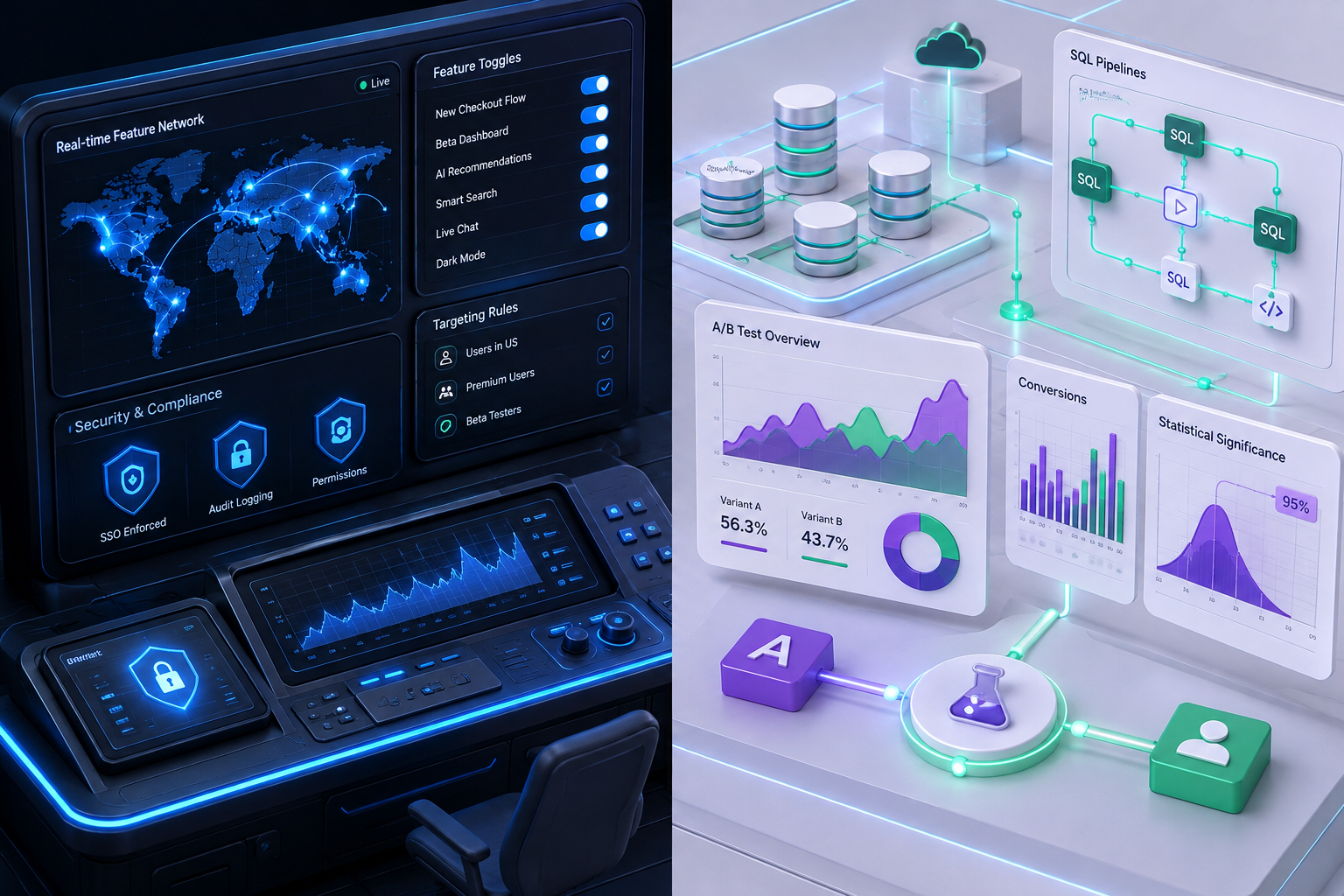
Choosing between LaunchDarkly and GrowthBook comes down to a fundamental architectural decision: do you want an enterprise-grade managed platform focused on governance and stream-based release safety, or an open-source, warehouse-native platform designed for cost-controlled experimentation?
If your engineering organization has hundreds of developers, complex compliance requirements, and needs real-time streaming feature toggles out of the box, LaunchDarkly remains the market benchmark. However, if your team wants to avoid scaling bills tied to Monthly Active Users (MAUs), prefers self-hosting data, or wants to run deep statistical experimentation directly against your existing data warehouse (like Snowflake, BigQuery, or Databricks), GrowthBook presents a compelling, developer-friendly alternative.
In this guide, we break down how these two platforms compare across architecture, developer experience, statistical experimentation, security compliance, and total cost of ownership.
Core Architecture: How Flags Get Evaluated
At the heart of any feature flagging system is the flag evaluation engine. How a platform evaluates rules determines latency, bandwidth usage, and reliability when third-party services experience downtime.
LaunchDarkly: Streaming and the Relay Proxy
LaunchDarkly relies primarily on Server-Sent Events (SSE) to push configuration updates down to connected client and server SDKs in near real time. When an engineer flips a switch in the LaunchDarkly dashboard, that event broadcasts through a persistent socket connection to all active SDK instances within milliseconds.
- Client-side evaluation: Client SDKs receive targeted state payloads or connect directly to stream endpoints. To protect privacy, client SDKs only evaluate rules relevant to the current session or user context.
- Server-side evaluation: Server SDKs download the full ruleset once upon initialization, store it in memory, and evaluate requests locally in microsecond speeds. Updates are continuously streamed in the background.
- Enterprise Scale: For high-throughput backends processing tens of thousands of requests per second, LaunchDarkly offers an architectural component called the Relay Proxy. The proxy sits between your infrastructure and LaunchDarkly's cloud, caching configuration rules and maintaining the streaming connection to reduce outbound WAN traffic.
GrowthBook: Local Evaluation and Edge Caching
GrowthBook approaches flag distribution through a decentralized, payload-first architecture. Rather than establishing persistent streaming sockets across every server instance, GrowthBook publishes encrypted, lightweight JSON configuration blobs to high-speed CDNs (such as Cloudflare or Fastly).
- Zero Network Latency: Both client and server SDKs pull down the payload and evaluate rules entirely locally using fast in-memory engines. Because evaluation requires zero outbound network calls, an outage in GrowthBook's central service does not affect application runtime or feature resolution.
- Self-Hosting Options: GrowthBook provides an open-source core that can be run on Docker or Kubernetes inside your own Virtual Private Cloud (VPC). You retain full control over encryption keys, network boundaries, and user identifier exposure.
Developer Experience and Flag Management Workflows

As software engineering teams scale, the burden of managing feature toggles shifts from initial setup to long-term lifecycle control. Unused flags become technical debt, and poorly targeted rollouts can introduce production regressions.
Rollout Safeguards and Targeting Engine
LaunchDarkly provides an extensive context-targeting framework. You can construct complex logical rules combining nested attributes, user segments, device parameters, and custom fields.
- Workflows and Scheduling: LaunchDarkly supports scheduled rollouts, multi-stage approval workflows, and automated rollbacks tied to observability integrations (e.g., Datadog, Dynatrace, or New Relic). If an operational metric breaches a threshold during a rollout, LaunchDarkly can toggle the flag off automatically.
- Code References: To prevent stale flags from littering your codebase, LaunchDarkly's command-line tool scans your code repositories during CI/CD pipelines, highlighting exact line numbers where flags are declared and flagging unused toggles for deprecation.
GrowthBook offers a clean, modern developer interface with strong focus on simplicity and local debugging.
- Rule Tracing and Debugging: GrowthBook includes built-in Chrome DevTools extensions and visual rule trace diagnostics. Engineers can inspect why a specific user received a particular flag variant, step-by-step through targeting conditions.
- Schema Validation: Remote configurations accept JSON payloads validated against custom JSON Schemas. This guarantees that dynamic payload changes pushed by product managers won't crash backend service parsers.
- AI CLI Integrations: GrowthBook includes integrations for AI-assisted workflows and Model Context Protocol (MCP) servers, enabling developer tooling to query flag states and assist with code cleanups directly inside code editors.
A/B Testing and Experimentation: Native vs Warehouse-Native
Feature flagging naturally leads to product experimentation. Once you can toggle code paths for specific user segments, running A/B tests is a logical next step. However, the two platforms handle event tracking and analytics through fundamentally different paradigms.
LaunchDarkly: Native Event Ingestion
LaunchDarkly approaches experimentation as an integrated extension of feature delivery.
- You define custom conversion metrics directly within LaunchDarkly.
- SDKs send tracking events directly to LaunchDarkly's analytics pipeline.
- LaunchDarkly processes the incoming event stream and computes statistical significance, exposure metrics, and variant confidence intervals.
While this turnkey model requires minimal initial setup, it can lead to fragmented data. Your raw user interaction data lives inside LaunchDarkly's proprietary store rather than alongside your primary business intelligence (BI) data. Additionally, running high-volume experiments can increase data ingestion fees.
GrowthBook: Warehouse-Native Analytics
GrowthBook pioneered the warehouse-native approach to experimentation. Instead of capturing and storing event streams in an isolated third-party database, GrowthBook connects directly to your existing data warehouse.
- Direct Querying: GrowthBook writes SQL directly against Snowflake, Amazon Redshift, Google BigQuery, ClickHouse, or Postgres.
- Single Source of Truth: You run experiments using the exact revenue, retention, and conversion metrics already modeled by your data engineering team. There is no need to re-implement event tracking code in client SDKs.
- Advanced Statistics: GrowthBook supports both Bayesian and Frequentist engines, along with variance reduction techniques like CUPED (Controlled-experiment Using Pre-Experiment Data) and post-stratification. This allows product teams to achieve statistical significance up to 50% faster without increasing sample sizes.
| Feature Dimension | LaunchDarkly | GrowthBook |
|---|---|---|
| Core Focus | Enterprise Release Control & Governance | Feature Management & Warehouse Experimentation |
| Deployment Model | Managed Cloud (Proxy available) | Cloud SaaS or Self-Hosted Open Source |
| Evaluation Method | Real-time Streaming (SSE) & Local SDKs | Payload-based Local Evaluation (CDN/Edge) |
| Data Architecture | Proprietary Analytics Pipeline | Warehouse-Native (Snowflake, BigQuery, Redshift) |
| A/B Testing Engine | Add-on module, native event ingestion | Built-in, CUPED variance reduction, custom SQL |
| Security & Auditing | SOC 2 Type II, FedRAMP, Fine-grained RBAC | SOC 2 Type II, Self-hosted full data control |
| Primary Cost Driver | Seats + Monthly Active Users (MAUs) / Contexts | Seats (Cloud) or Free Self-Hosted Core |

Pricing and Total Cost of Ownership (TCO)
Pricing structure often becomes the deciding factor when choosing between these platforms as a SaaS engineering organization grows.
LaunchDarkly's Value and Usage Pricing
LaunchDarkly uses a tiered plan model that scales based on user seats and Monthly Active Contexts (MACs). While the platform offers starter tiers for small teams, enterprise pricing scales with application volume.
- Predictable Release Governance: For large enterprise teams, LaunchDarkly reduces engineering overhead by eliminating the need to build and maintain internal flag dashboards, audit logs, and permission controls.
- Scale Considerations: If you build consumer-facing applications or high-volume mobile apps where millions of users trigger flag evaluations monthly, MAC overage costs require active capacity planning.
GrowthBook's Open-Source and Seat-Based Model
GrowthBook decouples platform usage from event volume and end-user counts.
- Self-Hosted Community Edition: Completely free to run on your own infrastructure with unlimited users, flags, and experiments.
- GrowthBook Cloud: Features a generous free tier for small teams, moving to a flat per-seat monthly model on commercial plans. Because you aren't charged per end-user evaluation or bandwidth volume, costs remain predictable even during massive traffic spikes.
Real-World SaaS Use Cases: Which Should You Choose?
Choose LaunchDarkly If:
- You need top-tier release governance: Your organization operates in regulated industries (fintech, healthcare, enterprise B2B) where granular Role-Based Access Control (RBAC), multi-step approvals, and strict audit logging are mandatory.
- Instant sub-second propagation is critical: You run distributed global systems that require flag state changes to propagate worldwide within milliseconds via active socket streaming.
- You want a fully managed ecosystem: Your engineering team wants a complete turn-key solution with minimal infrastructure management or statistical pipeline configuration.
Choose GrowthBook If:
- You want warehouse-native experimentation: Your product and data teams want to run A/B tests directly against your central data warehouse without duplicating event tracking.
- You require full data sovereignty: Compliance policies prevent user identifiers or behavioral attributes from leaving your cloud VPC environment.
- You want predictable pricing at scale: You have a massive consumer audience and want to avoid paying usage fees tied to monthly active contexts.
How to Transition Between Feature Flag Platforms
If you decide to migrate from one tool to another, follow this structured deployment path to minimize downtime and prevent release regressions.
- Implement an Abstraction Layer: Wrap vendor SDK calls inside an internal interface (e.g., FeatureFlagService.isEnabled('my-flag')). This decouples your core application logic from vendor-specific code.
- Audit and Prune Existing Flags: Review active flag inventories. Archive stale boolean toggles and permanent configuration flags that no longer require dynamic switching.
- Dual-Write Configuration States: Mirror targeting rules in both platform dashboards before switching client runtime evaluation engines.
- Shift Evaluation Traffic Gradually: Use environment variables or local overrides to route evaluation calls from your legacy provider to the new platform across staging, canary environments, and finally production.
Evaluating infrastructure tools for modern software development requires balancing operational security, statistical rigor, and developer velocity. Choosing the right tool early prevents costly refactoring as your team grows.
At Saasbonus, we track, review, and benchmark software engineering infrastructure to help technical leaders make informed stack decisions. Browse our in-depth developer tool evaluations and architectural breakdowns to find the right software for your team the first time.