Mem0 vs Zep: Best Memory Layer for AI Agents? (2026)
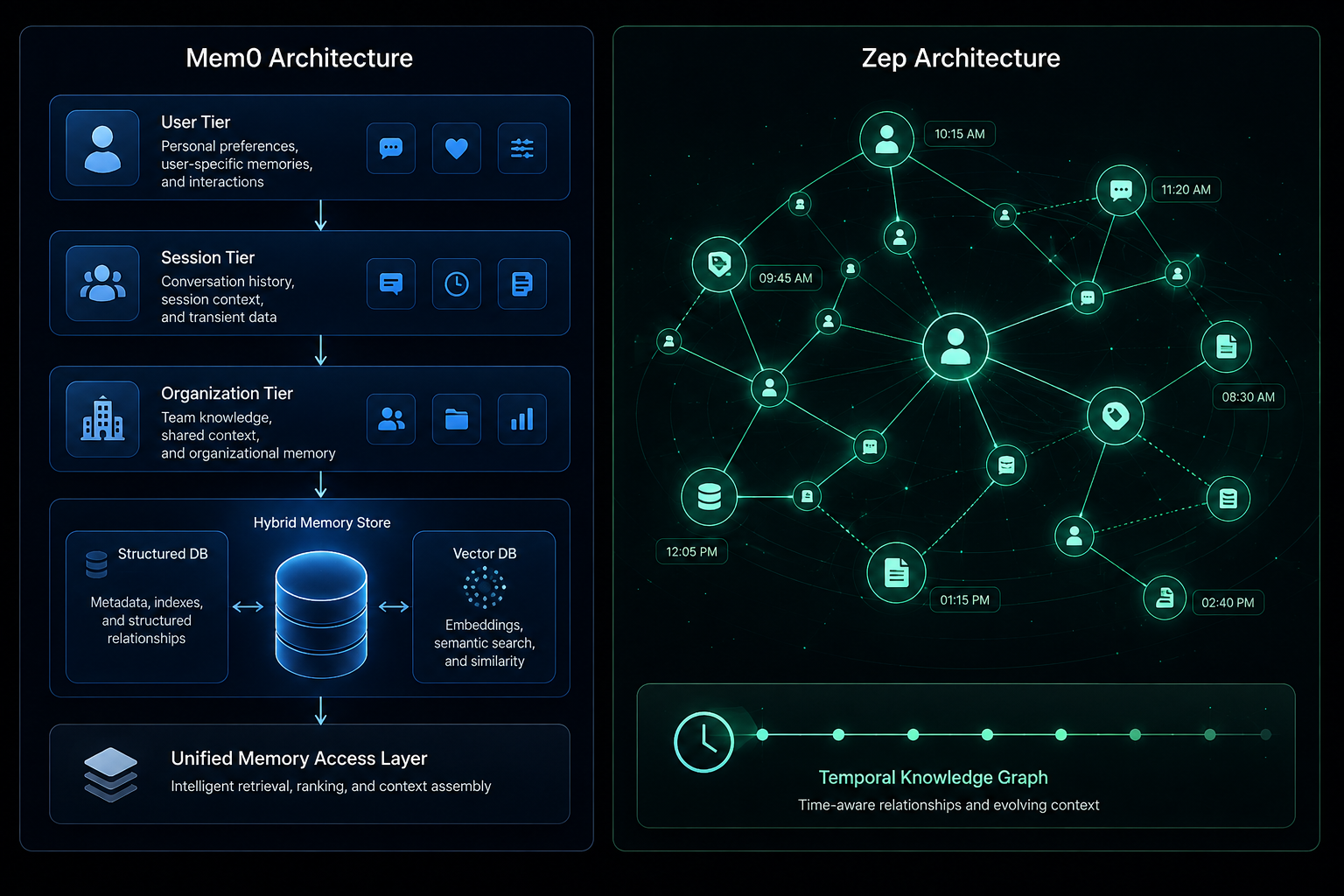
Choosing the right memory layer for production AI agents comes down to a fundamental architectural trade-off: do you need multi-layered scope isolation for multi-tenant apps, or strict bitemporal graph reasoning for evolving state?
If your AI agent forgets user preferences after three turns, it irritates your users. If it hallucinates old facts because it cannot tell whether a user changed their email address yesterday or three months ago, it breaks your business logic.
As LLMs transition from single-turn chat interfaces to autonomous, multi-session agents, maintaining state without exploding context windows or token budgets has become a primary engineering hurdle. Simple vector similarity searches and raw message buffers no longer scale. Developers are turning to dedicated memory engines like Mem0 and Zep.
While Mem0 excels at broad framework compatibility, rapid setup, and multi-layered scope filtering (user, session, organization), Zep wins when handling time-sensitive knowledge updates via its native bitemporal context graph engine (Graphiti).
This guide breaks down their architectures, benchmark scores, latency overhead, deployment models, and costs so you can select the right infrastructure for your application.
Why Standard RAG and Chat Buffers Fail AI Agents
To understand why Mem0 and Zep exist, you must first recognize the structural failure modes of legacy memory implementations.
The Limits of Vector RAG for State
Traditional Retrieval-Augmented Generation (RAG) chunking treats texts as static documents. When an agent queries a standard vector database, it retrieves text chunks based on semantic similarity rather than temporal relevance. If a user says 'I moved from New York to Austin in March,' and later asks 'Where do I live?', a naive vector search brings back both cities with nearly identical similarity scores. The underlying LLM is left to guess which fact supercedes the other.
The Context Window Tax
Sliding chat windows and raw conversation histories waste tokens. Appending full chat histories to every turn increases costs exponentially as session length grows. Furthermore, LLMs suffer from the 'lost-in-the-middle' phenomenon, where critical instructions tucked into massive prompt buffers are overlooked by the model's attention mechanism.
A dedicated memory layer acts as a stateful filter between raw user logs and model context windows. It extracts key entities, updates dynamic profiles, prunes expired state, and injects only the most relevant, deduplicated memory payload per execution turn.
Mem0 Overview: Layered Scopes and Rapid Framework Integration
Mem0 positions itself as a universal personalization engine for AI applications. Built to be developer-friendly and lightweight, Mem0 organizes context into hierarchical layers that match how real-world applications organize data access control.
Instead of storing raw chat streams, Mem0 processes user inputs through three sequential phases:
- Entity and Fact Extraction: Incoming messages are parsed by lightweight LLM calls to identify core facts, entities, and user preferences.
- Hybrid State Persistence: Extracted details are updated inside a unified data layer combining key-value caching, vector embeddings, and graph connections.
- Multi-Scope Scaffolding: Memories are tagged and segregated across four explicit scopes (`user_id`, `session_id`, `agent_id`, and `app_id`).
Architectural Breakdown
- Multi-Scope Hierarchy: Mem0 explicitly segments memories into distinct operational scopes. This hierarchical structuring ensures isolated memory boundaries across tenants and execution sessions.
- Hybrid Storage Layer: Beneath its API, Mem0 utilizes a persistence layer combining key-value caching, vector stores (such as Qdrant, Pgvector, or Redis), and graph databases (such as Neo4j).
- LLM-Based Fact Extraction: When a new interaction is sent to Mem0 via its `add()` method, an internal parsing engine uses targeted LLM prompts to isolate facts and update existing records rather than duplicating them.
Primary Strengths of Mem0
- Ecosystem Penetration: Mem0 provides native integrations across major orchestration frameworks, including CrewAI, LangChain, LlamaIndex, AutoGen, and Flowise.
- Flexible Licensing: Mem0's core SDK is available under the permissive Apache 2.0 license, making it fully self-hostable without hidden enterprise paywalls.
- Low Integration Friction: A minimal code footprint allows developers to drop long-term memory into existing LLM pipelines within minutes using straightforward SDK methods.

Zep Overview: Bitemporal Context Graphs for Enterprise Agents
Zep approaches agent memory through context engineering, viewing conversation history as an evolving network of facts bound by temporal mechanics. Its core architecture relies on Graphiti, an open-source framework for building temporal knowledge graphs.
Zep converts unstructured chat logs into an active temporal graph through the following workflow:
- Fact Extraction and Provenance: Raw text is parsed for entities, relations, and source context to build an immutable lineage trail.
- Bitemporal Ingestion: Facts are recorded with dual timestamps: valid time (when the event happened in reality) and transaction time (when the system recorded it).
- Automated Edge Invalidation: When new information contradicts existing nodes, older graph edges are marked as invalid rather than deleted, keeping history intact while returning only current facts.
Architectural Breakdown
- Bitemporal Knowledge Graph: Unlike standard graphs that track only static nodes and edges, Zep records both valid time and transaction time. Every edge carries explicit `valid_from`, `valid_to`, and `invalid_at` timestamps.
- Automatic Fact Edge Invalidation: When Zep processes a statement that contradicts an earlier record (for example, 'I switched my stack from Postgres to ClickHouse'), it does not overwrite or delete the older record. Instead, it marks the historic edge as invalidated, keeping provenance intact while serving only active facts by default.
- Sub-200ms Context Assembly: Zep automates context construction, entity extraction, summarization, and hybrid search into a single API call optimized for p95 retrieval latencies under 200 milliseconds.
Primary Strengths of Zep
- Temporal Reasoning: Handles state changes, historical time-series queries (such as 'What was the customer's budget in Q2?'), and conflicting updates seamlessly.
- Context Lake Architecture: Acts as an enterprise-grade Context Lake that governs, audits, and ingests heterogeneous enterprise data streams.
- Enterprise Security: Incorporates native Attribute-Based Access Control (ABAC), role permissions, data retention policies, and SOC 2 Type II compliance.
Deep Dive Comparison: Mem0 vs Zep
| Feature / Dimension | Mem0 | Zep |
|---|---|---|
| Core Paradigm | Multi-scope hybrid store (Vector + KV + Graph) | Bitemporal context graph (Graphiti Engine) |
| Time Awareness | Metadata-based timestamps | Structural native time (validity windows & invalidation) |
| Open Source Model | Apache 2.0 (SDK & local graph support) | Graphiti engine open-source; Context Lake hosted/enterprise |
| Primary Retrieval Mechanism | Semantic hybrid search + scope filters | Multi-hop graph retrieval + temporal graph search |
| Orchestration Integrations | CrewAI, AutoGen, LangChain, LlamaIndex, AWS Strands | LangChain, LlamaIndex, SDKs for Python & TypeScript |
| Setup Complexity | Very Low (pip install & minimal API) | Moderate (requires graph store setup like Neo4j/Kuzu for self-hosting) |
| LongMemEval Accuracy | ~49% | ~71.2% |
| Best For | Multi-tenant apps, rapid prototyping, cross-agent user memory | Complex state updates, audit trails, enterprise customer support |
Benchmarks & Accuracy: The LongMemEval Gap
Evaluating memory layers requires testing beyond standard semantic similarity scores. Industry benchmarks like LongMemEval measure an engine's performance across long conversational threads, focusing specifically on:
- Information Extraction: Retrieving facts buried within deep chat logs.
- Knowledge Updates: Identifying superseded facts when a user modifies preferences or information over time.
- Temporal Order: Answering questions regarding the order in which past events took place.
In published LongMemEval evaluations, Zep achieves a score of 71.2%, compared to Mem0's 49%.
Why the Performance Gap Exists
The score divergence stems directly from their structural handling of temporal data:
Mem0 handles updates by appending timestamps as metadata alongside vector embeddings. When queried, the retriever pulls semantically relevant items and relies on prompt instructions or secondary scoring passes to resolve temporal conflicts. When dealing with multiple contradictory state changes, vector similarity can score stale data higher than newer data, causing the LLM to make incorrect choices.
In contrast, Zep's underlying Graphiti engine updates edge validity directly inside the graph database. Stale facts are marked as invalid, preventing them from polluting the active context window altogether. When the agent queries the system, superseded nodes are suppressed automatically, leading to higher accuracy on knowledge-update tasks.
Infrastructure, Self-Hosting, and Developer Experience
Mem0 Developer Experience
Mem0 focuses on operational simplicity. Installing the SDK and persisting memory requires only a few lines of code:
```python from mem0ai import MemoryClient
Initialize the client
memory = MemoryClient(api_key="your_api_key")
Store a user fact
memory.add( "User prefers ClickHouse over Postgres for event analytics.", user_id="user_123", metadata={"category": "infrastructure_preference"} )
Retrieve relevant user context
relevant_memories = memory.search( query="What database does this user prefer for analytics?", user_id="user_123" )
For teams self-hosting Mem0 via the open-source repository, configuration can be bound to local instance backends using Vector stores (Qdrant, Redis, Pgvector) alongside simple graph stores. The overall infrastructure overhead remains light.
Zep Developer Experience

Zep operates through a dedicated client SDK that interfaces directly with its hosted Context Lake or self-hosted Graphiti deployments.
Python from zep_python.client import Zep
Initialize Zep Client
client = Zep(api_key="your_zep_key")
Add chat thread episode
client.memory.add_session( session_id="session_456", user_id="user_123", messages=[ {"role": "user", "content": "Our migration budget was cut to $50k this quarter."} ] )
Retrieve temporal context graph state
context = client.memory.get_context( session_id="session_456", min_rating=0.7 )
Self-hosting Zep requires hosting Graphiti alongside graph database instances like Neo4j, FalkorDB, or Kuzu. While this configuration introduces additional operational dependencies, it provides robust enterprise infrastructure capable of running complex graph traversals at scale.
Pricing Comparison: Production Cloud Costs
Both Mem0 and Zep provide cloud-hosted SaaS tiers alongside their open-source offerings.
Mem0 Cloud Pricing
Hobby (Free): 10,000 add operations and 1,000 retrievals per month.
Starter ($19/month): 50,000 add operations and 5,000 retrievals per month.
Pro ($249/month): 500,000 add operations and 50,000 retrievals per month, with graph memory support and analytics dashboard included.
Enterprise: Custom volume-based pricing with dedicated VPC or on-prem deployment, HIPAA compliance, and custom SLA options.
Zep Cloud Pricing
Free Tier: Limited developer credits for testing graph construction and chat history ingestion.
Team Tier (Starts around $25/month): Base tier offering credits for graph enrichment, context retrieval, and session storage.
Pro and Enterprise Tiers ($475+/month & Custom): Higher usage throughput limits, advanced Graphiti temporal controls, SOC 2 compliance features, RBAC controls, and dedicated support options.
Note: Because Zep performs graph extraction, summarization, and temporal validity edge evaluation upon ingestion, its processing usage is tied directly to message volume and active entity density. Mem0's usage model scales primarily around raw add and search throughput operations.
Common Implementation Pitfalls to Avoid
Regardless of whether you select Mem0 or Zep, integrating a dedicated memory layer requires careful application design:
Treating Memory as a Full Vector DB Replacement: Memory engines are optimized for dynamic context extraction, entity state, and conversation summaries. Do not ingest 500-page static PDFs directly into Mem0 or Zep; standard RAG pipelines remain better suited for static documentation.
Ignoring Scope Definitions: Failing to specify explicit user_id or session_id tags in Mem0 leads to cross-tenant memory leakage, where preferences from one user leak into another agent's context window.
Over-Extracting Low-Value Facts: Unfiltered ingestion of every casual message (such as 'Hello' or 'Thanks!') inflates cloud expenses and pollutes knowledge graphs. Use basic client-side intent filters before pushing data to the memory API.
How to Choose the Right Memory Layer for Your Stack Choose Mem0 if:
You need fast integration across multi-agent frameworks: If you are building with CrewAI, Flowise, AutoGen, or Langflow, Mem0 offers immediate, low-code SDK integration.
Your primary goal is multi-tenant scope isolation: Your application requires simple, isolated memory pools organized cleanly across users, sessions, and organizations.
You want a lightweight, Apache 2.0 self-hosted stack: You want to run your memory infrastructure locally on Postgres with Pgvector or Redis without managing complex graph backends.
Choose Zep if:
Your agents handle dynamic, time-sensitive knowledge updates: Your domain involves facts that change over time (such as project statuses, user job titles, or financial figures) where historic state must be preserved without polluting current contexts.
Maximum retrieval accuracy on benchmarks matters: You need higher performance scores on complex, multi-session knowledge tests like LongMemEval.
You require enterprise governance and Context Lake capabilities: You need enterprise features like bitemporal auditing, RBAC access policies, and sub-200ms Context Lake retrieval SLAs.
Conclusion & Next Steps
Adding long-term memory transforms brittle, single-turn LLMs into stateful, adaptive AI agents. Mem0 provides an accessible, developer-friendly path to multi-scope user recall, while Zep offers a powerful bitemporal knowledge graph engine built for time-aware enterprise systems.
Evaluating infrastructure costs, latency overhead, and API tooling before deploying to production saves engineering teams weeks of refactoring. Explore more architectural analyses, benchmark breakdowns, and SaaS tooling reviews on Saasbonus.