Multi-Tenant Data Isolation in Postgres: 2026 Architectural Guide
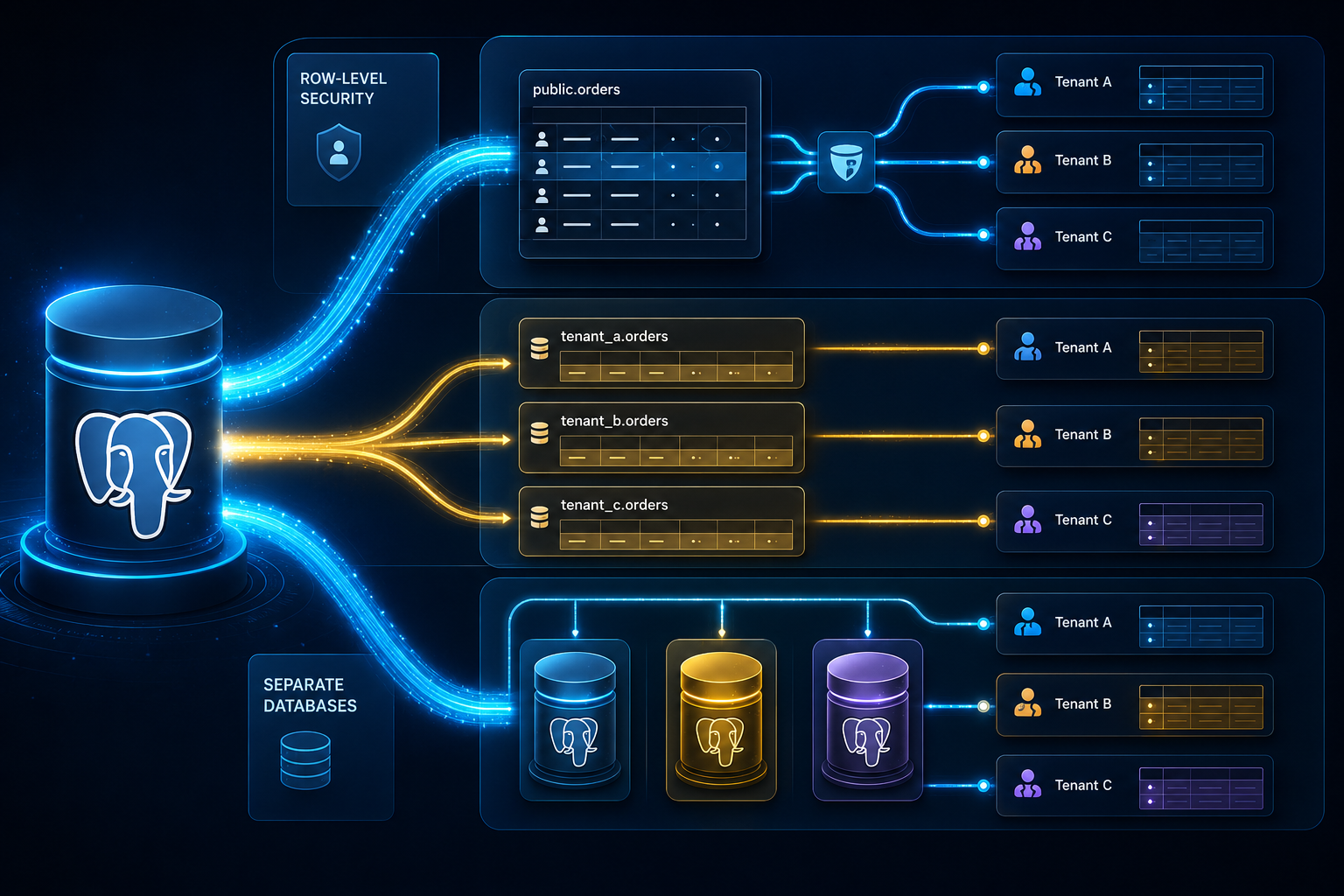
To implement multi-tenant data isolation in Postgres, you must choose between three fundamental structural patterns: row-level security (RLS) on shared tables, schema-per-tenant, or database-per-tenant. For 90% of modern SaaS applications, Row-Level Security on a shared table model provides the optimal balance of ironclad security, low infrastructure cost, and effortless schema migrations.
Selecting the right model requires understanding how memory, connection pools, query plans, and compliance mandates interact within PostgreSQL. This comprehensive guide breaks down each architectural pattern, provides battle-tested code implementations, compares operational overhead, and shows you how to scale multi-tenant Postgres to millions of users without risking a catastrophic cross-tenant data leak.
The Core Problem: Why Multi-Tenant Isolation Fails
Multi-tenancy is an architectural pattern where a single instance of a software application serves multiple customers (tenants). While sharing compute and storage resources drives down infrastructure costs dramatically, it introduces an existential threat: tenant data leakage.
In a naive multi-tenant PostgreSQL implementation, every table contains a `tenant_id` column. Your application layer is responsible for appending `WHERE tenant_id = 'tenant_123'` to every single database query.
```sql -- The naive approach: Relying entirely on application logic SELECT * FROM invoices WHERE tenant_id = 'tenant_123' AND status = 'unpaid'; ```
This model works smoothly in early-stage development. But as your engineering team grows and your codebase expands to hundreds of endpoints, background jobs, ORM abstractions, and microservices, human error becomes inevitable.
Where Application-Level Isolation Breaks Down
- ORM Abstractions and Raw SQL Bypasses: Object-Relational Mappers (ORMs) simplify data access, but custom raw SQL queries written for performance tuning frequently omit the tenant filter.
- Complex Joins and Subqueries: When joining five or six tables, developers routinely apply the `tenant_id` filter to the primary table but forget to enforce it on inner or left joins, leaking correlated data.
- Background Workers and Queue Processors: Asynchronous jobs processing bulk tasks often run under elevated database privileges, making them prone to cross-contamination if job payloads carry mismatched IDs.
- Direct Database Access: Engineers running analytics queries, support tasks, or manual hotfixes directly against production can easily query across boundaries without automated guards.
To prevent these failure modes, data isolation must be enforced at the database level, making it physically or logically impossible for an application session to read or write another tenant's rows.
The 3 PostgreSQL Multi-Tenancy Models Explained
When designing a multi-tenant system on PostgreSQL, you must pick one of three structural approaches. Each makes explicit trade-offs across operational complexity, resource utilization, noisy-neighbor resilience, and security boundary strength.
Structural Overview
- Shared Database / Shared Schema (Row-Level Security): All tenants share a single PostgreSQL database and schema (`public`). Tables contain a `tenant_id` discriminator column, and Postgres enforces access boundaries natively using Row-Level Security policies.
- Shared Database / Separate Schemas (Schema-Per-Tenant): All tenants share a single database instance, but each customer receives a dedicated schema (e.g., `tenant_a`, `tenant_b`). Tables are identical across schemas, and query execution relies on setting the PostgreSQL `search_path` dynamically.
- Separate Database Per Tenant: Every tenant receives an isolated PostgreSQL database (or cluster). Application instances route database queries to dedicated tenant connection strings.
Model Trade-Offs
1. Shared Database, Shared Schema (Discriminator Column / RLS)
All tenants store their records inside the same tables within a single default schema (typically `public`). Every multi-tenant table includes a `tenant_id` discriminator column. Isolation is enforced natively by Postgres using Row-Level Security policies.
- Ideal for: 90% of early-to-late-stage SaaS apps, products with a high volume of self-serve users, and systems requiring high resource efficiency.
2. Shared Database, Separate Schemas (Schema-per-Tenant)
All tenants share a single PostgreSQL database instance, but each tenant receives their own dedicated schema (e.g., `tenant_acme`, `tenant_globex`). Tables inside these schemas are identical in structure, and queries are routed by adjusting the PostgreSQL `search_path`.
- Ideal for: Mid-market B2B applications with hundreds (not tens of thousands) of customers requiring light logical segregation and easy tenant-level data dumps.
3. Separate Database per Tenant
Every tenant gets a completely isolated PostgreSQL database instance (or a separate database within the same cluster). Compute and storage are fully partitioned.
- Ideal for: Enterprise tiers, healthcare (HIPAA), finance (PCI-DSS), or strict data sovereignty requirements where customers mandate physical or cryptographic database isolation.
Architectural Comparison Matrix
| Dimension | Row-Level Security (RLS) | Schema-Per-Tenant | Database-Per-Tenant |
|---|---|---|---|
| Tenant Capacity Limit | Millions of tenants | 1,000 to 5,000 tenants max | Unlimited (horizontal scale) |
| Isolation Strength | Logical (Kernel-enforced) | Logical (Namespace) | Physical / Process |
| Infrastructure Cost | Lowest (maximum density) | Low-Medium | High |
| Schema Migration Speed | Instant (1 DDL statement) | Slow (N DDL statements) | Very Slow (N DB executions) |
| Noisy Neighbor Protection | Requires query limits | Moderate | Complete |
| Cross-Tenant Analytics | Simple SQL `GROUP BY` | Complex (Requires UNION/FDW) | Requires ETL / Data Warehouse |
| Backup / Restore per Tenant | Complex (Row filtering) | Moderate (`pg_dump -n`) | Simple (`pg_dump` single DB) |
Deep Dive 1: Implementing Row-Level Security (RLS)
Row-Level Security turns the database engine into an active security gatekeeper. When RLS is enabled on a table, all standard SELECT, INSERT, UPDATE, and DELETE queries are automatically rewritten by Postgres to enforce a tenant boundary predicate.
Step-by-Step Implementation
To implement RLS safely, we use session configuration variables (`app.current_tenant`) that the application sets whenever a database connection is checked out from a pool.
Step 1: Create the Schema with Discriminator Columns

```sql -- Enable UUID extension for secure, non-sequential tenant IDs CREATE EXTENSION IF NOT EXISTS "uuid-ossp";
CREATE TABLE tenants ( id UUID PRIMARY KEY DEFAULT gen_random_uuid(), name VARCHAR(255) NOT NULL, created_at TIMESTAMPTZ DEFAULT NOW() );
CREATE TABLE documents ( id UUID PRIMARY KEY DEFAULT gen_random_uuid(), tenant_id UUID NOT NULL REFERENCES tenants(id) ON DELETE CASCADE, title VARCHAR(255) NOT NULL, body TEXT, created_at TIMESTAMPTZ DEFAULT NOW() );
-- Index the discriminator column! Crucial for performance. CREATE INDEX idx_documents_tenant_id ON documents(tenant_id); ```
Step 2: Enable Row-Level Security and Define Policies
By default, enabling RLS blocks all access for non-superusers until explicit policies are created.
```sql -- Step 2a: Turn on RLS for the table ALTER TABLE documents ENABLE ROW LEVEL SECURITY;
-- Step 2b: Force RLS even for table owners (prevents accidental bypasses) ALTER TABLE documents FORCE ROW LEVEL SECURITY;
-- Step 2c: Create isolation policy matching session context CREATE POLICY tenant_isolation_policy ON documents FOR ALL USING (tenant_id = NULLIF(current_setting('app.current_tenant', true), '')::uuid) WITH CHECK (tenant_id = NULLIF(current_setting('app.current_tenant', true), '')::uuid); ```
How `current_setting('app.current_tenant', true)` Works
- `USING` clause: Controls which existing rows are visible for `SELECT`, `UPDATE`, and `DELETE`.
- `WITH CHECK` clause: Controls which new or modified rows can be written via `INSERT` or `UPDATE`. If an app tries to insert a document with a `tenant_id` mismatching `app.current_tenant`, Postgres rejects the transaction.
- The `true` parameter: Tells Postgres not to throw an error if `app.current_tenant` has not been set yet, returning `NULL` instead (which safely matches zero rows).
Step 3: Application Query Execution Workflow
Every time your application layer handles a request, it must open a transaction, set the session parameter, execute business logic, and commit.
```sql -- Transaction block start BEGIN;
-- Set the active tenant context for this specific session/transaction SET LOCAL app.current_tenant = 'a0eebc99-9c0b-4ef8-bb6d-6bb9bd380a11';
-- Execute standard application queries WITHOUT explicit tenant WHERE clauses SELECT FROM documents; -- PostgreSQL automatically rewrites this internally to: -- SELECT FROM documents WHERE tenant_id = 'a0eebc99-9c0b-4ef8-bb6d-6bb9bd380a11';
INSERT INTO documents (title, body) VALUES ('Q4 Strategy', 'Confidential roadmap details...');
COMMIT; -- Session variable app.current_tenant is automatically cleared due to 'SET LOCAL' ```
Critical Rule: Always use `SET LOCAL` instead of `SET`. `SET LOCAL` scopes the configuration variable exclusively to the active transaction block. When using connection poolers like PgBouncer in transaction pooling mode, standard `SET` leaks session variables across different HTTP requests sharing the same physical connection.
Deep Dive 2: Implementing Schema-Per-Tenant
In the schema-per-tenant pattern, every customer receives an isolated PostgreSQL schema within the same database.
Step-by-Step Implementation
Step 1: Create the Tenant Provisioning Template
First, define a base schema or run migrations programmatically whenever a new tenant signs up.
```sql CREATE SCHEMA tenant_acme_corp;
CREATE TABLE tenant_acme_corp.documents ( id UUID PRIMARY KEY DEFAULT gen_random_uuid(), title VARCHAR(255) NOT NULL, body TEXT, created_at TIMESTAMPTZ DEFAULT NOW() ); ```
Step 2: Route Queries via `search_path`
When handling an incoming request for Acme Corp, the application sets the PostgreSQL `search_path` session variable before running queries.
```sql BEGIN;
-- Direct Postgres to resolve table names inside tenant_acme_corp first SET LOCAL search_path TO tenant_acme_corp, public;
-- This query targets tenant_acme_corp.documents automatically SELECT * FROM documents;
COMMIT; ```
The Catalog Bloat Trap of Schema-Per-Tenant
While schema-per-tenant feels like a clean middle ground, it hits severe scaling bottlenecks in PostgreSQL due to system catalog bloat.
PostgreSQL tracks tables, columns, indexes, and constraints inside system catalogs (`pg_class`, `pg_attribute`, `pg_index`). If you have 2,000 tenants and 50 tables per tenant, your database contains 100,000 distinct tables and hundreds of thousands of indexes.
Consequences of Catalog Bloat:
- Severe DDL Latency: Schema migrations require looping over thousands of schemas, running millions of DDL statements. A migration that takes seconds on an RLS setup can take hours on a multi-schema setup.
- Autovacuum Degradation: The Postgres autovacuum daemon must continuously scan system tables, causing massive I/O spikes and CPU degradation.
- Query Optimization Penalties: Postgres query planner caches and memory pools (`shared_buffers`) get polluted with metadata, leading to sluggish execution plans.
Rule of Thumb for Schema-Per-Tenant: Do not use this model if you project growing beyond 1,000 active tenants. Reserve it for enterprise applications where you have a small number of high-value customers.
Deep Dive 3: Database-Per-Tenant
For strict enterprise compliance, physical database separation remains the gold standard.
```sql -- Creating completely distinct databases per tenant CREATE DATABASE app_tenant_stark_industries; CREATE DATABASE app_tenant_wayne_enterprises; ```
Application Routing Architecture
In a database-per-tenant architecture, your application routes requests dynamically using connection management steps:
- Tenant Identification: The incoming HTTP request specifies the target tenant context (for example, via an `X-Tenant-ID` header or subdomain).
- Pool Lookup: The application router looks up the tenant in a registry map (backed by Redis or an in-memory store) to find its target database connection string.
- Connection Dispatch: The application routes the query payload to the dedicated connection pool for that specific database instance.
- Database Execution: The database executes the query inside a completely partitioned instance, guaranteeing zero physical risk of cross-tenant data contamination.
When Database-Per-Tenant is Unavoidable
- Data Sovereignty Laws: Regulations in specific jurisdictions requiring local physical storage.
- Customer-Managed Encryption Keys (CMEK): Enterprise clients demanding distinct AWS KMS keys to encrypt their database files at rest.
- Custom Schemas: Tenants who require custom fields, bespoke tables, or tailored triggers.

Performance Tuning for Multi-Tenant Postgres
When using Row-Level Security on a high-throughput shared database, performance optimization is critical. Without proper indexing and query design, RLS introduces CPU overhead and sub-optimal query plans.
1. Composite Indexing Strategies
Every query evaluated under RLS appends `AND tenant_id = $1` under the hood. Therefore, single-column indexes on secondary fields are rarely used efficiently by the query planner.
```sql -- Inefficient: Single-column index on created_at CREATE INDEX idx_documents_created ON documents(created_at);
-- Optimal: Composite index with tenant_id leading CREATE INDEX idx_documents_tenant_created ON documents(tenant_id, created_at DESC); ```
By placing `tenant_id` as the first column in composite B-Tree indexes, PostgreSQL can instantly filter the index tree down to the specific tenant's memory pages, ignoring millions of rows belonging to other tenants.
2. Preventing RLS Performance Penalties on Joins
By default, PostgreSQL re-evaluates security policies for every joined row. If you join three multi-tenant tables, RLS checks run repeatedly.
To optimize join performance:
- Ensure primary and foreign keys share identical data types (preferably `UUID` or `BIGINT`).
- Wrap security function evaluations in `STABLE` or `IMMUTABLE` SQL functions if custom security context checks are required.
```sql -- Efficient security check function pattern CREATE OR REPLACE FUNCTION current_tenant_id() RETURNS UUID AS $$ SELECT NULLIF(current_setting('app.current_tenant', true), '')::uuid; $$ LANGUAGE sql STABLE PARALLEL SAFE;
-- Optimized Policy using the STABLE function CREATE POLICY tenant_isolation_policy ON documents FOR ALL USING (tenant_id = current_tenant_id()); ```
Declaring the function as `STABLE` signals to the Postgres query optimizer that the function returns the exact same result for the duration of a single table scan, preventing redundant function calls across millions of evaluated rows.
Connection Pooling with PgBouncer and RLS
In high-scale SaaS architectures, running direct database connections from dozens of serverless functions or web containers will quickly exhaust PostgreSQL's connection limits (`max_connections`). Tools like PgBouncer or AWS RDS Proxy are mandatory.
However, mixing multi-tenant session state (`SET app.current_tenant`) with connection pooling requires precise configuration.
Session Pooling vs. Transaction Pooling
- Session Pooling: PgBouncer assigns a server connection to the client for as long as the client remains connected.
- Pros: Safe for simple `SET app.current_tenant`.
- Cons: Poor pool utilization; limits client scaling.
- Transaction Pooling: PgBouncer assigns a server connection to the client only for the duration of a single transaction (`BEGIN` to `COMMIT`).
- Pros: Extreme connection reuse (thousands of clients served by 50 DB connections).
- Cons: Session settings persist on the physical connection after the transaction finishes unless explicitly handled.
The Safe Pattern for Transaction Pooling
When operating in Transaction Pooling mode, you must use `SET LOCAL` inside an explicit transaction block, or use a custom application wrapper that guarantees cleanups.
```javascript // Example Node.js / PostgreSQL Client wrapper pattern async function runTenantQuery(tenantId, queryFn) { const client = await pool.connect(); try { await client.query('BEGIN'); // SET LOCAL ensures the variable automatically vanishes on COMMIT or ROLLBACK await client.query('SET LOCAL app.current_tenant = $1', [tenantId]);
const result = await queryFn(client);
await client.query('COMMIT'); return result; } catch (error) { await client.query('ROLLBACK'); throw error; } finally { client.release(); // Safe to return connection to PgBouncer pool } } ```
Common Mistakes & How to Avoid Them
Mistake 1: Forgetting `FORCE ROW LEVEL SECURITY`
By default, the owner of a table (the role that created it) and database superusers bypass RLS policies completely. If your backend connects to Postgres using the database owner credentials, RLS will not execute.
```sql -- FIX: Explicitly enforce RLS for table owners ALTER TABLE invoices FORCE ROW LEVEL SECURITY; ```
Mistake 2: Missing Indexing on Foreign Keys and Tenant IDs
Creating an RLS policy without an index on `tenant_id` turns every query into a full table scan across all tenants.
```sql -- FIX: Always index tenant_id alongside common query filters CREATE INDEX idx_invoices_tenant_status ON invoices (tenant_id, status); ```
Mistake 3: Leaking Data via Shared Caches
Even if your database isolation is 100% bug-free, putting query results into an application cache (like Redis) using generic keys will cause cross-tenant data leaks.
```javascript // BAD CACHE KEY const cacheKey = `document:${documentId}`;
// GOOD CACHE KEY: Always prefix cache keys with tenant context const cacheKey = `tenant:${tenantId}:document:${documentId}`; ```
Testing Your Isolation Engine
Never launch a multi-tenant system without automated integration tests that explicitly attempt cross-tenant access.
Automated Isolation Test Suite (SQL Example)
```sql -- Step 1: Create two test tenants INSERT INTO tenants (id, name) VALUES ('11111111-1111-1111-1111-111111111111', 'Tenant Alpha'), ('22222222-2222-2222-2222-222222222222', 'Tenant Beta');
-- Step 2: Insert data as Tenant Alpha BEGIN; SET LOCAL app.current_tenant = '11111111-1111-1111-1111-111111111111'; INSERT INTO documents (id, title, body) VALUES ('99999999-9999-9999-9999-999999999999', 'Alpha Secret', 'Top Secret Data'); COMMIT;
-- Step 3: Switch context to Tenant Beta and attempt to read Alpha's document BEGIN; SET LOCAL app.current_tenant = '22222222-2222-2222-2222-222222222222';
-- TEST A: SELECT must return 0 rows SELECT count(*) FROM documents WHERE id = '99999999-9999-9999-9999-999999999999'; -- Expected result: 0
-- TEST B: Malicious UPDATE must modify 0 rows UPDATE documents SET title = 'Hacked' WHERE id = '99999999-9999-9999-9999-999999999999'; -- Expected result: UPDATE 0
COMMIT; ```
Integrating cross-tenant attack assertions into your CI/CD pipeline guarantees that schema modifications or policy adjustments never accidentally reopen data leaks.
How Saasbonus Simplifies Your Infrastructure Stack
Architecting reliable multi-tenant database infrastructure requires carefully balancing security, operational overhead, and platform costs. As your SaaS scales, selecting the right databases, ORMs, connection poolers, and monitoring tools becomes as critical as writing clean SQL.
At Saasbonus, we publish independent, hands-on reviews and architectural comparisons of modern developer tools, cloud databases, and SaaS infrastructure. Whether you are evaluating managed Postgres platforms like Neon and Supabase, deciding between specialized analytical engines like ClickHouse, or selecting connection pooling proxies for serverless architectures, our benchmarks help engineering teams build fast, compliant applications without wasting months on trial-and-error integrations.
Final Checklist for Multi-Tenant Postgres Isolation
Before deploying your multi-tenant PostgreSQL database to production, audit your architecture against this production readiness checklist:
- [ ] RLS Enabled & Forced: `ALTER TABLE table_name ENABLE ROW LEVEL SECURITY;` and `ALTER TABLE table_name FORCE ROW LEVEL SECURITY;` applied to all tenant tables.
- [ ] Transaction-Scoped Variables: Application uses `SET LOCAL app.current_tenant` strictly inside explicit transaction blocks (`BEGIN ... COMMIT`).
- [ ] Composite Indexing: All multi-tenant tables feature composite indexes with `tenant_id` as the leading column.
- [ ] Connection Pooling Security: PgBouncer is configured for transaction pooling with proper session cleanup wrappers.
- [ ] Non-Superuser Application Role: The application connects using a restricted role, never the database owner or superuser account.
- [ ] Cross-Tenant Test Suite: Automated CI tests explicitly attempt unauthorized cross-tenant reads, updates, and deletes.
- [ ] Tenant-Aware Caching: All Redis, Memcached, or in-memory application caches incorporate `tenant_id` in key prefixes.