Polar vs Lago: Best Open-Source Usage Billing for SaaS
The Core Verdict: Polar vs Lago in 60 Seconds
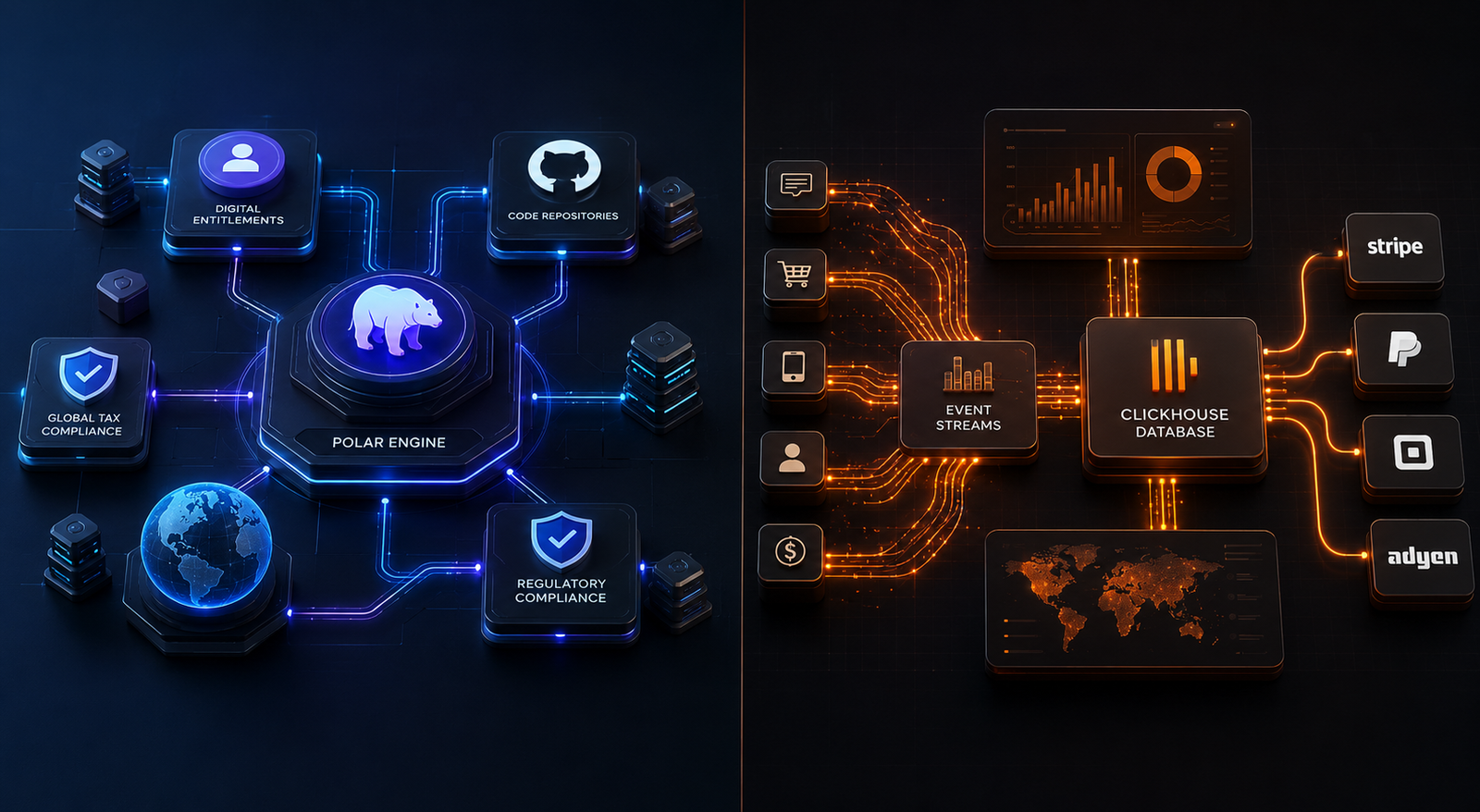
Choosing between Polar and Lago for usage-based billing comes down to a fundamental architectural decision: are you monetizing developer-centric software, digital goods, and subscriptions through an all-in-one merchant platform, or are you building a complex, high-throughput usage metering engine on top of your existing payment gateways?
Choose Polar if:
- You are building a developer tool, open-source project, or modern SaaS where you want an out-of-the-box merchant of record (MoR) experience that handles global tax compliance, EU VAT, invoices, and digital product delivery.
- You need frictionless setup using TypeScript, Python, or Next.js with pre-built checkout components and GitHub repository access control natively integrated.
- You want a lightweight platform that combines digital product sales, monthly recurring subscriptions, and metered benefit usage without managing dedicated data pipeline infrastructure.
Choose Lago if:
- You operate a high-volume SaaS or API platform that ingests millions of raw usage events per day and requires a decoupled, enterprise-grade metering engine.
- You want to retain your existing relationships with payment processors like Stripe, Adyen, or custom payment gateways while hosting the billing logic on your own infrastructure.
- You need advanced enterprise billing primitives, such as complex aggregation rules, multi-attribute pricing tiers, prepaid credits, commit-and-overage structures, and custom enterprise plan overrides.
| Core Attribute | Polar | Lago |
|---|---|---|
| Primary Architecture | Merchant-of-Record & Digital Product Engine | Decoupled Usage Billing Engine |
| Payment Processing | Integrated Merchant of Record (handles tax & payouts) | Gateway Agnostic (connects to Stripe, Adyen, etc.) |
| Ingest Throughput | High (built for API & digital entitlement events) | Massive (built on ClickHouse for millions of events/sec) |
| Self-Hosting Model | Open Source (AGPL-3.0) / Fully Hosted Cloud | Open Source (AGPL-3.0) / Enterprise Cloud |
| Tax Compliance | Native (handles VAT, sales tax, global filing) | Third-party integration required (e.g., Anrok) |
| Best For | Dev tools, SaaS MVPs, open-source monetizers, solopreneurs | Scale-up SaaS, high-volume API products, enterprise engineering teams |
Why Usage-Based Billing Broke Traditional Billing Engines
For nearly two decades, SaaS monetization rested on a single database column: `seat_count`. Traditional subscription platforms were built around a simple state machine that billed a customer $20 per user on the first day of every month. The underlying architecture was straightforward: a cron job ran once every 30 days, queried the active seat count, generated an invoice, and charged a credit card through a basic payment gateway API.
Modern SaaS products, particularly AI platforms, API suites, and cloud infrastructure services, made that simple model obsolete. When your costs are driven by token generations, compute hours, storage gigabytes, or dynamic API calls, charging a flat monthly fee per seat creates an unsustainable mismatch between your operational expenses and your revenue.
Transitioning to usage-based billing introduces three major engineering challenges:
- High-Throughput Ingestion: Billing events arrive continuously as customers interact with your application. Your system must process tens of thousands of write requests per second without dropping a single event or degrading API latency.
- State Aggregation and Rating: Raw events must be transformed into billable metrics. Converting millions of raw log entries into precise financial figures requires distributed stream processing and persistent analytical storage.
- Financial Idempotency and Auditability: You cannot approximate a customer bill. Every single event must be uniquely processed, deduplicated, and matched against dynamic pricing contracts with strict transactional integrity.
Attempting to build these capabilities directly into traditional billing platforms like standard Stripe Billing often leads to high platform fees, vendor lock-in, and rigid data structures that resist custom pricing experiments. This architectural gap has driven engineering teams toward open-source usage billing solutions like Polar and Lago.
What is Polar? The Merchant-of-Record Platform for Developers
Polar (`polar.sh`) began with a clear mission: enable open-source maintainers, independent software developers, and technical founders to monetize their code without navigating international tax compliance, billing infrastructure, or subscription logistics.
While often categorized alongside usage billing engines, Polar operates primarily as a developer-centric Merchant of Record (MoR). When a customer purchases a subscription or incurs usage charges through Polar, Polar acts as the legal reseller of the software. They calculate, collect, and remit global taxes (including EU VAT and US state sales taxes), issue compliant customer invoices, and handle chargeback risks.
To fulfill orders, Polar handles transaction processing through the following sequence:
- The customer places an order through a Polar checkout form or embedded widget.
- Polar acts as the Merchant of Record, processing the payment and applying local tax rates.
- Polar automatically remits tax liabilities to international tax authorities.
- Polar issues a net revenue payout to the software creator's account.
Core Architectural Features of Polar
- Integrated Digital Entitlements: Polar links payments directly to product access. You can natively restrict access to GitHub repositories, Discord roles, file downloads, or custom API license keys out of the box.
- Benefit-Driven Metering: Polar handles usage limits through a benefit and quota system. Customers purchase access tiers, and your application sends usage events to deduct credits or track consumption against set entitlements.
- Modern SDKs and Embeddable Components: Built natively for modern TypeScript, React, Next.js, and Python stacks, Polar offers polished embeddable checkout components, pricing tables, and customer portal widgets that integrate cleanly into modern frontends.
- Zero Tax Overhead: Because Polar acts as the Merchant of Record, you avoid setting up accounts with third-party tax engines like TaxJar or Anrok. Polar handles tax liability across global jurisdictions automatically.
Polar appeals strongly to technical founders, devtool startups, and open-source project leads who want to go from an empty codebase to a revenue-generating software product in an afternoon without managing tax filings or complex payment infrastructure.
What is Lago? The Enterprise Usage Metering Architecture
Lago (`getlago.com`) approaches usage billing from an infrastructure perspective. Rather than acting as a payment reseller, Lago provides a decoupled, open-source metering and rating engine designed to sit between your high-throughput event pipeline and your payment execution layer.
Lago assumes you already have or want full control over your payment processing accounts with vendors like Stripe, Adyen, or Brex. Lago acts as the central ledger, tracking usage events, calculating bills based on complex pricing models, generating structured invoices, and triggering charge commands through your connected payment gateway.
Lago orchestrates metered events using a four-step pipeline:
- Your application streams usage events directly to Lago's ingestion endpoint.
- Lago processes events inside its ClickHouse metering engine for real-time aggregation.
- Lago applies rating rules, dynamic tiers, and discounts to generate finalized invoices.
- Lago triggers your connected payment gateway account (such as Stripe or Adyen) to collect payment.
Core Architectural Features of Lago
- High-Performance Event Ingestion Engine: Lago leverages an architecture powered by ClickHouse, an analytical columnar database built for real-time aggregation. This setup allows Lago to process millions of usage events per day with minimal infrastructure overhead.
- Advanced Rating and Pricing Models: Lago supports complex enterprise monetization structures out of the box, including progressive tiering, package pricing, matrix pricing based on multiple event attributes, prepaid credit balances, minimum spend commitments, and custom plan overrides per enterprise client.
- Decoupled Billing Ledger: Lago acts as an independent billing source of truth. If you decide to migrate from Stripe to Adyen, or run multiple payment processors concurrently across different regions, your metering engine, customer pricing plans, and usage history remain completely untouched inside Lago.
- Developer-Centric API and UI Controls: Lago provides a functional Web UI for revenue teams to construct pricing plans and monitor usage, alongside a developer-friendly API and SDK ecosystem (Node.js, Python, Ruby, Go, PHP) for engineering teams.

Lago is built for scale-up SaaS engineering teams, high-traffic API products, and enterprise platforms that need custom billing rules, high-volume event ingestion, and complete ownership of their payment pipeline.
Deep Dive Comparison: Ingest Pipeline and Event Metering
When evaluating open-source usage billing platforms, the engineering quality of the event ingestion pipeline is a crucial criterion. If an API call occurs in your service, how does that action translate into a secure, deduplicated dollar figure on a customer's monthly bill?
Lago's Architectural Approach: ClickHouse-Backed Scale
Lago handles high-volume streaming data through a dedicated `/api/v1/events` endpoint. Every event sent to Lago includes four core properties: `transaction_id` (for strict idempotency), `external_customer_id`, `code` (mapping to the billable metric), and a payload of custom attributes.
```json { "event": { "transaction_id": "evt_unique_hash_987654", "external_customer_id": "cust_enterprise_001", "code": "llm_token_generation", "timestamp": 1775827200, "properties": { "tokens_input": 1250, "tokens_output": 450, "model": "gpt-4o", "region": "us-east-1" } } } ```
Under the hood, Lago routes these events into an analytical storage engine backed by ClickHouse. This allows Lago to run asynchronous SQL aggregation functions (`SUM`, `COUNT`, `MAX`, `UNIQUE_COUNT`) across millions of historical events without slowing down live ingestion requests.
```sql SELECT external_customer_id, SUM(CAST(JSONExtractString(properties, 'tokens_input') AS UInt64)) AS total_input_tokens FROM usage_events WHERE code = 'llm_token_generation' AND timestamp >= 1773187200 GROUP BY external_customer_id; ```
This architectural separation guarantees that even if your application generates 500 events per second per user, Lago ingests them asynchronously, deduplicates them using `transaction_id`, and calculates current billables on demand without blocking your production database.
Polar's Architectural Approach: Light Metering & Benefit Quotas
Polar addresses usage tracking through a combination of continuous benefit tracking and API quota management. Rather than operating an analytical data warehouse designed for raw event streams, Polar exposes an API centered around dynamic meter tracking, subscription updates, and benefit usage.
```python from polar_sdk import Polar
polar = Polar(access_token="polar_at_123456789")
polar.events.ingest( events=[ { "name": "api_request", "customer_id": "cust_01HJ2...", "metadata": { "endpoint": "/v1/chat/completions", "tokens": 1700 } } ] ) ```
Polar's engine checks these events against active subscription entitlements, updating the user's current billing state and decrementing available quota balances. This workflow works smoothly for dev tools, software access tiers, and API usage up to moderate volumes. However, if your architecture streams hundreds of thousands of events per minute, streaming those raw logs directly into Polar can introduce API latency and higher operational overhead compared to a dedicated columnar engine like Lago.
Metering Takeaway: For extreme scale, real-time log aggregation, and complex multi-attribute event rating, Lago's ClickHouse architecture offers a clear advantage. For standard usage tiers, quota management, and moderate API metering integrated with payment collection, Polar provides a cleaner, lower-overhead integration.
Developer Experience, SDKs, and Native Integrations
Both platforms prioritize a modern developer experience, but their SDK design philosophies mirror their broader product architectures.
Integrating Polar in a Modern Next.js Stack
Polar's developer workflow feels natural to full-stack TypeScript engineers. The setup focuses on rapid time-to-market, providing pre-built React components, webhooks, and streamlined API SDKs.
Setting up a checkout flow in a Next.js application using Polar takes only a few lines of code:
```typescript import { Polar } from '@polar-sh/sdk'; import { NextResponse } from 'next/server';
const polar = new Polar({ accessToken: process.env.POLAR_ACCESS_TOKEN!, server: 'sandbox', });
export async function POST(request: Request) { const { priceId, customerEmail } = await request.json();
const result = await polar.checkouts.create({ productPriceId: priceId, customerEmail: customerEmail, successUrl: `${process.env.NEXT_PUBLIC_APP_URL}/dashboard?checkout=success`, });
return NextResponse.json({ url: result.url }); } ```
Polar provides built-in entitlement webhooks out of the box. When a customer pays or consumes a benefit, Polar dispatches event notifications that automatically grant access to GitHub teams, trigger custom webhooks, or deliver downloadable files without requiring manual database synchronization.
Integrating Lago into a Microservices Backend
Lago is built to integrate cleanly into microservice architectures. Because Lago does not handle checkout UI, your backend code interacts with Lago to manage customer profiles, assign plans, ingest event streams, and fetch real-time bill calculations.
```typescript import { Client } from '@getlago/sdk';
const lago = new Client({ apiKey: process.env.LAGO_API_KEY! });
export async function registerCustomerAndAttachPlan( organizationId: string, email: string, planCode: string ) { const customer = await lago.customers.createCustomer({ customer: { external_id: organizationId, name: email, email: email, currency: 'USD', }, });
const subscription = await lago.subscriptions.createSubscription({ subscription: { external_customer_id: organizationId, plan_code: planCode, external_id: `sub_${organizationId}`, billing_time: 'anniversary', }, });
return { customer, subscription }; } ```
Lago provides comprehensive backend SDKs for Go, Ruby, Python, Node.js, and PHP. It focuses on maintaining a strict separation between your core application logic and your monetization engine, giving backend teams total programmatic control over pricing state without managing tax UI or checkout workflows.
Custom Pricing Structures & Enterprise Billing Flexibility
As SaaS companies mature, their pricing models often become more complex. What starts as a simple flat fee per gigabyte frequently evolves into custom enterprise agreements, tiered usage thresholds, prepaid credit packs, and dynamic overage rates.
Pricing Primitives Supported by Lago
Lago was designed explicitly to handle complex enterprise pricing models. Its rating engine natively supports:
- Standard Metered Usage: Charging per unit consumed (e.g., $0.002 per API call).
- Graduated Tiered Pricing: First 10,000 units at $0.05, next 50,000 units at $0.03, and all subsequent units at $0.01.
- Volume Pricing: Once total consumption hits a specific threshold, all units are rated at the discounted rate.
- Matrix Pricing: Rating an event based on multiple dynamic parameters (e.g., charging different rates for compute based on region, CPU type, and memory allocation simultaneously).
- Prepaid Credit Balances: Customers purchase a $5,000 credit block upfront, and live usage events continuously deduct from that balance at customized burn rates.
- Commitment & Overage Contracts: Enterprise agreements where a client commits to $50,000 annually, with clear overage pricing applied automatically if consumption exceeds the baseline commitment.

Matrix Pricing Rates Example
| Region | Instance Type | Price / Hour |
|---|---|---|
| us-east-1 | c6i.xlarge | $0.17 |
| us-east-1 | p4d.24xlarge | $32.77 |
| eu-west-1 | c6i.xlarge | $0.19 |
Pricing Primitives Supported by Polar
Polar focuses on subscription tiers, digital product access, and straightforward usage metrics. Its monetization models include:
- Fixed Monthly/Annual Subscriptions: Standard recurring billing cycles.
- One-Time Digital Product Sales: Selling downloadable assets, standalone software licenses, or repository access.
- Metered Benefit Consumptions: Allowing users to consume usage-based credits linked directly to explicit product benefits.
- Pay-What-You-Want / Custom Amounts: Flexible payment structures commonly used for open-source sponsorships or developer donations.
Polar handles subscription access, seat upgrades, and standard usage tiers smoothly. However, if your sales team frequently negotiates complex enterprise contracts with customized matrix pricing, multi-attribute event scoring, or prepaid draw-downs, Lago provides significantly deeper native tooling.
Merchant of Record vs Gateway Agnostic Architecture
Understanding the structural difference between a Merchant of Record (MoR) and a Gateway-Agnostic Billing Engine is critical when choosing between Polar and Lago. This choice dictates how you handle international taxes, payouts, fee structures, and enterprise customer relationships.
| Architecture Pillar | Merchant of Record Model (Polar) | Gateway-Agnostic Model (Lago) |
|---|---|---|
| Tax Ownership | Platform calculates and remits global taxes | Your team manages filings via tools like Anrok |
| Credit Card Statements | Polar appears as seller on customer receipt | Your company name appears on statements |
| Payment Fees | All-in fee percentage per transaction | Direct gateway rates with Stripe/Adyen |
| Merchant Setup | Instant activation globally | Requires custom gateway merchant approval |
The Merchant of Record Model (Polar)
When using Polar, Polar acts as the reseller of your software. The legal contract for the purchase exists between the end customer and Polar.
- Pros:
- Zero Tax Liability Management: Polar handles foreign tax registrations, state sales taxes, and international value-added tax (VAT) compliance (such as EU VAT OSS).
- Chargeback & Fraud Protection: Polar handles chargeback disputes, fraud detection, and payment collection failures directly.
- Instant Global Selling: You can sell to customers worldwide from day one without setting up international tax accounts or localized billing entities.
- Cons:
- Higher Platform Cut: MoR providers charge higher transaction fees (typically a percentage plus a fixed per-transaction cost) to cover tax processing, payment fees, and compliance risks.
- Customer Descriptor Control: Customer credit card statements reflect Polar as the seller of record, which can occasionally confuse corporate enterprise buyers expecting a direct billing relationship with your company.
The Gateway-Agnostic Model (Lago)
When using Lago, you maintain direct merchant relationships with payment gateways like Stripe, Adyen, or Chase Payment Tech. Lago acts strictly as software that calculates billing metrics and instructs your gateway to execute payments.
- Pros:
- Lower Payment Processing Costs: You pay standard processing fees directly to Stripe or Adyen, avoiding additional revenue-share cuts from a reseller platform.
- Full Merchant Control: You own your customer merchant relationships directly. Your company name appears on all credit card statements, and you retain control over payment routing, retries, and custom payment options.
- Multi-Gateway Redundancy: You can route domestic transactions through local gateways to maximize conversion rates and reduce cross-border fees.
- Cons:
- Tax Compliance Responsibility: You must calculate, collect, and remit global taxes yourself using services like Anrok, Quaderno, or Stripe Tax.
- Operational Maintenance: Managing chargeback disputes, local business filings, and banking relationships remains the responsibility of your finance and legal teams.
Total Cost of Ownership: Self-Hosting, Cloud, and Transaction Fees
When calculating the true cost of open-source billing infrastructure, engineering teams must evaluate both cloud subscription fees and long-term hosting overhead.
Polar's Financial Model
Polar offers a hybrid open-source and hosted cloud model under the AGPL-3.0 license. Because Polar acts as a Merchant of Record on its hosted cloud platform, its revenue model scales directly with your transaction volume:
- Polar Hosted Cloud: Free to set up with no recurring monthly software fee. Polar charges a transparent fee per transaction (typically around 5% + $0.50 per transaction), which covers payment processor costs, global tax collection, and platform maintenance.
- Self-Hosted Polar: You can self-host the core Polar codebase on your own servers. However, self-hosting removes the Merchant of Record tax compliance layer, requiring you to handle payment gateway connections and tax logic independently.
Lago's Financial Model
Lago is distributed under the AGPL-3.0 license for its core open-source engine, with a commercial cloud tier for larger organizations:
- Lago Open Source (Self-Hosted): Free to deploy on your infrastructure (using Docker or Kubernetes). You get access to the full event metering engine, ClickHouse integration, API services, and administrative UI. You only pay for your underlying cloud compute resources and direct payment gateway processing fees.
- Lago Cloud & Enterprise: A fully managed cloud service that eliminates self-hosted infrastructure management. Pricing scales based on monthly active users (MAUs) or aggregated usage event volumes, starting with a free tier and scaling into predictable monthly enterprise plans.
For an early-stage company processing $10,000 per month across hundreds of micro-transactions, Polar's MoR model saves thousands of dollars in legal and tax configuration fees. Conversely, for a scale-up platform processing $500,000 per month across high-volume usage events, self-hosting Lago alongside a direct Stripe account can yield substantial monthly savings compared to revenue-share models.
Migration Path and Production Deployment Considerations
Deploying a new usage billing platform into production requires a deployment strategy that avoids service disruptions or lost usage events.
To safely introduce usage billing into production, follow this five-step engineering roadmap:
- Define Your Billable Metrics Clearly: Identify the exact variables that drive cost and value in your software (e.g., token counts, storage volume, active seats, monthly compute seconds). Avoid overly complex multi-variable models early on.
- Establish an Asynchronous Event Dispatcher: Never issue blocking network calls to a billing engine directly within your application's critical user path. Wrap billing event calls inside an asynchronous task queue (such as Redis BullMQ, Celery, or AWS SQS).
- Implement Strict Idempotency: Ensure every usage event includes a unique, deterministic hash (such as combining user ID, timestamp, and action type). This guarantees that network retries never double-charge a customer.
- Run Dual-Write Validation: Run your new usage billing platform alongside your existing legacy billing setup for at least one full billing cycle. Compare generated invoices line-by-line to catch discrepancies in aggregation or tax calculations before switching over live payments.
- Establish Billing Alert Fallbacks: Configure real-time alerts for unexpected spikes in usage. Both customer run-away costs and billing engine drop-offs should trigger immediate system alerts.
Common Pitfalls in Usage-Based Billing Implementation
Transitioning to usage-based pricing introduces edge cases that can disrupt engineering and revenue operations. Here are three common pitfalls to avoid:
1. Tight Coupling Between Billing Logic and Product Code
Writing billing checks directly inside core business logic makes future pricing changes difficult to deploy. Instead of hardcoding checks like `if (user.tokens > 10000)`, use clean entitlement checks against an isolated billing wrapper or local feature-flag cache. Your application code should ask, 'Does this account have access to benefit X?' rather than manually calculating event balances.
2. Ignoring Micro-Rounding and Precision Losses
Rating events at fractions of a cent (e.g., $0.0000035 per LLM token) can lead to floating-point precision issues when processing millions of events. Store raw metric quantities as integers or high-precision decimals (`NUMERIC`/`DECIMAL` types) in your application database, applying unit rate rounding only when generating final aggregated customer invoices.
3. Missing Real-Time Usage Visibility for End Users
Usage-based pricing can introduce bill shock if customers cannot track their spending in real time. Provide a clear customer portal showing current billing period consumption, forecasted monthly spend, and configurable spending limits. Both Polar and Lago provide API endpoints to expose live consumption data directly within your frontend dashboard.
How to Choose: Decision Framework for Engineering Teams
To select the right open-source usage billing platform for your stack, run your requirements through this decision checklist:
- Select Polar if:
- You are a developer, startup, or open-source team monetizing software or subscriptions.
- You do not want to manage global tax filings, EU VAT compliance, or invoice generation.
- You want pre-built checkout UI components, GitHub access controls, and fast TypeScript/Python SDKs.
- Your usage event volume is moderate or structured around straightforward credit tiers.
- Select Lago if:
- You are a scale-up SaaS platform, API provider, or enterprise engineering organization.
- You need to process millions of usage events per day using a dedicated ClickHouse-backed analytics layer.
- You want to keep your existing Stripe, Adyen, or custom payment processor integrations.
- You need enterprise pricing capabilities, such as multi-attribute matrix pricing, prepaid credit balances, and custom enterprise contracts.
Evaluating the right billing tools for your SaaS stack involves balancing developer experience, tax compliance, and long-term architectural scalability. When you align your usage billing engine with your product's underlying scale, you turn your monetization infrastructure into a durable engine for long-term growth.
Discover More Developer Tool Reviews on Saasbonus
At Saasbonus, we provide independent, hands-on architectural reviews of modern developer tools, infrastructure components, and SaaS platforms. Explore our latest technical comparisons to make informed decisions for your engineering stack: