Portkey vs LiteLLM: Best AI Gateway for Production SaaS?
The Core Verdict: Portkey vs LiteLLM in 60 Seconds
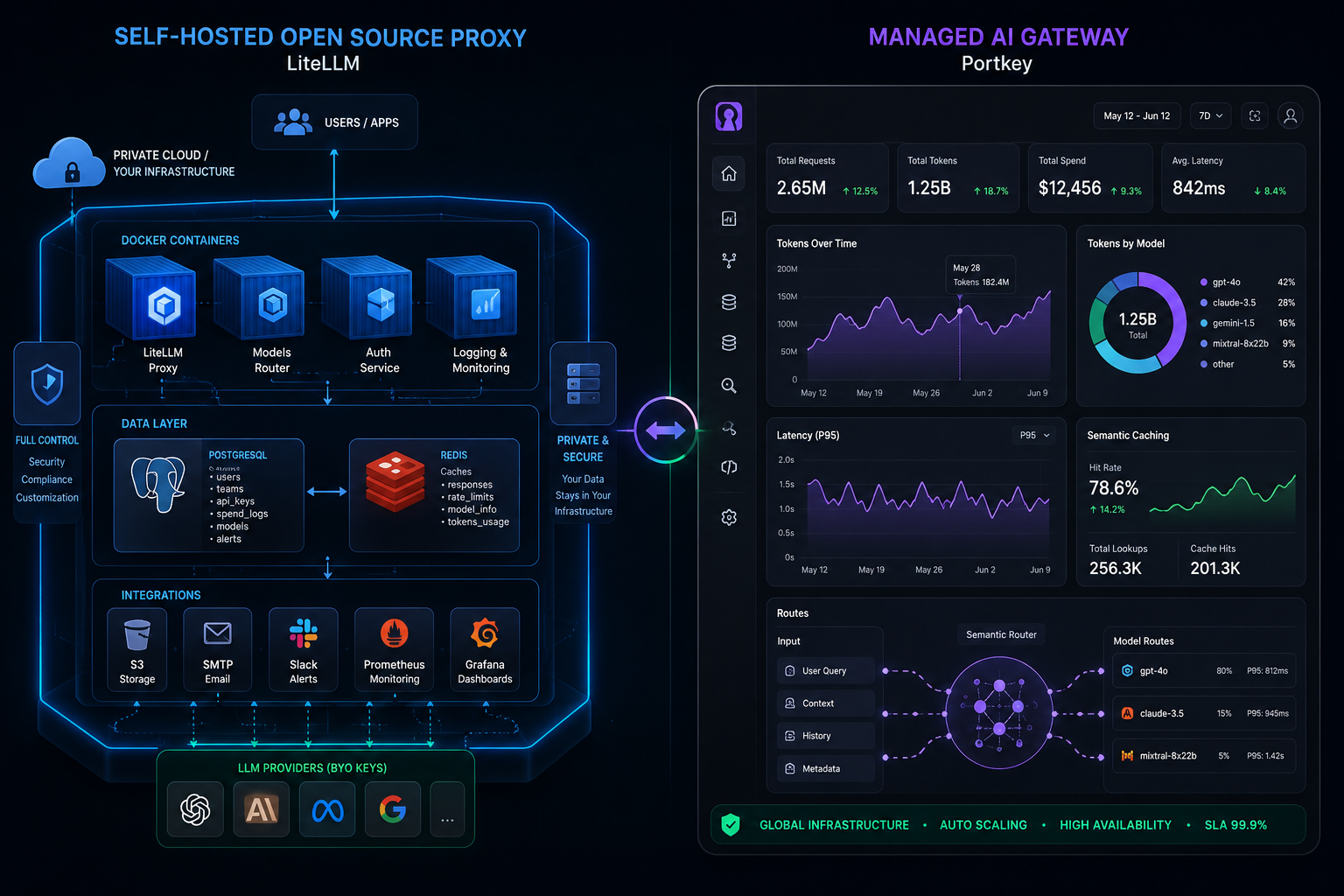
Choosing between Portkey and LiteLLM comes down to a fundamental architectural trade-off: do you want a fully managed control plane with integrated observability and guardrails, or do you want an open-source, self-hosted proxy where you retain 100 percent control over your data plane?
LiteLLM is an open-source, MIT-licensed Python proxy and translation layer. It allows you to wrap more than 100 Large Language Model (LLM) providers inside a single, OpenAI-compatible API standard. You deploy it via Docker inside your own Virtual Private Cloud (VPC), store usage data in PostgreSQL or Redis, and maintain full custody of prompt data without paying a per-token SaaS markup. Managing high-concurrency scaling, state storage, and external observability connections rests on your engineering team.
Portkey is a managed AI gateway and observability platform engineered for production GenAI products. It delivers unified multi-provider routing alongside native session tracing, semantic caching, prompt versioning, and built-in guardrails out of the box. While Portkey offers VPC and enterprise self-hosted deployments, its primary strength lies in zero-ops convenience. You get SOC2 Type II and HIPAA compliance without running proxy clusters or maintaining database schemas.
Pick LiteLLM if you have strict data sovereignty requirements, a dedicated platform team, and want to avoid third-party log retention costs. Pick Portkey if you want to deploy production-grade LLM features quickly with cost tracking, deep debugging traces, and compliance guardrails already wired up.
At Saasbonus, we evaluate foundational software infrastructure to help engineering teams build resilient, cost-effective SaaS products. In this review, we dissect the architecture, performance, security, cost control, and developer experience of both platforms to help you select the ideal gateway for your stack.
Why Production SaaS Applications Need an AI Gateway
When engineering teams first integrate generative AI into a SaaS application, they typically start with direct SDK calls. They write code using the official OpenAI or Anthropic Python library, store an API key in an environment variable, and ship the feature. This works during initial development, but direct integration breaks down under production demands.
Production SaaS platforms face four critical operational bottlenecks when interacting directly with LLM providers:
- Provider Outages and Rate Limits: Every major LLM vendor enforces strict Requests Per Minute (RPM) and Tokens Per Minute (TPM) limits. During peak usage periods or sudden traffic spikes, direct SDK calls trigger HTTP 429 rate-limit errors or HTTP 503 service unavailable responses. Without an automated routing layer, your users experience application crashes.
- SDK Fragmentation and Maintainability: As your application grows, you will likely need to route lightweight tasks to faster, cheaper models while reserving reasoning-heavy workflows for frontier models. Maintaining distinct client libraries, authentication flows, error handling patterns, and request schemas across OpenAI, Anthropic, Google Gemini, and AWS Bedrock introduces technical debt.
- Uncontrolled Costs and Multi-Tenant Isolation: In a B2B SaaS environment, a single power user or poorly optimized autonomous agent loop can consume thousands of dollars in API credits overnight. Without real-time budget enforcement, rate limiting per customer tenant, and granular token attribution, tracking cost per user becomes difficult.
- Observability and Security Blindspots: Traditional application performance monitoring (APM) tools like Datadog or New Relic are not designed to capture LLM-specific telemetry. They do not natively track prompt tokens, completion tokens, time-to-first-token (TTFT), prompt injection attempts, or sensitive personally identifiable information (PII) leaking to external model endpoints.
An AI gateway solves these challenges by acting as a reverse proxy between your application services and upstream LLM providers. It standardizes API requests, normalizes response payloads, handles failover routing, enforces rate limits, logs telemetry, and applies security policies before requests reach the provider.
The Architectural Split: LiteLLM Proxy vs. Portkey Control Plane
To choose the right gateway, you must understand how LiteLLM and Portkey approach request processing, data persistence, and system architecture.
LiteLLM: The Open-Source Python Proxy
LiteLLM consists of two distinct components: the stateless Python SDK (litellm) and the standalone proxy server (litellm-proxy). In production SaaS environments, engineering teams deploy the LiteLLM Proxy.
The proxy is a standalone FastAPI service written in Python, distributed as a pre-built Docker image. It accepts requests in the standard OpenAI REST schema (such as /v1/chat/completions) and translates those payloads into native formats required by over 100 model backends.
Because LiteLLM is stateless at the compute layer, scaling the proxy requires running multiple container instances behind a standard cloud load balancer (such as an AWS ALB or NGINX). To enable stateful enterprise features—such as virtual key management, global rate limits, team budgets, and request logging—LiteLLM requires external infrastructure dependencies:
- Redis Cluster: Handles distributed rate limiting, in-memory request queueing, and transient cache storage.
- PostgreSQL Database: Stores virtual API keys, team organizations, budget configurations, and persistent cost logs.
This architecture ensures that 100 percent of your application data plane remains inside your infrastructure boundary. Prompts, completions, and user identifiers never touch an external third-party server. The trade-off is operational maintenance: your platform team is responsible for patch management, Redis state management, PostgreSQL index optimization, and Kubernetes pod autoscaling.
Portkey: Managed Control Plane with Edge Gateway
Portkey approaches the problem from a cloud-native, control-plane perspective. Instead of requiring you to run stateful proxy infrastructure, Portkey provides a globally distributed AI gateway hosted on Cloudflare Workers edge nodes, coupled with an enterprise SaaS telemetry backend.
When your app sends a request to Portkey, it hits the nearest edge location. Portkey reads your routing configurations, authenticates virtual keys stored in its encrypted vault, injects provider credentials, and forwards the payload to the target LLM provider. The edge worker processes the streaming response back to your client while asynchronously emitting detailed trace telemetry to Portkey's log indexing engine.
Portkey separates routing logic from application code using JSON-based config objects. You can update fallbacks, retry parameters, semantic cache thresholds, and load-balancing weights directly through the Portkey dashboard without redeploying application code or restarting gateway services.
For enterprise customers with regulatory constraints, Portkey offers hybrid deployment models. You can deploy the Portkey gateway binary inside your own AWS, GCP, or Azure VPC while using Portkey's managed control plane for configuration and analytics.
Side-by-Side Feature Comparison

The following table illustrates how Portkey and LiteLLM compare across architectural and operational categories:
| Feature / Metric | LiteLLM Proxy | Portkey AI Gateway |
|---|---|---|
| Deployment Model | Self-hosted Docker container in VPC (Enterprise SaaS available) | Managed SaaS Edge proxy, Hybrid, or Self-hosted Enterprise |
| Core Licensing | Open Source (MIT) with Commercial Enterprise tier | Proprietary SaaS with open-source client SDKs |
| Supported Providers | 100+ (OpenAI, Anthropic, Bedrock, Azure, Vertex, Ollama) | 250+ (OpenAI, Anthropic, Gemini, Azure, Bedrock, Groq) |
| Data Plane Location | Customer-owned infrastructure (100% in VPC) | Managed Cloud Edge by default; VPC options on Enterprise |
| API Compatibility | OpenAI REST compatible (/v1/chat/completions) | OpenAI REST compatible with custom headers |
| Native Observability | Basic admin dashboard; requires external tools for deep tracing | First-class native suite (Traces, Spans, Cost, Feedback, Logs) |
| Guardrails & Security | Integrations via plugins (Presidio, LlamaGuard) and OTel | Built-in guardrail engine (PII masking, Regex, Injection checks) |
| Caching Mechanisms | Exact-match & Vector Similarity (Redis-backed) | Simple Caching & Semantic Caching (Vector engine integrated) |
| Multi-Tenant Budgeting | Virtual keys with monthly max budget, TPM/RPM limits | Virtual keys with metadata tagging, team limits, log caps |
| Compliance Capabilities | Inherits your infrastructure compliance (SOC2/HIPAA) | Native SOC2 Type II, ISO 27001, GDPR, and HIPAA BAAs |
High Availability: Fallbacks, Retries, and Smart Routing
When an upstream model provider experiences downtime, high-concurrency rate limits, or elevated latency, your AI gateway must automatically re-route traffic to keep your application operational.
LiteLLM Failover Architecture
LiteLLM handles resiliency through YAML configuration files or database-backed virtual routes. You define model aliases alongside a prioritized array of fallback targets.
For instance, you can configure an alias named production-chat that maps primary traffic to gpt-4o on OpenAI. If OpenAI returns an HTTP 429 rate limit or an HTTP 500 server error, LiteLLM automatically retries the payload against claude-3-5-sonnet on Anthropic, followed by azure/gpt-4o as a secondary fallback.
LiteLLM supports core load-balancing strategies across provider deployments:
- Simple Round-Robin: Distributes requests evenly across an array of API keys or provider endpoints.
- Latency-Based Routing: Tracks the moving average response time of each provider and routes incoming traffic to the lowest-latency endpoint.
- Least-Busy Routing: Tracks active in-flight requests per endpoint and picks the route with the fewest active connections.
Because LiteLLM exposes an auto-syncing model price and context mapping file (model_prices_and_context_window.json), it handles parameter mapping adjustments between different providers during failovers.
Portkey Config-Driven Routing Engine
Portkey manages routing using declarative JSON configurations assigned dynamically per request via HTTP headers. Portkey separates failover logic into distinct operational modes:
- Automatic Fallbacks: If the primary provider fails or times out, Portkey falls back to secondary or tertiary providers, mapping message schemas and prompt formatting automatically.
- Conditional Routing: You can set rules based on incoming request metadata. For example, if a request originates from a free-tier user, route it to gpt-4o-mini. If the request comes from an enterprise tenant, route it to a dedicated claude-3-5-sonnet deployment.
- Canary Testing and Split Traffic: Portkey allows you to define percentage splits across providers. You can direct 90 percent of production traffic to an established model while sending 10 percent to a newly fine-tuned model or alternative provider to compare performance and output quality.
- Circuit Breakers: If an upstream provider exhibits a high rate of consecutive failure errors, Portkey temporarily trips a circuit breaker, routing subsequent traffic away from that provider for a cooling-off period to prevent cascade delays.
Portkey's config approach helps teams where product managers or prompt engineers need to adjust routing rules or test alternative models without requiring backend code deployments.
Observability, Tracing, and Telemetry
You cannot optimize what you do not measure. Deep observability is critical for diagnosing latency spikes, identifying prompt regression, and tracking cost drivers in LLM applications.
LiteLLM: The Modular Observability Pipeline
LiteLLM includes a lightweight admin UI (/ui) that displays token metrics, active virtual keys, and cost totals logged to PostgreSQL. However, it is not designed to be a full tracing and debugging application out of the box.
Instead, LiteLLM functions as an open telemetry pipeline emitter. It supports native callbacks and integrations with specialized observability tools:
- OpenTelemetry (OTel): Emits standardized trace spans for every request, execution step, and guardrail check directly to Datadog, Dynatrace, or SigNoz.
- Dedicated LLM Tracing: Integrates with platforms like Langfuse, Arize Phoenix, Helicone, and OpenLLMetry.
If your organization utilizes Langfuse or Datadog for tracing, LiteLLM fits into your stack. You configure LiteLLM to emit trace headers to your existing tool, keeping your routing layer focused on proxying requests.
Portkey: Integrated Production Telemetry
Portkey offers an observability suite built natively into the gateway control panel. Every request that flows through Portkey is captured with detailed execution context:
- Full Request and Response Tracing: Logs prompt strings, completion outputs, system prompts, function calls, and raw HTTP payloads.
- Multi-Step Session Chains: Groups multi-turn agent conversations or retrieval-augmented generation (RAG) pipelines into hierarchical parent-child traces.
- Metadata and Customer Attribution: Allows you to attach custom key-value metadata to any request (such as user_id, tenant_id, environment, feature_flag). This enables real-time filtering of cost, latency, and token consumption by specific SaaS customers.
- User Feedback and Logging: Includes endpoints to capture user sentiment ratings directly alongside the originating trace, making it straightforward to assemble datasets for model evaluation and fine-tuning.
For teams that prefer a single system without configuring separate telemetry databases or maintaining third-party collector agents, Portkey provides a turnkey solution.
Cost Management, Virtual Keys, and Budget Limits
Preventing unexpected API charges is a core requirement for multi-tenant SaaS platforms. Both Portkey and LiteLLM address this through Virtual Keys—proxy-managed credentials that map to upstream provider API keys while enforcing access boundaries.
LiteLLM Virtual Keys
LiteLLM provides a database-backed virtual key system. Via the REST API or admin UI, engineering teams can provision virtual keys assigned to specific internal teams, external customer accounts, or individual developers.
Key capabilities of LiteLLM virtual keys include:
- Hard Budget Caps: Set rolling daily, weekly, or monthly spend limits in USD. Once a virtual key crosses its budget threshold, LiteLLM blocks subsequent requests with an HTTP 400 budget exceeded response before the call reaches the provider.
- Rate Limiting (TPM/RPM): Restrict maximum Tokens Per Minute or Requests Per Minute per key to prevent noisy-neighbor problems in multi-tenant systems.
- Model Access Controls: Lock specific keys to explicit models (for example, allow a frontend key to access only gpt-4o-mini while restricting gpt-4o access to background batch processes).
- Auto-Syncing Price Engine: LiteLLM tracks model token costs automatically. When providers update pricing or introduce new models, LiteLLM updates its internal cost map without requiring proxy pod restarts.
Portkey Key Vault and Spend Guardrails
Portkey manages provider keys centrally inside an encrypted Key Vault. Developers do not interact with raw provider credentials; instead, they authenticate using Portkey virtual keys.
Portkey's cost management features focus on product-level controls:
- Granular Rate Limits & Budgets: Set rate limits and max spend targets across keys, workspace teams, or specific config environments.
- Semantic and Simple Caching: Portkey offers both exact-match caching and vector-based semantic caching. Semantic caching evaluates whether an incoming query is semantically equivalent to a previously served request. If similarity exceeds a set threshold, Portkey returns the cached completion instantly—reducing API latency to under 50 milliseconds and saving up to 40 percent on token costs for repetitive workloads like customer support or RAG agents.
- Alerting and Notifications: Sends real-time webhooks or Slack alerts when spend velocity spikes unexpectedly or a workspace approaches its allocated log and budget limits.

Security, Guardrails, and Enterprise Compliance
When deploying generative AI features to enterprise customers, compliance requirements become paramount. You must guarantee that sensitive customer data, corporate secrets, and regulated information are protected.
LiteLLM Security Architecture
Because LiteLLM runs inside your cloud private network, data privacy is maintained by default. Prompts flow directly from your application services into the LiteLLM Docker container, through your outbound VPC gateway, and to the LLM provider over TLS.
For content filtering and security guardrails, LiteLLM uses an integration hook model:
- PII Masking: Connects to Microsoft Presidio or custom regex pipelines to detect and redact credit card numbers, email addresses, and social security numbers prior to external transmission.
- Guardrail Integrations: Integrates with third-party tools like Llama Guard, Lakera Guard, or AWS Bedrock Guardrails.
- Enterprise Features: LiteLLM's commercial enterprise edition adds SAML SSO, Role-Based Access Control (RBAC), fine-grained team permissions, audit logging, and custom request size limits.
Portkey Enterprise Security and Native Guardrails
Portkey includes a native guardrail engine that runs inline with every request processed by the gateway. You can define security policies inside your gateway routing configs:
- Built-in PII Redaction: Automatically detects and redacts sensitive data fields across inputs and outputs before payloads leave your security perimeter.
- Prompt Injection Defense: Scans incoming user prompts for known injection attack signatures and jailbreak attempts, blocking flagged requests before they execute on upstream models.
- Compliance Certifications: Portkey maintains SOC2 Type II, ISO 27001, GDPR, and HIPAA compliance certifications out of the box. Enterprise customers can sign Business Associate Agreements (BAAs) directly with Portkey, accelerating compliance reviews for healthcare or fintech SaaS products.
Latency, Throughput, and Performance Overhead
Adding an AI gateway introduces a network hop between your application and your model providers. Minimizing proxy overhead is essential for maintaining smooth streaming user experiences.
LiteLLM Performance Footprint
LiteLLM is written in Python using FastAPI. For standard completion calls, the LiteLLM proxy introduces approximately 10 to 20 milliseconds of processing overhead per request.
To keep latency low under high concurrency, you must size your deployment infrastructure properly:
- State Management Overhead: Every incoming request requires a Redis lookup to verify virtual key rate limits and an async write to PostgreSQL for log persistence. If your Redis or Postgres database experiences CPU throttling, proxy latency will degrade.
- Streaming Normalization: LiteLLM normalizes Server-Sent Event (SSE) streams across provider implementations. While efficient, async streaming in Python requires proper worker process tuning (such as running uvicorn with an optimal number of web workers) to prevent event-loop congestion under heavy load.
Portkey Performance Footprint
Portkey's managed edge gateway is built on lightweight runtimes deployed across Cloudflare's global edge network. This distributed architecture minimizes total round-trip time by executing gateway logic close to your application server.
- Routing Latency: Portkey adds approximately 20 to 40 milliseconds of latency overhead.
- Asynchronous Telemetry Offloading: Portkey separates the execution path from the telemetry logging path. Once an LLM completes its response stream, the edge worker closes the client connection while asynchronously streaming log metadata to Portkey's ingestion servers. This prevents logging operations from delaying application responses.
Total Cost of Ownership (TCO) and Pricing Comparison
Comparing the financial costs of Portkey and LiteLLM requires looking beyond software subscription pricing to account for cloud compute, database hosting, and ongoing DevOps overhead.
LiteLLM Pricing and Infrastructure Costs
LiteLLM uses an open-core licensing model:
- Community Edition (Open Source): Free (MIT License). Includes core proxy capabilities, multi-provider translation, fallbacks, load balancing, basic caching, and virtual key budgeting.
- Enterprise Edition: Commercial subscription priced per seat or enterprise deployment. Adds enterprise SAML/SSO, fine-grained RBAC, advanced audit logging, and dedicated SLA support.
Infrastructure Costs for Self-Hosting LiteLLM: Running LiteLLM in production requires hosting compute and database resources. For a medium-scale SaaS application handling 5 million requests per month, monthly infrastructure expenses typically look like:
- Kubernetes Compute / ECS Tasks: 3x high-availability container instances (~$120/month).
- Managed Redis Cluster (AWS ElastiCache / Redis Cloud): Distributed state and rate limiting (~$80/month).
- Managed PostgreSQL (AWS RDS / Supabase): Log storage and key indexing (~$100/month).
- DevOps / Platform Engineering: Maintaining Docker images, updating price maps, monitoring database indexing, and managing security patches (~2-5 engineering hours per month).
Portkey SaaS Pricing Structure
Portkey uses a usage-based pricing model based primarily on recorded logs—the number of requests tracked in its observability suite:
- Developer Plan (Free): $0/month. Includes 10,000 recorded logs per month, unified API access to 250+ models, basic logging, simple caching, and automatic fallbacks (30-day log retention).
- Pro Plan: Custom base pricing starting at approximately $49/month for 100,000 logs, plus $9 per additional 100,000 logs. Unlocks detailed analytics dashboards, semantic caching, unlimited prompt templates, and production support SLAs.
- Enterprise Plan: Custom pricing. Includes private cloud / VPC gateway deployment options, custom log retention durations, SSO/SAML, HIPAA BAAs, and guaranteed 24/7 SLAs.
Billing Note: On Portkey, if your usage exceeds your monthly recorded log tier, the AI gateway does not stop routing requests. Portkey continues forwarding traffic to your LLM providers; it pauses log recording until the next billing cycle or tier upgrade, preventing application downtime.
Decision Matrix: Which Gateway Should Your SaaS Choose?
To determine the right gateway for your production stack, match your team's profile with the operational scenarios below.
Choose LiteLLM if:
- You Require 100% Data Plane Sovereignty: Your security team prohibits sending prompt data or user identifiers to third-party SaaS vendors.
- You Have Established Platform Infrastructure: You already run Kubernetes clusters, managed Redis, and PostgreSQL in your VPC, and your DevOps team can manage additional proxy services.
- You Have Existing Observability Tools: You rely on Langfuse, Datadog, or Arize for tracing and need an open-source proxy to route requests and enforce rate limits.
- You Want Zero Per-Token SaaS Markups: You want to avoid paying usage fees tied to log volume as your application traffic scales to tens of millions of monthly calls.
Choose Portkey if:
- You Want a Complete Solution: You want routing, fallbacks, full-stack tracing, prompt management, and guardrails working out of the box.
- You Need Immediate Compliance Certifications: Your sales team needs SOC2 Type II, ISO 27001, or HIPAA compliance to close enterprise SaaS deals.
- You Benefit from Semantic Caching: Your SaaS application handles repetitive user queries or structured agent tasks where vector caching can cut LLM provider costs by 30 to 40 percent.
- You Want Non-Technical Team Management: Product managers and prompt engineers need the ability to adjust routing weights, model fallbacks, and prompt templates through a clean UI without waiting on engineering deployments.
Practical Next Steps
Both Portkey and LiteLLM represent production-grade solutions for managing multi-LLM architectures. The choice is not about which tool is universally superior, but which architecture aligns with your engineering resources, security constraints, and operational goals.
If you have dedicated infrastructure engineers and require absolute data control within your VPC, deploy LiteLLM Proxy on Docker or Kubernetes. Connect it to your existing observability stack and use its open-source virtual key engine to enforce team budgets.
If you want to accelerate your product roadmap, gain instant enterprise compliance, and equip your team with native tracing and semantic caching without managing databases or proxy pods, sign up for Portkey.
At Saasbonus, we benchmark AI infrastructure tools to give SaaS builders clear, actionable insights. For more software reviews, technical architecture teardowns, and cost-optimization guides, explore our latest comparisons on Saasbonus.com.