PostHog vs Amplitude: Best SaaS Product Analytics?
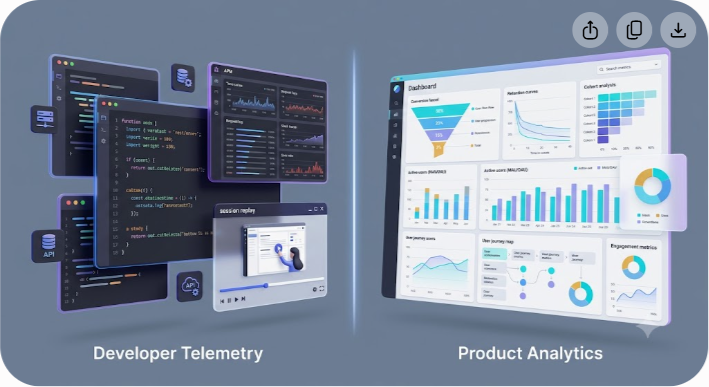
Choosing between PostHog and Amplitude isn't a battle between two identical dashboards—it is a fundamental architectural choice between an all-in-one developer operating system and an enterprise-grade behavioral analytics suite.
Here is the direct answer: PostHog is the best choice for engineering-led, technical SaaS teams that want product analytics, session replay, feature flags, and error tracking unified in a single, transparently priced platform. Amplitude is the superior choice for growth-stage SaaS companies with dedicated product managers and data analysts who require sophisticated cohort behavioral modeling, predictive analytics, and enterprise data governance.
While both platforms answer the baseline question—"What are users actually doing inside our application?"—they approach the problem from completely opposite directions. In this breakdown, we evaluate both platforms across architecture, pricing structures, core features, setup complexity, and privacy controls to help you pick the right tool the first time.
Core Differences: PostHog vs. Amplitude at a Glance
Before evaluating specific features, it helps to understand the underlying philosophy driving each tool. Amplitude was built during the wave of standalone enterprise product analytics, designed to transform complex user event streams into intuitive reports for non-technical product managers. PostHog was created as an open-source answer to tool sprawl, built specifically for engineers and technical founders who prefer not to maintain six separate SDKs.
| Evaluation Metric | PostHog | Amplitude |
|---|---|---|
| Primary Audience | Engineers, Technical Founders, Product Engineers | Product Managers, Growth Marketers, Data Analysts |
| Core Architecture | All-in-One Dev Suite (Analytics, Replay, Flags, Errors) | Specialized Behavioral & Digital Analytics Suite |
| Deployment Options | Cloud (US/EU) or Self-Hosted (Open-Source / Docker) | Cloud (US/EU Multi-Tenant & Dedicated) |
| Billing Model | Pay-as-you-go per event / recording / request | Monthly Tracked Users (MTUs) + Event Caps |
| Free Tier Limit | 1M events/mo + 5K session replays/mo | 10,000 to 50,000 MTUs (Plan dependent) |
| Session Replay | Native, built-in out of the box | Add-on module / included on select tiers |
| Feature Flags & Experiments | Native, built-in out of the box | Separate product line (Amplitude Experiment) |
| Data Privacy & Compliance | Full data sovereignty via self-hosting option | Enterprise SOC2, HIPAA, ISO27001 compliance |
Architectural Philosophy: Open-Source Engine vs. Enterprise Suite
To make an informed decision, look beyond surface-level dashboards and evaluate how each platform integrates with your existing technology stack.
PostHog: The All-in-One Developer Platform
PostHog positions itself as a single telemetry engine for software products. Rather than requiring you to instrument Mixpanel for funnels, LogRocket for session recordings, LaunchDarkly for feature toggles, and Sentry for bug tracking, PostHog combines all four into a unified JavaScript SDK.
Because PostHog is open-core, engineering teams can inspect the codebase, build custom plugins, or self-host the infrastructure on their own cloud instances. This architecture eliminates vendor lock-in and allows developers to query underlying ClickHouse tables directly using SQL.
Amplitude: The Specialized Behavioral Analytics Engine
Amplitude is engineered specifically for granular behavioral discovery. It assumes that your data engineering team already streams raw events into a cloud data warehouse (like Snowflake, BigQuery, or Databricks) or customer data platform (like Segment).
Amplitude does not attempt to capture DOM interactions or manage application feature toggles out of the box on its base plan. Instead, it focuses heavily on user journey pathways, retention curves, persona clustering, and predictive churn modeling. Its query engine is optimized to handle complex multi-step funnels with millions of daily active users without performance slowdowns.
Deep Feature Breakdown: Which Tool Wins Where?
Evaluating product analytics requires testing how each platform handles everyday workflows: building funnels, reviewing session recordings, running feature flags, and maintaining clean data.
1. Funnel Analytics and Retention Analysis

Both platforms excel at basic conversion tracking, but their analytical depth diverges when examining complex user behavior.
- PostHog Funnels: Allows you to build conversion funnels, set time conversion windows, break down metrics by user properties, and calculate time-to-convert between steps. PostHog’s standout capability is its direct integration with Session Replay: if a user drops off between Step 2 and Step 3 in a signup funnel, you can click directly on that dropped-off cohort and watch recordings of their exact browser sessions to see where they encountered friction.
- Amplitude Funnels: Amplitude provides exceptionally deep funnel math. It offers advanced options like Any Order conversion, Exclusion Steps, Holding Constant variables, and Conversion Velocity. Furthermore, Amplitude offers Root Cause Analysis and Persona Cohorting—automatically surfacing which user properties or actions correlated most heavily with conversion drops or retention spikes without requiring manual SQL queries.
Verdict: Amplitude wins for statistical discovery; PostHog wins for visual bug identification via integrated session replay.
2. Session Replays and DOM Visualization
Observing actual user interactions provides immediate context that aggregate numbers alone cannot offer when debugging UX friction.
- PostHog Session Replay: Built natively into the primary platform, recording DOM changes, mouse movements, network requests, console logs, and click maps. You can filter recordings by custom events, errors, or feature flag states. The free tier includes 5,000 web recordings per month, making it practical for early-stage products.
- Amplitude Session Replay: Amplitude added session replay capabilities to bridge the visual gap. While fully functional and integrated into event charts, it functions as an add-on or higher-tier module. It operates more like an supplementary layer on a reporting tool rather than an integrated component of the developer workflow.
Verdict: PostHog. Native DOM replays tied directly to error stack traces and event logs inside one interface save considerable context-switching time.
3. Feature Flags and A/B Testing
Releasing code safely requires controlling feature access in real time.
- PostHog Feature Flags & Experiments: Included out of the box with 1 million free flag requests per month. You can roll out features to specific user segments, evaluate flags locally or server-side, and run multivariate A/B tests with automated statistical significance calculations.
- Amplitude Experiment: Amplitude treats experimentation as a dedicated enterprise product. While effective for growth teams running complex multivariate tests with strict statistical guardrails, it requires separate provisioning, setup, and contract negotiation for advanced capabilities.
Verdict: PostHog. Accessing feature toggles and A/B testing out-of-the-box without extra enterprise add-ons provides immediate value for SaaS teams.
4. Data Governance and Event Taxonomy
As a SaaS platform scales, event tracking can degrade into a disorganized collection of duplicate names like clicked_button, button_click, and signup_submit.
- PostHog Data Management: Offers event definitions, action grouping, and schema enforcement rules. It is developer-centric, allowing you to define actions retroactively using autocaptured frontend events or SQL transformations.
- Amplitude Data (Data Governance Hub): Provides enterprise-grade taxonomy management. Amplitude lets data teams set strict event schemas, block or transform invalid event payloads before they hit reporting tables, manage data dictionaries, and enforce naming conventions across multiple engineering teams.
Verdict: Amplitude. Its data governance tooling prevents taxonomy decay far better in larger organizations.
Pricing and Total Cost of Ownership (TCO)
Pricing structure is frequently where the PostHog vs Amplitude choice is decided. The two companies use fundamentally different billing metrics.
PostHog Pricing Structure: Transparent Usage-Based
PostHog operates on a usage-based model with no seat limits or mandatory minimum contracts. Every customer gets access to every feature, with monthly free allowances that reset every 30 days:
- Product Analytics: First 1,000,000 events/month free; then starts at $0.00005 per event (with volume discounts down to $0.000009).
- Session Replay: First 5,000 web recordings/month free; then starts at $0.005 per recording.
- Feature Flags: First 1,000,000 requests/month free; then starts at $0.0001 per request.
- Error Tracking: First 100,000 exceptions/month free; then $0.00037 per exception.
You can set monthly spending caps per product module directly inside the dashboard to keep costs predictable.
Amplitude Pricing Structure: MTUs and Contract Tiers
Amplitude primarily bills based on Monthly Tracked Users (MTUs)—the unique count of identified or anonymous users who perform at least one action in a 30-day window:
- Starter (Free): Covers up to 10,000–50,000 MTUs (depending on current promotional tiers) with basic core analytics, limited chart saves, and standard session replays.
- Plus Plan: Starts around $49/month (billed annually) for lower MTU volumes, scaling up as user volume increases.
- Growth & Enterprise Plans: Custom annual contracts. Based on published industry deal data, median enterprise contracts for scaling companies range from $30,000 to $65,000+ per year.
The Pricing Consideration for SaaS: MTU pricing can become unpredictable if your product receives high top-of-funnel traffic, maintains viral free tiers, or experiences user churn. If 100,000 users visit your marketing site or start a trial but only 2,000 become paying customers, Amplitude bills based on all 100,000 MTUs. Conversely, PostHog’s per-event pricing charges strictly for the exact volume of telemetry generated.
Implementation & Technical Overhead

Implementation complexity depends heavily on your team structure and data workflows.
Installing PostHog
PostHog installs using standard web or server SDKs (posthog-js, Node, Python, React Native, Go). When initialized with autocapture enabled, PostHog automatically records pageviews, clicks, form submissions, and input changes without requiring manual event instrumentation upfront.
javascript import posthog from 'posthog-js'
posthog.init('
While autocapture allows non-technical team members to build retroactive funnels instantly, best practice still involves adding explicit backend custom events (posthog.capture('subscription_upgraded')) for critical business metrics.
Installing Amplitude
Amplitude relies on explicit event tracking. Events are not captured automatically by default. Your team designs an event tracking plan (taxonomy) in advance, specifying every event name, event property, and user attribute.
javascript import amplitude from '@amplitude/analytics-browser';
amplitude.init('
While explicit instrumentation requires more initial planning (typically 2 to 4 weeks for complete implementation across a SaaS platform), it results in clean, structured data from the start.
Data Privacy, Security, and Self-Hosting
For SaaS platforms serving regulated industries or international markets with strict data residency requirements, control over telemetry data is critical.
- PostHog: Offers both US/EU cloud hosting and an open-source self-hosted option. Deploying PostHog inside a private Kubernetes cluster or cloud VPC keeps user data within your infrastructure. PII (Personally Identifiable Information) can be masked in the SDK before writing to storage.
- Amplitude: Operates as a managed cloud service with dedicated US and EU data centers. Amplitude provides enterprise security controls, SOC 2 Type II compliance, and HIPAA Business Associate Agreements (BAAs) on Enterprise tiers. However, Amplitude cannot be run self-hosted inside a private cloud environment.
Real-World SaaS Use Cases: Which Should You Pick?
Consider these three standard SaaS scenarios when selecting a platform:
Scenario A: Early-Stage Bootstrapped SaaS (1-10 Employees)
- Recommendation: PostHog
- Why: Speed and cost efficiency are paramount. PostHog’s free tier (1M events, 5K replays, 1M flag requests) provides operational headroom without initial software costs. You gain product analytics, session replay, and feature flags in one install without managing multiple vendor subscriptions.
Scenario B: Product-Led Growth (PLG) Scale-up (20-100 Employees)
- Recommendation: PostHog or Amplitude (Hybrid Approach)
- Why: If engineering speed is the focus and developers want feature flags paired with session replays, PostHog is ideal. If dedicated product managers need to analyze complex retention cohorts and cross-platform attribution, Amplitude Plus or Growth provides greater analytics depth.
Scenario C: Enterprise B2B SaaS with Large Data & Growth Teams
- Recommendation: Amplitude
- Why: When dedicated data engineers manage cloud data warehouses and non-technical PMs run complex behavioral cohort queries daily, Amplitude’s visualization interface, data governance hub, and predictive analytics justify the investment.
Common Pitfalls to Avoid
- Relying Solely on Autocapture: PostHog’s autocapture is convenient, but DOM changes during frontend refactors can break tracked funnels over time. Always instrument core conversion events explicitly.
- Skipping Taxonomy Design in Amplitude: Implementing Amplitude without a standardized event naming structure leads to cluttered data. Establish an event schema document before deploying SDK code.
- Overlooking MTU Spikes: High-traffic marketing campaigns or automated bot traffic can cause unexpected Amplitude MTU spikes, leading to overage charges.
- Tool Overlap: Maintaining separate subscriptions for analytics, feature flags, session recording, and error monitoring creates unnecessary expense. Audit your software stack to consolidate overlapping tools.
The Final Verdict
The decision between PostHog and Amplitude depends on matching software architecture to your team's workflow:
- Choose PostHog if: You want an integrated developer platform with usage-based pricing, open-source code options, native session replays, and no seat-based licensing.
- Choose Amplitude if: You have dedicated product managers and data analysts who require enterprise cohort discovery, behavioral modeling, and central data governance.
Evaluating SaaS tools shouldn't involve unexpected pricing models or hidden fees. At Saasbonus, we test software platforms and breakdown tech stacks to help software teams pick the right tools with confidence. Explore our recent software comparisons to refine your analytics setup.