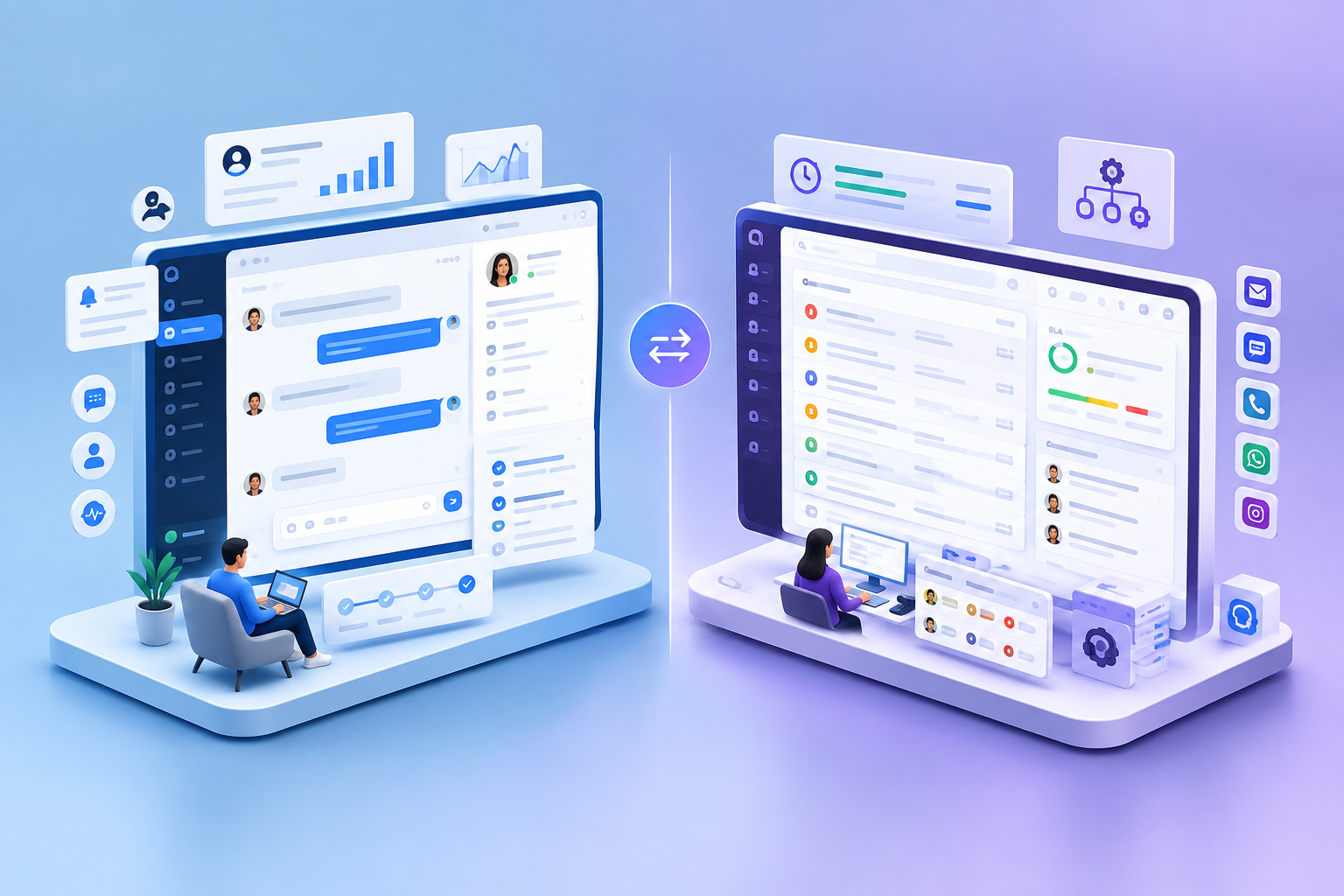
Pylon vs Plain: Best B2B Support Platform for SaaS?
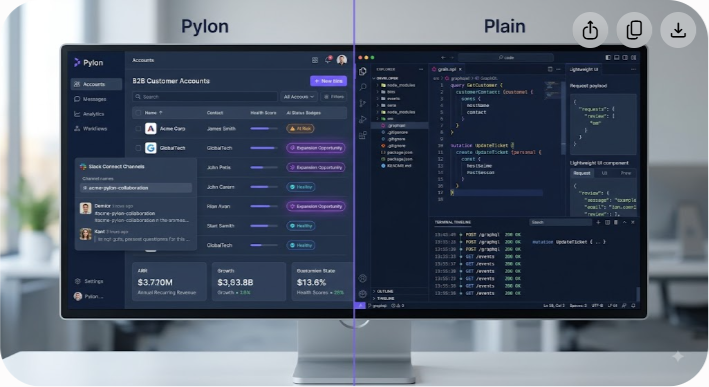
The Short Verdict: Pylon vs Plain in 60 Seconds
Choosing between Pylon and Plain comes down to a fundamental operational choice: do you want an out-of-the-box, account-intelligent support workspace built for non-technical customer success and support operations, or do you want an API-first support engine designed for engineering teams that want to embed support directly into their product architecture?
If your B2B SaaS company manages dozens or hundreds of high-touch enterprise accounts across Slack Connect, Microsoft Teams, email, and Discord, and your customer operations team wants AI agents and account health signals without writing backend code, Pylon is the clear winner. It aggregates context from Salesforce, HubSpot, Linear, and Slack threads before a human agent even opens a ticket.
Conversely, if your engineering team treats customer support as a core product feature, wants full data ownership, and prefers composable GraphQL APIs, custom UI primitives, and Model Context Protocol (MCP) servers to build custom support workflows inside your own application UI, Plain is the superior architectural choice.
Here is a quick snapshot of how they stack up across primary technical and operational criteria:
| Operational Factor | Pylon | Plain |
|---|---|---|
| Core Philosophy | Full-stack, out-of-the-box agentic support workspace | Developer-first support primitives and API engine |
| Primary Persona | Support leads, Customer Success Managers, Ops teams | Engineering leads, technical product managers, developers |
| Channel Strengths | Native Slack Connect, MS Teams, Email, In-App, Discord | Embedded web UI, custom app forms, API streams, Slack |
| AI Implementation | Pre-built AI agents with Account Intelligence (ARR, health) | Bring-your-own AI, custom prompts, or native Ari/Sidekick |
| Implementation Time | Days to weeks (no-code and low-code setup) | Weeks (requires frontend and backend engineering time) |
| CRM & Bug Sync | Bidirectional sync with Salesforce, HubSpot, Linear, Jira | API-driven customer models and webhook-based integrations |
| Customization Depth | UI templates, automated rules, custom fields | Unlimited via GraphQL API, webhooks, and custom React components |
| Ideal Customer Profile | Growing to enterprise B2B SaaS with high Slack volume | Engineering-led B2B SaaS, developer tools, and infrastructure |
Why Traditional Helpdesks Break Down in Modern B2B SaaS
For over a decade, legacy helpdesks like Zendesk and Freshdesk dominated customer service. They operated on a simple paradigm: a customer visits a web portal or sends an email, a ticket is created with a tracking number like #48291, and an isolated support representative replies through a transactional email queue.
That model fails for modern B2B Software-as-a-Service companies. Modern high-value SaaS deals are rarely sold or retained over single-threaded email. Instead, mid-market and enterprise B2B customers expect real-time access to customer success, support engineers, and product managers through dedicated Slack Connect channels or Microsoft Teams workspaces.
When support moves to conversational channels, legacy ticketing systems create severe operational friction:
- Thread Fragmentation: A single customer issue leads to fifteen unstructured Slack messages, two unlinked code snippets, and a side conversation in a private channel. Standard helpdesks turn this into fifteen distinct email tickets or ignore the messages entirely.
- Account Context Blindness: A support representative answering an urgent message often has no idea if the user belongs to a $5,000 annual account or a $200,000 enterprise contract facing an imminent renewal.
- Engineering Disconnect: Software bugs reported in Slack or live chat are manually copy-pasted into Linear or Jira, losing reproduction steps, user logs, and account severity.
- Context Switching Burnout: Support agents spend half their working day jumping between CRM tabs, database query dashboards, Slack workspaces, and email queues just to assemble basic facts.
Both Pylon and Plain were created to solve this specific structural breakdown, but they approach the solution from opposite sides of the stack.
What is Pylon?
Pylon is an omnichannel, agentic support workspace built explicitly for B2B SaaS companies. It bridges the gap between conversational messaging channels (like Slack Connect, Microsoft Teams, and Discord) and traditional support workflows.
Instead of treating Slack as an external messaging add-on, Pylon treats conversational channels as first-class citizens alongside email and in-app chat widgets. It ingests raw messages from shared customer channels, groups related discussions using AI thread parsing, and converts them into structured issues.
The platform operates through three sequential processing layers:
- Channel Ingestion Layer: Collects live messages across Slack Connect, Microsoft Teams, Email, Discord, and In-App Chat.
- Unified Account Intelligence Engine: Normalizes raw messages and attaches account data including ARR, Health Scores, CRM fields, and Linear issue statuses.
- Agentic Automation and Workspace UI: Routes triaged issues to out-of-the-box AI Agents or presents them inside an omnichannel inbox for human operators.
Core Capabilities of Pylon
- Account Intelligence: Pylon links every incoming ticket or Slack message directly to account-level business metrics. Before a support agent reads a message, Pylon displays the account's Annual Recurring Revenue (ARR), contract tier, renewal date, health score, and open engineering bugs.
- Omnichannel Inbox: Unifies Slack Connect, Microsoft Teams, in-app chat, email, web forms, and Discord into a single agent inbox. Agents can reply inside Pylon, and the response posts natively back to the customer's specific Slack thread or email chain.
- Agentic AI Automation: Pylon ships pre-configured AI agents that triage incoming requests, gather missing diagnostic details, search company documentation, and resolve routine issues autonomously without human intervention.
- No-Code Workflow Builder: Non-technical team members can design complex routing logic, SLA tracking, and escalation paths using an intuitive rule builder.
- Bidirectional CRM and Issue Sync: Deep integrations with Salesforce, HubSpot, Linear, and Jira keep account data, deal stages, and bug reports synchronized across all systems.
What is Plain?
Plain is a developer-first, API-centric support platform engineered for technical product teams who want to build custom support experiences into their applications. Plain provides the backend primitives, data models, webhooks, and GraphQL endpoints needed to manage customer communications, paired with an ultra-fast, minimalist workspace UI for support personnel.

While traditional support platforms force you into their predefined UI opinions and hosted widgets, Plain operates as infrastructure. It allows developers to build support forms directly inside a web app, stream events to internal data warehouses, and script custom AI agents.
Its architecture runs on three foundational infrastructure tiers:
- Ingestion and Entry Points: Captures interactions via Custom App UIs, GraphQL API requests, incoming Webhooks, and native Slack sync.
- Composable Headless Support API: Processes customer models, thread states, key-value metadata, and timeline activity events.
- Agent UI and Custom Integrations: Surfaces threads inside a keyboard-driven agent workspace while exposing Model Context Protocol (MCP) servers and custom AI nodes for developer pipelines.
Core Capabilities of Plain
- GraphQL API First: Every action available in the Plain workspace can be executed programmatically through a well-documented GraphQL API.
- Composable Customer Timeline: Plain aggregates support interactions alongside custom app events, tenant metrics, and deployment history directly into a clean customer timeline.
- Lightweight, Keyboard-Driven UI: Designed like a modern developer tool, the Plain agent interface features rapid keyboard shortcuts, instant search, and zero bloat.
- Custom MCP Servers and AI Flexibility: Plain allows engineering teams to hook up Model Context Protocol (MCP) servers or connect their own custom LLM pipelines, giving complete control over how AI reads internal app data.
- Native Slack Integration: Plain supports messaging via Slack, allowing teams to handle Slack threads alongside internal application requests.
Head-to-Head Architectural Comparison
To understand which platform fits your organization, we must analyze how they perform across six crucial operational pillars.
1. Omnichannel Slack and Teams Orchestration
If Slack Connect or Microsoft Teams is your primary customer communication channel, Pylon and Plain approach thread management differently.
Pylon was built from day one to master Slack Connect and Microsoft Teams at enterprise scale. It automatically tracks customer messages across hundreds of shared channels without requiring custom bot triggers for every message. Pylon recognizes when multiple customer employees comment on an issue, automatically threads responses, and enforces response-time SLAs specific to Slack channels. If an unthreaded message arrives in a customer channel three days after an issue was marked closed, Pylon intelligently evaluates whether to re-open the existing issue or spawn a new linked ticket.
Plain supports Slack as an official channel, converting Slack messages into threads within the Plain interface. However, Plain's philosophy expects your engineering team to define how customers interact with your support ecosystem. While it handles bidirectional message syncing cleanly, managing complex multi-tenant Slack environments with tailored SLA rules requires more hands-on schema configuration or custom logic compared to Pylon's pre-packaged workflows.
Key Takeaway: Pylon offers a turnkey, operations-ready Slack Connect suite. Plain provides a clean, API-backed Slack bridge that fits best when embedded into broader developer workflows.
2. AI Agents, Copilots, and Context Layers
Artificial intelligence in customer support has evolved past simple text-deflection chatbots. Modern SaaS platforms demand agents that can inspect database states, summarize technical issues, and interact with external systems.
Pylon's AI Architecture: Pylon ships out-of-the-box Background Agents, a Support Agent, and an Assist Agent. The core strength of Pylon's AI is its pre-built Account Intelligence layer. When a ticket arrives, Pylon's AI automatically analyzes historical Slack threads, CRM opportunity values, contract health scores, and linked engineering tickets before presenting a suggested resolution or taking autonomous action. Non-technical support managers can adjust agent permissions, guidelines, and knowledge base sources in plain text without engineering deployment cycles.
Plain's AI Architecture: Plain provides native AI capabilities (Ari and Sidekick) while emphasizing developer flexibility. Plain allows teams to connect Model Context Protocol (MCP) servers. This means if you have proprietary internal databases, complex backend microservices, or specific compliance boundaries, your engineers can expose custom tool definitions directly to Plain's agents. However, out-of-the-box, Plain's agents do not automatically inherit account health context or CRM contract metrics unless your engineers configure those data pipelines through the API.
Key Takeaway: Pylon provides immediate, no-code AI grounded in B2B account business context. Plain offers superior extensibility for developer teams who want to build custom MCP tooling or bring their own models.
3. CRM, Data Models, and B2B Account Intelligence
Understanding who is asking a question is just as important as answering the question itself.
Pylon Account Intelligence: Pylon is explicitly structured around the B2B account model. It aggregates individual users into company accounts, continuously syncing fields with Salesforce and HubSpot. Pylon calculates holistic health indicators based on sentiment, average first-response time across channels, open bug count, and ticket frequency. Customer Success Leads can review dedicated dashboard views showing high-ARR accounts with degraded support experiences before an account threatens churn.
| Account Field | Pylon Status | Context Details |
|---|---|---|
| Account Name | Acme Corp | Tier: Enterprise ($150k ARR) |
| Health Score | At-Risk | Sentiment: Negative (-0.4) |
| Open Tickets | 4 total (2 Urgent) | Assigned CSM: Sarah Jenkins |
| Linked Bug | LINEAR-402 | Status: API Latency Spike in EU Region (In Progress) |
Plain Customer Primitives: Plain models data around Customers, Threads, and Events. Rather than assuming a rigid CRM structure, Plain gives engineers clean GraphQL mutations to update customer attributes, attach key-value metadata, and log custom events (such as workspace upgrades, API limit exceptions, or deployment failures). This makes Plain exceptional at surfacing technical context directly inside the ticket view, though building account-level executive rollups requires custom reporting or data warehouse exports.
| Customer Field | Plain Metadata | Timeline Event Stream |
|---|---|---|
| User Profile | Alex Chen (alex@devco.io) | Tenant: devco-prod-02 |
| App SDK Version | v4.12.0 | Account Plan: Pro Developer |
| Recent Event 1 | 10:14 AM | API key rotated |
| Recent Event 2 | 10:18 AM | Thread Opened: Webhook failing with status 502 |
| System Event | 10:19 AM | Error trace #99401 attached via API |
Key Takeaway: Pylon excels at commercial account management and CS cross-collaboration. Plain excels at technical developer telemetry and user-level event logging.
4. Implementation Effort and Engineering Overhead
One of the biggest differences between these platforms is the upfront and ongoing engineering investment required.
Pylon Implementation Timeline
- Connect Channels (Day 1): Grant OAuth access to Slack Connect, Microsoft Teams, and email domain routers.
- Sync CRM and Bug Trackers (Day 2): Connect Salesforce, HubSpot, Linear, or Jira through native integration settings.
- Configure Workflows (Days 3-5): Build SLA queues, agent assignment rules, and knowledge base routing using the no-code builder.
- Launch AI Agents (Week 2): Test Background Agents against historical ticket data and turn on auto-replies.

Total Engineering Time Required: Minimal (typically 0 to 5 hours for DNS routing and application permissions).
Plain Implementation Timeline
- Schema Design (Week 1): Map your customer identity model, thread metadata, and event triggers to Plain's GraphQL schema.
- Backend API Integration (Week 2): Implement Plain's SDK in your backend services to programmatically create threads, pass JWT tokens, and listen to webhooks.
- Frontend Integration (Week 3): Build embedded support components or forms directly into your web application using Plain UI components or raw endpoints.
- Custom Tooling / MCP Setup (Week 4): Configure custom internal tools, MCP servers, or bot workflows to automate issue resolution.
Total Engineering Time Required: Moderate to High (typically 20 to 60+ engineering hours initially, plus ongoing software maintenance).
Practical Use Cases: When to Choose Which
To make this decision actionable, let us evaluate three typical SaaS company profiles.
Profile A: Mid-Market B2B SaaS with High Slack Volume
- Company Profile: 50 employees, $5M ARR, 120 customer accounts on Slack Connect.
- Primary Pain Point: Support engineers and CSMs miss messages in Slack. Sales has no visibility into open issues during renewal conversations.
- Recommendation: Choose Pylon. Pylon will immediately centralize every Slack Connect channel into a single queue, enforce SLAs, attach Salesforce deal values to incoming questions, and prevent missed messages without requiring a dedicated engineer to build integrations.
Profile B: API-First Developer Tool / Infrastructure Platform
- Company Profile: 25 employees, technical audience (developers, DevOps), product-led growth model.
- Primary Pain Point: Wants users to submit tickets directly inside the web console with automatic diagnostic attachments (browser logs, backend traces, tenant ID).
- Recommendation: Choose Plain. Plain's GraphQL API and component-friendly model allow your engineers to build a seamless, native support experience right inside your dashboard while retaining full control over telemetry and UI styling.
Profile C: Multi-Product Enterprise SaaS
- Company Profile: 200 employees, hybrid GTM (Self-serve + High-touch enterprise), using email, web forms, and MS Teams.
- Primary Pain Point: Operations wants unified SLA analytics across all tiers, and CS leadership needs AI agents to auto-deflect basic questions while escalating enterprise accounts.
- Recommendation: Choose Pylon. The omnichannel coverage, robust no-code rule builder, and pre-built AI agent framework allow the operations team to scale support without demanding constant frontend dev work.
Common Implementation Mistakes to Avoid
When evaluating or rolling out either Pylon or Plain, engineering and support leaders often make predictable missteps:
- Buying Plain Without Dedicated Engineering Bandwidth: Plain is an exceptionally engineered product, but treating it like a turnkey SaaS app without allocating engineering time leads to stalled rollouts. Ensure your team has sprint capacity allocated before choosing an API-first solution.
- Ignoring Slack Channel Naming Hygiene: When adopting Pylon for Slack support, failing to standardize customer channel names (e.g., support-acme vs acme-help) makes workspace routing harder. Establish strict naming conventions during onboarding.
- Over-automating AI Responses on Day One: Launching autonomous AI agents without backtesting against past support data risks frustrating high-value enterprise accounts. Start with AI in copilot/suggested mode before enabling full auto-resolution.
- Failing to Map Custom Metadata Early: In both tools, neglecting to define key account tags (e.g., tier, region, account_owner) during initial setup forces painful data cleanup later when building reporting dashboards.
Total Cost of Ownership (TCO) Considerations
When calculating the true cost of a B2B support platform, software subscription prices are only one part of the equation.
- Subscription Pricing Models: Pylon typically prices on per-seat or tier-based commercial models with modules for Slack/Teams connectors and advanced AI agents. Plain uses seat-based and usage-aware tiers reflecting API calls, threads, and workspace seats.
- Engineering Maintenance Overhead: Plain requires ongoing developer attention when you add new product features, update customer data schemas, or build new in-app support components. Pylon shifts configuration maintenance to non-technical operations staff using its no-code builder.
- Context Switching Costs: Pylon's built-in Account Intelligence saves support reps an estimated 3 to 5 minutes per ticket by eliminating manual CRM and account lookup steps. Multiply that across 1,000 monthly tickets, and operational savings become significant.
Summary Checklist: Making Your Final Choice
Ask your team these four direct questions to make your decision:
- Who will own the support setup and maintenance?
- Support Ops / Customer Success Leads: Choose Pylon
- Software Engineering / Product Leads: Choose Plain
- Where do your most valuable customers talk to you today?
- Shared Slack Connect or Microsoft Teams channels: Choose Pylon
- Directly inside your web application via embedded forms/APIs: Choose Plain
- How do you want AI to interact with customer data?
- Pre-packaged AI that automatically understands ARR and CRM health: Choose Pylon
- Custom LLMs, custom prompts, and developer-built MCP servers: Choose Plain
- What is your target time-to-value?
- Up and running in days without an engineering sprint: Choose Pylon
- Built custom into your product over a multi-week engineering cycle: Choose Plain
Final Conclusion
Both Pylon and Plain represent the modern generation of B2B support software, leaving legacy email-only ticketing systems far behind.
If your priority is giving your customer success and support teams a powerful, out-of-the-box omnichannel workspace that deeply understands B2B business metrics and Slack channels, Pylon is your best partner.
If your priority is architectural elegance, composable APIs, developer ergonomics, and total control over how support is woven directly into your software product, Plain is the superior tool.
At Saasbonus, we publish independent, hands-on reviews and technical benchmarks to help founders, engineering leaders, and operations managers make the right software decisions the first time. Explore our complete library of B2B SaaS comparisons to make sure your software stack scales as fast as your business.