Qdrant vs Weaviate: Which Vector DB Fits Production AI?
The Core Verdict: Qdrant vs Weaviate in 60 Seconds
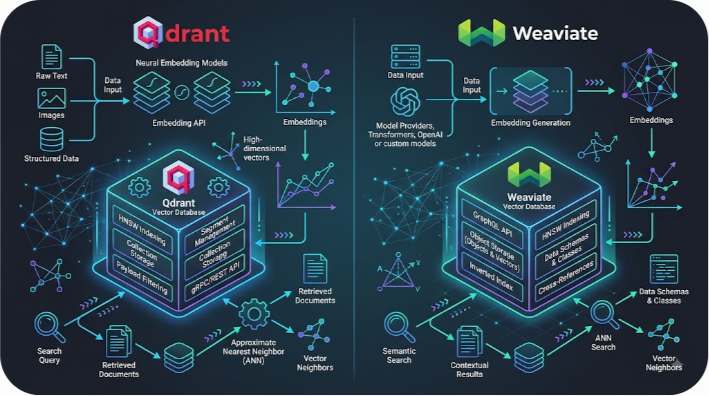
For production Retrieval-Augmented Generation (RAG) and high-throughput vector search systems, choosing between Qdrant and Weaviate comes down to a fundamental architectural trade-off: do you need an ultra-fast, memory-efficient vector engine built for complex metadata filtering, or do you need a batteries-included AI data platform with native multi-tenancy and built-in embedding pipelines?
- Choose Qdrant if: Your application demands single-digit millisecond p99 query latencies, high concurrent throughput (QPS), aggressive vector quantization to minimize RAM overhead, and complex payload filtering. Written in Rust, Qdrant is optimized for raw infrastructure performance, cost efficiency at scale, and custom application pipelines where you manage embeddings externally.
- Choose Weaviate if: You are building a multi-tenant SaaS application or enterprise knowledge base that requires built-in hybrid search (BM25 keyword matching plus vector similarity), native multi-tenant isolation out of the box, and integrated vectorization modules that automatically turn incoming text or images into embeddings without external orchestrators. Written in Go, Weaviate functions as an all-in-one AI platform.
At Saasbonus, we routinely evaluate backend infrastructure and database software to help engineering teams avoid costly architectural rewrites. Switching vector databases after indexing hundreds of millions of high-dimensional vectors is expensive. This guide breaks down the core technical differences between Qdrant and Weaviate across architecture, indexing, filtering, multi-tenancy, resource consumption, and cloud pricing.
Deep Dive Comparison Matrix
The following table highlights how Qdrant and Weaviate compare across key engineering criteria:
| Engineering Feature | Qdrant | Weaviate |
|---|---|---|
| Core Language | Rust | Go (with C extensions for HNSW) |
| Primary API Style | REST, gRPC | GraphQL, REST, gRPC |
| Vectorization Pipeline | External (BYO embeddings or FastEmbed) | Built-in modules (OpenAI, Cohere, HuggingFace, etc.) |
| Hybrid Search | Sparse + Dense Vectors (native BM25 via sparse indices) | Native Hybrid Search (BM25 keyword + Dense vector fusion) |
| Filtering Engine | Payload-aware HNSW graph filtering | Inverted index filtering combined with vector traversal |
| Quantization Methods | Scalar (SQ8), Product (PQ), Binary (BQ) | Product (PQ), Scalar (SQ8), Binary (BQ) |
| Multi-Tenancy | Collection-level or Payload-based tenant key filtering | Native Multi-Tenant Classes (Active/Inactive state isolation) |
| Multi-Vector Support | Native Named Vectors (multiple vector spaces per point) | Supported via Named Vectors |
| Storage Engine | Memory-mapped files (mmap) with Write-Ahead Log (WAL) | Custom LSM-tree based object and vector storage |
| Garbage Collection (GC) | Zero-cost abstractions (no GC pauses) | Go Runtime GC (requires tuning for peak RAM allocations) |
Core Architecture: Go vs. Rust Under the Hood
To understand why these two databases behave differently under production load, you have to look at their runtime engines and storage architecture.
Qdrant: Purpose-Built Engine in Rust
Qdrant was designed from day one in Rust as a specialized vector search engine. By avoiding garbage collection overhead entirely, Qdrant achieves predictable memory utilization and lower p99 latency variances. It handles concurrency through native asynchronous Rust routines and low-level memory control.
Qdrant organizes data into Points, where each Point consists of:
- An ID (UUID or integer).
- One or more vector embeddings (supports dense vectors and sparse vectors natively via named vectors).
- A JSON Payload containing arbitrary structured or unstructured metadata (strings, numbers, booleans, nested objects, geo-coordinates).
Data persistence relies on custom memory-mapped storage combined with Write-Ahead Logging (WAL). Because Qdrant allows vectors to reside in memory-mapped files on NVMe SSDs while keeping index structures in RAM, it scales efficiently without forcing every single vector float array to consume active system memory.
Weaviate: Object-Vector Hybrid Engine in Go
Weaviate is built in Go and positions itself as an AI-native database rather than just a vector indexer. It combines structured object storage with high-dimensional vector search into a single unified architecture.
In Weaviate, data is structured into Classes (similar to tables in SQL or collections in MongoDB). Each data object contains:
- A UUID and timestamp.
- Class properties defined by a strongly typed schema.
- The vector representation (either generated automatically by an attached vectorization module or supplied manually).
Weaviate uses a custom LSM-tree (Log-Structured Merge-tree) storage engine for objects and inverted indices. For vector indexing, it integrates HNSW implementations optimized in C/C++ alongside Go bindings. While Go's garbage collector has improved significantly over recent releases, high-throughput memory allocations during large batch ingestions can still introduce GC latency spikes if heap allocations are not carefully tuned.
Vector Indexing and Quantization: RAM Footprint at Scale
In vector search, RAM is your primary infrastructure cost driver. Storing 100 million OpenAI embeddings (1,536 dimensions using standard 32-bit floating point numbers) requires roughly 614 GB of pure raw vector memory—before accounting for HNSW graph edges, metadata, and index overhead.
Both Qdrant and Weaviate implement HNSW (Hierarchical Navigable Small World) graphs as their primary approximate nearest neighbor (ANN) search index. However, their approach to vector compression and memory management differs in practice.
Quantization Strategies in Qdrant
Qdrant offers extensive built-in vector quantization options to reduce memory footprints by up to 95% with minimal impact on retrieval recall:
- Scalar Quantization (SQ8): Compresses 32-bit floats (float32) down to 8-bit integers (int8), cutting RAM usage by 75% while maintaining ~98%+ recall. Qdrant keeps quantized vectors in RAM for fast distance calculations and pulls original vectors from disk only for final rescoring.
- Product Quantization (PQ): Divides vector vectors into sub-vectors and quantizes them into centroids. This achieves higher compression ratios (up to 90-95% RAM savings) at a slight cost to indexing speed and recall accuracy.
- Binary Quantization (BQ): Converts float values into single-bit binary values (positive vs. negative). Designed specifically for high-dimensional model outputs (such as OpenAI's text-embedding-3-large or Cohere v3), BQ provides a 32x memory reduction and enables hyper-fast Hamming distance calculations on modern CPUs.
Quantization Strategies in Weaviate
Weaviate provides flexible quantization controls configured at the Class level:
- Product Quantization (PQ): Weaviate's primary compression driver. It allows real-time background vector quantization once a threshold number of objects are indexed. It supports configurable codebook sizes and vector segment dimensions.
- Dynamic Vector Caching: Weaviate can unload vectors from memory to disk when they aren't actively being queried, loading them back on-demand. This reduces idle infrastructure costs for infrequently accessed data partitions.
- Binary & Scalar Quantization: Recent updates have expanded Weaviate's support for Binary and Scalar quantization methods, allowing high-density indexing similar to Qdrant.
Infrastructure Rule of Thumb: If your production dataset exceeds 50 million vectors and budget constraints require running on minimal RAM nodes, Qdrant's combined combination of Binary Quantization, on-disk payload storage, and memory-mapped HNSW edges generally yields lower cloud compute bills.

Metadata Filtering: Pre-Filtering, Post-Filtering, and Filtered HNSW
In real-world enterprise software, vector queries almost never run in isolation. A user doesn't just search for "documents about quarterly revenue." They search for "documents about quarterly revenue where tenant_id = 'acme_corp' AND region = 'US-East' AND created_year >= 2025."
How a vector database handles metadata filtering determines whether query latency stays flat at 5ms or balloons to 1,500ms when filtering eliminates 99% of the dataset.
Naïve Post-Filtering: Vector Search (Top 100) -> Apply Filter -> 2 Matching Results (Low Recall!)
Naïve Pre-Filtering: Apply Filter (100,000 matches) -> Exact Vector Scan (High Latency!)
Payload-Aware HNSW Graph Search (Qdrant & Weaviate): Traverse HNSW Graph directly filtering valid nodes during graph traversal
Qdrant's Payload Engine
Qdrant treats payload filtering as a core architectural primitive rather than an addon. When building HNSW graphs, Qdrant constructs payload indexes (keyword, numeric range, geo, text, datetime) alongside the vector index.
During a query, Qdrant's search algorithm dynamically selects between three execution paths based on filter cardinality:
- Custom Filtered HNSW Traversal: The search algorithm traverses the HNSW graph while evaluating payload conditions at every step. If a node fails the filter, the engine follows its graph links to adjacent matching nodes without abandoning graph search efficiency.
- Inverted Index Iteration: If the filter is highly restrictive (e.g., matching only 0.01% of vectors), Qdrant bypasses HNSW graph traversal and executes exact vector distance evaluation directly on the small matching subset retrieved from inverted payload indices.
- Iterative Unfiltered HNSW: If the filter is unrestrictive (e.g., matching 99% of vectors), Qdrant runs normal HNSW vector search and filters results on the fly.
Because Qdrant handles this decision automatically, query latency remains predictable even under complex nested logical filters (AND, OR, NOT, MATCH, RANGE).
Weaviate's Filtered Traversal
Weaviate uses a combined inverted index and object storage mechanism. Filters in Weaviate are declared using structured where operators across class properties.
Weaviate implements an optimized single-stage filtering algorithm that uses its inverted index to create a bitset of valid object IDs prior to traversing the HNSW index. The HNSW graph search then uses this bitset to ignore non-matching nodes during search.
While highly effective for general schema queries, extremely restrictive filters on massive collections in Weaviate can occasionally suffer from latency degradation if the bitset checking slows down graph expansion, though recent updates have reduced this gap.
Hybrid Search and Multi-Modal Pipelines
Pure vector similarity search (dense retrieval) excels at capturing conceptual meaning, but it fails on exact keyword matching. If a user queries a product code like ERR-502-X9, a pure vector search model might return generic documents about HTTP server errors rather than the exact product manual page containing that specific string.
Production RAG systems solve this by combining Dense Vectors (semantic search) with Sparse Retrieval (BM25 keyword search) in a hybrid pipeline.
User Query: "How to fix error code ERR-502-X9" | +--> Dense Vector Search (OpenAI / Cohere) ---> Semantic Results | +--> BM25 Keyword Search (Exact Text Match) ---> Exact Match Results | +--> Reciprocal Rank Fusion (RRF) / Alpha Blending ---> Final Ranked List
Weaviate: The Hybrid Search Powerhouse
Hybrid search is where Weaviate clearly excels. Hybrid retrieval is natively built into Weaviate's query engine without requiring external plugins or dual-database setup.
When querying a Weaviate class, you can pass a single hybrid query object containing:
- query: The search string.
- alpha: A weighting parameter between 0.0 and 1.0.
- alpha = 0.0: Pure BM25 keyword search.
- alpha = 0.5: Equal combination of BM25 and vector scores.
- alpha = 1.0: Pure dense vector search.
- fusionMethod: Choose between Reciprocal Rank Fusion (RRF) or relative score fusion.
Because Weaviate manages both the inverted BM25 index and the HNSW vector index within the same storage node, hybrid search runs in a single turn without network overhead between separate search services.
Qdrant: Sparse Vector and Named Multi-Vectors
Qdrant handles hybrid search through its Sparse Vector architecture and Named Vectors feature.
Instead of running an internal traditional BM25 text indexer, Qdrant allows Points to store multiple vectors per record (e.g., a dense vector from OpenAI and a sparse vector generated by models like SPLADE, BM25, or BGE-M3).
- Named Vectors: A single Qdrant Point can store a text embedding, an image embedding (CLIP), and a title embedding simultaneously. You can query specific vector spaces or search across multiple spaces in a single request.
- Sparse Vectors: Qdrant natively indexes inverted sparse vector representations. By combining dense and sparse vector queries with Prefetching and Reciprocal Rank Fusion (RRF) rules directly inside Qdrant's API, you achieve production-grade hybrid search.
While Qdrant requires your application or indexing worker to generate the sparse tokens (or use FastEmbed), it gives engineering teams fine-grained control over how text is tokenized and scored.
Multi-Tenancy Architecture: Building B2B SaaS Products
If you are building a multi-tenant B2B SaaS platform (where thousands of business customers store isolated documents), tenant data isolation is a hard security and performance requirement. You cannot allow Customer A to view or query Customer B's embeddings.
There are three standard ways to implement multi-tenancy in a vector database:
- Collection-per-Tenant: Create a separate vector collection for every user or organization.
- Payload/Metadata Filtering: Store all data in one giant collection with a tenant_id metadata key and inject tenant_id == X into every search request.
- Native Class Multi-Tenancy: The database manages isolated internal index structures per tenant automatically under a single collection abstraction.
Weaviate: Native Multi-Tenancy Classes
Weaviate provides built-in multi-tenancy designed specifically for SaaS platforms. When defining a class in Weaviate, you simply set multiTenancyConfig: { enabled: true }.
Key architectural benefits in Weaviate:
- Isolated Indexes: Weaviate creates distinct physical storage shards and HNSW graphs for each tenant behind the scenes.
- Tenant Lifecycle Management: You can explicitly set a tenant's state to HOT (active in memory), COLD (offloaded to disk/object storage), or FROZEN.
- Cost Control: For SaaS applications with thousands of free-tier users who rarely log in, setting inactive tenants to COLD frees up memory, allowing you to serve 10,000+ tenants on modest cluster footprints.
Qdrant: Payload Filtering and Multi-Collection Strategies
Qdrant takes a streamlined, payload-driven approach to multi-tenancy:
- Payload Tenant Keys: For small to medium tenant counts (up to thousands), Qdrant recommends storing all data in a single collection with a payload index on tenant_id. Qdrant's payload-aware HNSW algorithm ensures search queries filtered by tenant_id execute with near-zero overhead.
- Collection-Level Isolation: For large enterprise tenants with massive volume, dedicated collections can be provisioned on demand.
- Grid Sharding: Qdrant supports dynamic collection sharding across distributed nodes, allowing multi-tenant collections to scale horizontally seamlessly.
While Qdrant lacks Weaviate's native automated HOT/COLD state transition API per tenant, its lower baseline memory consumption often makes single-collection payload partitioning simple and highly performant at scale.
Developer Experience, API Ecosystem, and RAG Integration

Developer velocity is often the deciding factor for engineering teams building fast-moving AI features.
Weaviate: Batteries-Included Platform
Weaviate prioritizes an integrated developer experience. It features a module ecosystem (text2vec-openai, text2vec-cohere, text2vec-huggingface, generative-openai, img2vec-neural) that handles embedding generation and LLM prompt orchestration directly inside the database node.
When you insert raw text into Weaviate with an active vectorizer module, Weaviate calls the model provider API, generates the vector, and stores the object automatically. Similarly, with generative search modules, you can execute RAG queries that return completed LLM responses alongside retrieved source context in a single GraphQL or v4 Python SDK request.
```python
Weaviate v4 Python SDK Example: Integrated RAG Search
import weaviate
client = weaviate.connect_to_weaviate_cloud(cluster_url=URL, auth_credentials=AUTH) documents = client.collections.get("Document")
response = documents.generate.near_text( query="How does rate limiting work?", limit=3, grouped_task="Summarize the rate limit policies into 3 bullet points." )
print(response.generated)
Qdrant: Explicit and Modular Control
Qdrant follows the Unix philosophy: do vector search, and do it exceptionally well. Qdrant does not attempt to be an LLM orchestrator or embedding pipeline host. Instead, it expects your application layer (or framework like LangChain, LlamaIndex, or Haystack) to pass embeddings explicitly.
For developers who want lightweight local vectorization without cloud API dependencies, Qdrant maintains FastEmbed—a high-performance, lightweight Python library built for fast local embedding generation using ONNX runtime.
python
Qdrant Python SDK Example: Clean, Explicit Vector Search
from qdrant_client import QdrantClient from qdrant_client.models import Filter, FieldCondition, MatchValue
client = QdrantClient(url="https://your-cluster.qdrant.tech", api_key="YOUR_KEY")
search_results = client.search( collection_name="enterprise_knowledge", query_vector=("dense", [0.023, -0.412, 0.119, ...]), # Explicit vector query_filter=Filter( must=[ FieldCondition(key="tenant_id", match=MatchValue(value="acme_corp")), FieldCondition(key="status", match=MatchValue(value="published")) ] ), limit=5 )
Developers who prefer clean REST/gRPC interfaces, strongly typed Python/TypeScript clients, and total control over embedding worker pipelines often prefer Qdrant's explicit design.
Benchmarks, Latency, and Throughput Under Concurrency
Evaluating performance benchmarks across vector databases requires looking at p95/p99 latency under concurrent search load (Queries Per Second / QPS) rather than single-threaded batch search.
Independent benchmarks (including VectorDBBench and community stress tests) highlight distinct operational profiles:
1. Pure Vector Retrieval Throughput
- Qdrant (Rust): Consistently delivers higher throughput (2x to 4x QPS compared to Go-based alternatives on identical hardware instances). The zero-overhead Rust runtime maintains steady 3ms to 8ms p99 latencies even when concurrency ramps up to hundreds of parallel requests.
- Weaviate (Go): Delivers fast retrieval (typically 10ms to 25ms p95 latencies). Under extreme QPS saturation, latency variances can widen slightly due to Go runtime scheduler overhead and garbage collection cycles under high memory pressure.
2. Performance Under Restrictive Filtering
- Qdrant: Maintains linear performance even when filters isolate 1% or less of the total vector dataset. Its payload index choices ensure graph traversal does not collapse into brute-force iteration.
- Weaviate: Performs well across standard filter schemas. However, complex nested logical filters combined with large collection sizes can result in higher CPU consumption per request.
3. Ingestion Speed
- During bulk ingestion, Weaviate's integrated pipeline modules simplify setup, though embedding generation external to the DB is generally bottlenecked by external LLM API rate limits.
- Qdrant's gRPC ingestion pipeline supports high parallel streaming throughput, allowing thousands of vector insertions per second per node when vector calculations are distributed across worker nodes.
Managed Cloud Offerings & Pricing Breakdown
Both vector database vendors offer self-hosted open-source editions (Apache 2.0 for Qdrant, BSD-3-Clause for Weaviate) alongside fully managed cloud services.
Qdrant Cloud
- Free Tier: Permanent 1 GB free cluster (no auto-expiry credit card trap). Ideal for testing, staging, or small side projects.
- Standard Managed Clusters: Starts at roughly $9/month for a 0.5 GB RAM node and scales granularly based on allocated RAM, vCPU, and disk capacity.
- Cost Efficiency Model: Pricing is strictly resource-based. Because Qdrant's memory management and quantization reduce RAM consumption significantly, running high-volume vector workloads on Qdrant Cloud often results in a lower total monthly infrastructure spend.
Weaviate Cloud (WCD)
- Free Sandbox: A 14-day temporary sandbox cluster for testing and development.
- Serverless Tier: Starts at roughly $25/month, charging based on stored vector dimensions and query volume.
- Dedicated Enterprise Instances: Dedicated clusters start around $180+/month, offering dedicated SLA guarantees, private VPC peering, and custom cluster topology configurations.
- Bring Your Own Cloud (BYOC): Enterprise options allow deploying Weaviate's control plane inside your own AWS, GCP, or Azure Kubernetes accounts for strict compliance and data sovereignty.
Common Production Pitfalls to Avoid
When deploying either vector database into production AI environments, avoid these common architectural mistakes:
- Ignoring Quantization Early On: Storing full `float32` vectors in RAM without quantization is one of the fastest ways to blow through cloud budgets. Test Scalar (SQ8) or Binary Quantization early during proof-of-concept testing to measure recall impact against your specific embedding model.
- Mismanaging Multi-Tenant Collections in Qdrant: Creating 10,000 separate Qdrant collections for 10,000 small tenants creates unnecessary overhead. Use a single collection with payload-indexed `tenant_id` fields unless a client explicitly demands isolated physical storage.
- Over-relying on In-Database Vectorization for Large Scale: While Weaviate's `text2vec` modules are convenient during prototyping, coupling database worker threads with third-party embedding API network calls can create ingestion bottlenecks under heavy ETL workloads. Decoupling vector processing using queue workers gives you far better scale control.
- Neglecting Index Build Memory Requirements: HNSW index creation requires significant temporary RAM during graph edge construction. Ensure your deployment nodes have sufficient headroom during initial bulk indexing jobs to prevent Out-Of-Memory (OOM) process crashes.
Step-by-Step Decision Framework: Which Should You Pick?
To make your final decision, walk through these three questions:
Start | +---> Do you need built-in hybrid search (BM25 + Dense) and native multi-tenancy class controls? | |---> YES: Choose WEAVIATE | +---> Do you prioritize sub-10ms p99 query latency, heavy payload filtering, and maximum QPS per dollar? | |---> YES: Choose QDRANT | +---> Are you running an engineering team comfortable managing custom embedding workers in Python/Rust/Go? |---> YES: Choose QDRANT |---> NO (Prefer integrated modules): Choose WEAVIATE ```
Go with Qdrant if:
- Low latency and high query concurrency are non-negotiable.
- You rely heavily on complex metadata filtering (e.g., e-commerce recommendation engines, dynamic permission filters).
- You want a lightweight footprint in Rust with precise RAM/CPU utilization.
- Your application architecture already maintains an independent vectorization and LLM orchestration pipeline.
Go with Weaviate if:
- You are building a multi-tenant SaaS application that requires instant per-tenant data separation and cold tenant offloading.
- Native hybrid search (BM25 + vector fusion) is a core requirement for your RAG retrieval accuracy.
- You want an all-in-one AI platform where vectorization and generative RAG happen directly via GraphQL/REST APIs.
- Your engineering team favors schema-driven data structures and flexible Go/GraphQL ecosystems.
Final Takeaway
Both Qdrant and Weaviate are mature, highly capable, production-grade vector databases capable of scaling to billions of vector points. Qdrant wins on raw speed, resource efficiency, and filtering throughput. Weaviate wins on feature completeness, hybrid search integration, and multi-tenant developer workflow.
Evaluating modern software tools shouldn't require burning weeks of developer bandwidth on trial and error. At Saasbonus, we provide independent, hands-on architectural reviews, deep-dive comparisons, and actionable guides to help software teams pick the right technology stack the first time.