SaaS Pricing Experiments: 7 Tests to Increase Conversions
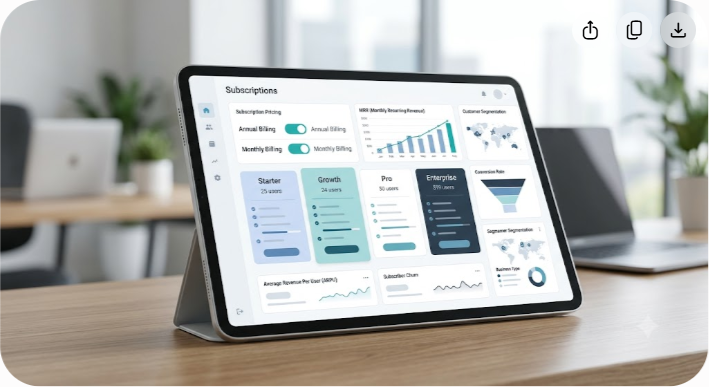
SaaS pricing experiments can improve conversion, revenue, or both, but the safest tests don't start by randomly showing different prices to different visitors. Pricing affects acquisition, sales conversations, retention, expansion, and customer trust, so a useful experiment needs a clear hypothesis and a measurement plan that extends beyond the checkout button.
The best place to start is usually not the headline price. Test the way customers buy: the value metric, plan boundaries, annual billing, trial design, feature access, or add-ons. A modest packaging change can remove a buying obstacle without forcing the entire customer base through a disruptive price change.
This guide explains which SaaS pricing experiments are worth running, how to structure them, what to measure, and which common mistakes can make the results misleading.
Why SaaS Pricing Experiments Need a Different Approach
A conventional website A/B test is relatively easy to understand. Half of the audience sees version A, the other half sees version B, and the team compares a defined outcome. Pricing isn't quite that simple.
A price change can alter who signs up, which plan customers choose, how much they use the product, how long they stay, and whether sales representatives can close deals at the same rate. The effect may not be visible in the first few days.
There is also a practical problem with showing different prices for the same plan at the same time. Buyers can compare screenshots, share pricing information with colleagues, or return to the site on another device. A test that produces clean analytics but makes customers question whether they're being treated fairly isn't a good test.
That doesn't mean you can't experiment with price. It means the experiment needs to match the buying motion of the business.
When a Traditional A/B Test Can Work
A controlled split test can still be useful when you're testing elements that don't create conflicting commercial terms. Examples include the presentation of annual savings, the order of plan cards, a feature comparison, or a call to action.
For actual price points, simultaneous testing is more difficult. If you have high traffic, a short sales cycle, a simple self-serve product, and strong billing controls, a controlled price test may be practical. For many B2B SaaS businesses, however, time-based cohorts or controlled market rollouts are easier to operate and explain.
The Main Constraints to Consider
Before choosing a test design, look at four constraints:
- Traffic and sample size: A low-volume pricing page may not generate enough conversions to distinguish a real effect from normal variation.
- Sales cycle: If customers take weeks or months to buy, an experiment based only on initial signups can produce a false winner.
- Customer visibility: Buyers may share prices publicly or compare notes with other teams.
- Billing complexity: Your billing system must be able to preserve old terms, apply new terms correctly, and report results by cohort.
A good pricing test respects all four.
The Core SaaS Pricing Experiments to Run
Not every pricing experiment changes the amount a customer pays. Often, the larger opportunity is changing what the price is attached to or what customers receive at each level.
1. Test the Value Metric
A value metric is the unit that connects price to customer usage or value. Depending on the product, that could be seats, active contacts, transactions, API usage, storage, locations, or another measurable unit.
The right metric should satisfy two conditions: customers should understand it, and their willingness to pay should generally increase as they receive more value from the product.
Seat-based pricing works well for products whose value grows with the number of people using the software. It can be a poor fit for a system that delivers substantial value in the background without requiring many users.
For example, a monitoring platform might charge by monitored resources rather than by employees. A payment platform may have a stronger connection between price and transaction volume. The important question isn't which model is fashionable. It's whether the pricing unit tracks the way customers experience value.
How to test it: Keep the existing model available while introducing a limited alternative for a clearly defined customer segment, or test the alternative with new customers during a controlled period. Compare conversion, average revenue, gross margin, usage, and retention rather than looking only at the initial purchase.
2. Rework Tier Boundaries
Pricing tiers often reflect internal product architecture instead of customer buying behavior. A company may place features into plans simply because the engineering team groups them together, even though buyers see a completely different hierarchy of value.
Review feature usage across customer segments and ask which capabilities actually influence purchase decisions. A frequently used feature that blocks adoption in a lower plan may belong earlier in the packaging structure. Conversely, advanced administrative controls may be valuable enough to reserve for larger customers.
How to test it: Move one meaningful feature at a time. Don't rebuild every tier in one release. Watch how the change affects plan selection, sales objections, expansion, and churn.
3. Introduce Modular Add-Ons
A single product can serve different customer needs without forcing every buyer into a large premium tier. Add-ons can be useful when a capability has clear value for some customers but little relevance to others.
Common candidates include advanced reporting, additional storage, premium support, specialized security controls, or extra usage capacity. The exact candidates depend on the product and customer base.
The risk is creating a pricing menu that feels like an à la carte airline ticket. If customers need five add-ons just to get a functional product, the packaging has gone too far.
How to test it: Start with one or two optional capabilities and measure attach rate, total contract value, conversion, and customer questions. If buyers repeatedly need the same add-on, consider whether it belongs in a standard plan instead.
4. Test Annual Versus Monthly Billing
Annual billing changes more than cash timing. It also changes the commitment a customer makes and can affect churn, procurement, and the perceived value of the purchase.
A common starting point is to offer a modest annual incentive and make the savings easy to understand. But don't assume that a larger discount is automatically better. The goal is to find the point where the annual option feels worthwhile without giving away unnecessary margin.
How to test it: Compare annual-plan selection, upfront cash collected, first-year revenue, refunds, retention, and expansion. If an annual offer increases upfront collections but attracts customers who churn quickly after renewal, the test hasn't necessarily improved the business.
5. Test Trial Structure
Free trials can be designed in several ways. Some require a credit card at signup. Others allow users to start without one. Some offer a fixed number of days, while others end when the customer reaches a usage threshold.
There is no universal winner. Removing the credit card requirement can reduce signup friction, but it may also increase the number of low-intent users. Requiring payment details can reduce trial volume while improving the average intent of those who enter the product.
How to test it: Compare net paid customers rather than trial starts alone. Segment the results by acquisition source, customer type, and product usage. A channel that produces twice as many trials isn't necessarily better if most of those users never reach meaningful activation.
6. Test a Reverse Trial
A reverse trial gives new users access to premium capabilities for a limited period before moving them to a free or lower-feature plan. This approach lets customers experience the product's strongest capabilities before asking them to choose a paid level.

It can work particularly well when premium features are difficult to understand from a pricing page but become valuable after users see them in context.
How to test it: Define the premium features users can access, establish the trial duration, and decide exactly what happens when the period ends. Track activation, feature adoption, paid conversion, support requests, and post-trial usage. Don't measure success from trial-to-paid conversion alone.
7. Test Pricing Page Presentation
Sometimes the pricing itself is fine. The problem is how the buyer has to interpret it.
Test whether annual savings are clearer as a percentage or as a monthly-equivalent amount. Test whether a recommended plan reduces decision time. Test whether a shorter feature comparison helps buyers understand the differences between plans.
These tests are usually safer than changing the actual price because the commercial terms remain consistent.
The strongest version isn't necessarily the one with the most persuasive copy. It's the one that helps the right buyer make a decision without having to decode the page.
A Practical Framework for Running a SaaS Pricing Test
A pricing experiment should be treated as a commercial change with an analytical component, not as a cosmetic website experiment. Use a simple five-phase process.
Phase 1: Establish the Baseline
Start with enough historical data to understand normal performance. Depending on traffic and sales volume, that may mean reviewing several months rather than a few weeks.
Capture at least:
- Pricing page visits
- Signup or demo conversion rate
- Trial activation rate
- Trial-to-paid conversion
- Plan mix
- Average revenue per account or user
- Annual versus monthly selection
- Customer acquisition cost and payback
- Gross revenue retention
- Net revenue retention where relevant
- Early churn and expansion behavior
The exact metrics depend on the business model. A self-serve SaaS product and an enterprise platform shouldn't use the same scorecard.
Phase 2: Write One Clear Hypothesis
A useful hypothesis explains what you're changing, why you expect it to work, and what result would support the decision.
For example:
If we reduce the gap between our Starter and Business plans by introducing a mid-market tier, more qualified users will choose a paid plan because the next step will feel financially proportionate to their needs.
That is much more useful than saying, "We want to improve conversions."
Define the primary metric before launching the test. Choose secondary metrics that can expose unintended consequences.
Phase 3: Choose the Right Cohort
There are several ways to control exposure.
| Test design | How it works | Best suited to | Main concern |
|---|---|---|---|
| Time-based cohort | New customers entering during a defined period receive the new offer. | Price, packaging, and billing changes. | Market conditions can change between periods. |
| Geographic rollout | A defined market receives the new model first. | Localized pricing and market expansion. | Regional differences can affect results. |
| Customer-segment test | A specific customer type receives the new offer. | Packaging and value-metric tests. | Segment definition must be consistent. |
| Feature interest test | A proposed capability is presented before full development. | Add-ons and new premium features. | Clicks indicate interest, not guaranteed purchases. |
| Website presentation test | Visitors see different page treatments while commercial terms remain controlled. | Messaging and layout. | Short-term conversion can hide downstream effects. |
Choose the design that gives you useful evidence without creating unnecessary commercial confusion.
Phase 4: Align Sales, Support, and Finance
Pricing experiments fail surprisingly often because the website changes before the rest of the business is ready.
Sales representatives need to know which customers qualify for the new offer and how to handle questions about older pricing. Customer support should have a simple explanation for customers who notice a new plan. Finance needs accurate billing rules and reporting. Customer success needs to know whether a plan change affects renewals or expansion conversations.
Document the following before launch:
- Who is included in the experiment
- Who is excluded
- Start and end dates
- New and old commercial terms
- Discount rules
- Renewal treatment
- Grandfathering policy
- Approval rules for exceptions
- Primary and secondary metrics
- Conditions for stopping the test early
Phase 5: Measure the Whole Customer Journey
Don't stop at the first conversion event.
A pricing change can increase signup rates while attracting customers who are less likely to activate. Another test may reduce trial volume while producing more paying accounts. A third may increase first-year revenue but cause weaker renewal rates.
Track the customer journey from acquisition through activation, conversion, retention, and expansion. For longer sales cycles, give the cohort enough time to mature before making a final decision.
How to Measure Pricing Experiment Results
The right metric depends on the experiment, but one rule is consistent: don't optimize a single number in isolation.
Conversion Rate
Conversion tells you whether more visitors or leads become customers. It's useful for detecting friction, but it doesn't tell you whether those customers are economically attractive.
If a lower price increases conversion from 2% to 3% while reducing average contract value by 40%, the business needs more than the conversion-rate result before declaring victory.
Revenue Per Visitor
For pricing-page experiments, revenue per visitor can be more informative than conversion rate alone. It combines the likelihood of purchase with the value of the resulting purchase.
The same principle applies to revenue per qualified lead for sales-assisted businesses.
Plan Mix
Look at which plans customers choose. A pricing change can produce a higher overall conversion rate while shifting customers toward the cheapest tier.
That's not automatically bad. A larger entry-level customer base may create a healthy expansion path. But you need to understand the economics rather than assuming more conversions always mean better results.
Retention and Expansion
Pricing changes can affect how customers perceive value after the initial purchase. Monitor churn, renewal behavior, upgrades, downgrades, and expansion revenue.
For subscription businesses, a useful experiment often improves the quality of revenue rather than simply increasing the number of new accounts.
Qualitative Feedback
Numbers tell you what changed. Customer conversations can help explain why.
Review sales objections, support tickets, cancellation reasons, onboarding feedback, and recorded customer interviews where available. If several buyers say a plan feels difficult to understand, that's evidence worth investigating even when the headline conversion rate looks healthy.
Example: Testing a New Middle Tier
Suppose a SaaS company sells a Starter plan at $29 per month and a Business plan at $299 per month. The large gap creates a problem for growing customers that need more capacity but don't need every enterprise-oriented capability.
Instead of immediately lowering the Business price, the company could test a $79 or $99 middle tier with higher usage limits and selected team features.
The hypothesis is straightforward: some customers who currently reject the Business plan will choose the middle tier because it better matches their needs and budget.
The test should measure:
- Conversion from qualified visitors to paid accounts
- Percentage choosing each plan
- Average revenue per new account
- Activation and product usage
- Upgrade behavior
- Cancellation and downgrade rates
- Sales-assisted conversion where applicable
The company should also define what would make the test unsuccessful. If the new tier simply moves existing Business customers downward without creating enough incremental demand, the packaging change may reduce revenue rather than improve it.
This is why pricing experiments need a counterfactual mindset. Ask not only, "Did the new plan sell?" but also, "What would these customers probably have bought without it?"
Common SaaS Pricing Experiment Mistakes

Even well-designed tests can produce poor decisions when the surrounding process is weak.
Changing Too Many Variables at Once
If you change the price, rename the plans, redesign the pricing page, shorten the trial, and move features between tiers in one release, you won't know what drove the outcome.
Bundle changes only when the business decision genuinely requires a new package. Otherwise, isolate the most important variable.
Measuring Signups Instead of Customers
A larger signup number looks good on a dashboard. It doesn't necessarily pay the bills.
Measure activation and paid conversion alongside acquisition. For mature products, add retention and expansion to the analysis.
Ending the Test Too Quickly
Early results are noisy. A campaign, sales promotion, product launch, seasonal change, or unusual traffic source can distort a short experiment.
Set the evaluation period before the test begins. If you repeatedly stop tests when the numbers look favorable, you're more likely to mistake random variation for a real effect.
Ignoring Existing Customers
A new pricing page doesn't erase old contracts.
If existing customers can see a new offer that appears materially better than what they currently receive, your team needs a clear policy. Depending on the change, you may choose to grandfather existing customers, migrate them gradually, offer a renewal option, or provide a targeted transition incentive.
Don't make customer-specific exceptions informally. Record the rules so sales and support apply them consistently.
Hiding Pricing Without a Good Reason
Some enterprise products genuinely require custom pricing because implementation, security, usage, and contract terms vary substantially. That doesn't mean every SaaS company should hide its prices.
If customers can reasonably understand your commercial model, publishing prices or at least useful starting ranges can reduce friction. If you need a sales conversation, explain what drives the final quote instead of simply presenting a generic contact form.
Creating Too Many Tiers
More plans don't necessarily mean more choice. They often mean more comparison work.
Start with a small number of clearly differentiated options. Add complexity only when customer behavior shows that the additional structure solves a real problem.
Using Arbitrary Price Points
A price should reflect the economics and perceived value of the product, not a random number chosen because it looks familiar in the market.
Competitor prices can provide context, but they shouldn't replace customer research. Look at willingness to pay, alternatives, customer outcomes, usage, margins, and the cost of serving each segment.
Freemium vs. Free Trial: Which Should You Test?
Freemium and free trials solve different problems, so the right experiment depends on how your product creates value.
A free trial can work well when customers need the full product to understand its value and can reach an activation point within a reasonably short period. Freemium can work when the free version remains useful on its own and naturally creates a reason to expand as usage or team needs grow.
| Factor | Free trial | Freemium |
|---|---|---|
| Initial friction | Usually higher than instant free access | Usually low |
| Product exposure | Often broad during the trial | Limited by free-plan boundaries |
| Monetization timing | Concentrated around trial expiry | Delayed until users hit an upgrade trigger |
| Best fit | Products with a clear activation event | Products with natural usage or team expansion |
| Main risk | Users fail to activate before the trial ends | Large free population with weak conversion |
Don't choose between the models based on industry convention. Test which structure produces more activated, retained customers at an acceptable acquisition cost.
Usage-Based Pricing: When It Makes Sense
Usage-based pricing has become common in categories where consumption closely tracks customer value. It can be a strong fit for infrastructure, communications, data processing, and other products where usage naturally expands with customer activity.
The model becomes harder when customers can't predict their bills or when the usage unit doesn't correspond clearly to value.
If customers worry that success will produce an unexpectedly large invoice, they may deliberately limit usage. That's a pricing problem, not a product problem.
When testing usage-based pricing, provide clear usage visibility, sensible thresholds, and forecasting tools where appropriate. Consider whether customers need spending controls or predictable billing options. The model should reward growth without making the bill feel uncontrollable.
SaaS Price Increases: A Safer Way to Test Them
Price increases deserve separate treatment because they affect existing customers as well as new buyers.
Start by identifying which customers are affected and why the current price no longer reflects the value or cost structure of the product. Segment the customer base rather than applying the same increase blindly.
For existing customers, communicate the change clearly and early enough for them to evaluate it. Explain what is changing, when it takes effect, and what options are available. If the increase is substantial, a transition period can reduce disruption.
For new customers, a time-based cohort can provide cleaner evidence. Compare the new cohort with a similar historical cohort while controlling for major changes in acquisition mix, product capability, and market conditions.
Don't judge a price increase solely by initial revenue. Watch conversion, discounting, sales-cycle length, churn, and expansion.
How to Build a SaaS Pricing Experiment Backlog
A useful pricing program doesn't depend on finding one perfect test. Build a backlog of hypotheses and rank them by potential impact, confidence, and implementation effort.
A simple prioritization table can help:
| Experiment | Potential impact | Effort | Risk | Useful first test? |
|---|---|---|---|---|
| Annual billing presentation | Medium | Low | Low | Yes |
| Feature placement between tiers | High | Medium | Medium | Yes |
| New value metric | High | High | High | Usually later |
| New middle tier | High | Medium | Medium | Yes, with strong data |
| Price increase | High | Medium | High | Only with clear evidence |
| Add-on packaging | Medium | Medium | Medium | Often |
| Trial duration | Medium | Low | Low | Often |
Start with experiments that can answer an important commercial question without creating unnecessary customer disruption.
What Good Pricing Experiments Have in Common
The strongest SaaS pricing experiments share a few traits.
They start with customer value. The team can explain why the proposed pricing change should make sense to a particular buyer.
They have one primary hypothesis. Everyone knows what is being tested and what result would support the change.
They measure business outcomes. Conversion matters, but so do revenue, retention, acquisition cost, and expansion.
They have a defined audience. The team knows exactly who sees the new offer and who doesn't.
They account for operational reality. Sales, support, finance, and customer success understand the experiment before it goes live.
They preserve trust. Existing customers aren't surprised by inconsistent treatment or unexplained changes.
They produce a decision. Before launching, decide what you'll do if the test wins, loses, or produces mixed evidence.
A Practical Pre-Launch Checklist
Before launching a SaaS pricing experiment, confirm that you can answer each of these questions:
- What customer problem are we trying to solve?
- What pricing variable are we changing?
- Which customers will see the change?
- Why do we expect the change to work?
- What is the primary success metric?
- Which secondary metrics could expose a negative side effect?
- How long will the test run?
- How will existing customers be treated?
- Can billing apply the new terms accurately?
- Does sales know how to handle questions and exceptions?
- What result would cause us to roll the change back?
- What result would justify making the change permanent?
If several answers are unclear, the experiment probably isn't ready.
How SaaS Pricing Experiments Increase Conversions Without Sacrificing Revenue
Conversion and revenue don't have to be opposing goals, but they need to be evaluated together.
A better pricing structure can remove a mismatch between customer needs and available plans. A clearer annual offer can reduce hesitation. A sensible trial can help qualified users reach the product's value faster. A middle tier can give growing customers a logical next step.
The common thread is relevance. Customers are more likely to buy when the plan, price, and payment structure make sense for the job they're trying to accomplish.
That is why pricing optimization shouldn't become a hunt for a magic number. The more useful question is whether the entire commercial model helps the right customers recognize value and move forward with confidence.
Final Takeaways
SaaS pricing experiments work best when they're treated as controlled business decisions rather than isolated website tweaks.
Start with low-risk questions about packaging, annual billing, trial design, feature placement, and pricing-page clarity. Move into deeper changes such as value metrics, usage-based billing, new tiers, and price increases once your data and operational processes are strong enough to support them.
Most importantly, don't judge a pricing experiment by conversion alone. Follow the cohort through activation, revenue, retention, and expansion. A test that produces fewer signups but better customers may be the stronger result.
Pricing is part of the product experience. Test it with the same care you apply to onboarding, product features, and acquisition channels, and your experiments can become a repeatable source of better decisions rather than a series of risky one-off changes.