SaaS Product-Led Growth Strategy: Complete Guide
A SaaS product doesn't become product-led just because you add a free trial. Product-Led Growth (PLG) works when the product itself helps people discover value, reach that value quickly, adopt the product deeply, and expand their usage over time.
That changes how you build almost everything around the product. Acquisition, onboarding, pricing, analytics, customer success, sales, and even product design need to work together around user behavior rather than a traditional lead-to-demo process.
A strong SaaS product-led growth strategy therefore starts with a simple question: What action proves that a new user has received meaningful value, and how quickly can you help them reach it? Once that answer is clear, you can design the rest of the self-serve funnel around it.
This guide explains how PLG works, how to choose between freemium and free trials, how to design onboarding and PQL signals, which metrics matter, where PLG programs commonly fail, and how to combine product-led growth with sales as the company moves upmarket.
What Is a SaaS Product-Led Growth Strategy?
A SaaS product-led growth strategy makes the product a primary mechanism for acquiring, activating, retaining, converting, and expanding customers. Instead of asking prospects to sit through a sales presentation before they can evaluate the software, the company gives them a practical way to experience the product and judge its value themselves.
The exact experience varies by product. It might be a free plan, a time-limited trial, a sandbox, a template, or a limited version of the core workflow. The important part isn't the label. It's that the product does meaningful selling by helping the user understand its value through use.
In a traditional sales-led motion, the path often looks like this: marketing creates demand, a salesperson qualifies the account, a representative demonstrates the product, the buyer evaluates it, and procurement or legal completes the purchase. That model still works extremely well for many complex B2B products.
PLG changes the order of those interactions. A user can often start with the product before talking to sales. If the experience is good, that individual may invite colleagues, create additional usage, recommend the product internally, or eventually become part of an enterprise buying process.
Product-Led Growth vs Sales-Led Growth
PLG and Sales-Led Growth (SLG) aren't opposing philosophies. They're different ways of creating and converting demand, and many successful SaaS companies use both.
| Operational Dimension | Sales-Led Growth | Product-Led Growth |
|---|---|---|
| First meaningful interaction | Sales conversation or demo | Product experience |
| Primary entry point | Lead, meeting, or referral | Signup, invite, or self-serve entry |
| Proof of value | Demonstration and business case | Successful product workflow |
| Main early audience | Buyer and decision-maker | End user and champion |
| Main growth constraint | Sales capacity and pipeline | Product friction and activation |
| Expansion signal | Sales qualification | Usage, adoption, and account intent |
| Typical purchase path | Rep-assisted | Self-serve, assisted, or hybrid |
The best model depends on the product, market, price point, implementation requirements, and buying process. PLG is particularly useful when users can understand the product's value without extensive configuration or expert assistance.
How Does Product-Led Growth Work?
A practical SaaS PLG funnel has five connected stages:
- Acquisition: Give potential users a low-friction way to start using the product.
- Activation: Help them complete the action that demonstrates initial value.
- Conversion: Make the paid upgrade relevant to the user's growing needs.
- Retention: Keep the product useful enough that customers return and build habits around it.
- Expansion: Increase revenue through additional seats, usage, features, teams, or business units.
The product should support each stage rather than treating PLG as a marketing tactic that ends at signup.
The Core Principles of Successful PLG
Adding a prominent "Start Free" button isn't a PLG strategy. The real work happens after the signup, when a new user decides whether the product is worth their time.
1. Reduce Time to Value
Time to Value (TTV) measures how long it takes a new user to reach a meaningful outcome. The definition should be specific to your product. For an email platform, it might be sending the first campaign. For a project-management product, it could be creating a project and assigning the first task. For an analytics platform, it might mean connecting a data source and viewing a useful report.
Don't confuse TTV with the time required to complete onboarding. A user can finish every onboarding step and still fail to receive value.
Start by identifying the smallest meaningful outcome a new customer can achieve. Then remove anything that doesn't help them reach it. That might mean fewer form fields, sensible defaults, sample data, templates, automated configuration, or a clearer first-run experience.
2. Lower Friction Without Removing Necessary Controls
Every additional decision creates an opportunity for a user to leave. Long registration forms, unnecessary configuration screens, confusing pricing, forced product tours, and premature requests for payment information can all slow down activation.
That doesn't mean every form should disappear. Security, fraud prevention, compliance, and product-specific setup requirements still matter. The goal is to ask for information when it becomes useful, not simply because the system can collect it.
A useful test is to review each step of the signup and onboarding journey and ask: Does the user need this to experience the product's core value? If the answer is no, consider moving it later or removing it entirely.
3. Deliver Value Before Asking for a Commitment
PLG works best when users have evidence that the product solves their problem before they're asked to make a significant commitment.
That evidence can come from a successful workflow, a useful report, a completed project, a measurable improvement, or collaboration with colleagues. The product should make that outcome visible.
The point isn't to give away everything for free. It's to make the free experience useful enough that the user understands what they would gain by continuing.
4. Build Product Loops Into Normal Usage
A product loop occurs when using the product creates conditions that bring more people into the product or create additional usage.
Common examples include:
- Collaboration loops: A user invites teammates to review a document, manage a project, approve work, or contribute to a workspace.
- Sharing loops: A customer publishes or shares an output that exposes other people to the product.
- Workflow loops: A useful result creates another reason to return to the product.
- Integration loops: Connecting the product to another system increases the product's usefulness and embeds it deeper into daily work.
- Expansion loops: As adoption spreads across a team, additional seats, features, or usage become necessary.
Not every SaaS product needs viral growth. A product can be highly product-led without having a viral coefficient above one. Strong activation, retention, self-serve conversion, and account expansion are often more important than raw invitation volume.
Choosing Your PLG Model: Freemium, Free Trial, or Reverse Trial
Your access model should reflect how customers experience value and how much it costs you to support free users. There is no universal conversion rate that makes one model better than another.
Freemium SaaS
Freemium provides ongoing access to a limited version of the product. The free plan may restrict seats, usage, storage, integrations, automation, support, or advanced features.
Freemium tends to work well when the product has a useful standalone experience, low marginal cost for additional users, a large potential market, and a natural reason for successful users to outgrow the free plan.
Advantages:
- Creates a low-risk entry point.
- Gives users time to build familiarity and habits.
- Can support strong word-of-mouth and sharing.
- Creates a broad pool of users who may convert later.

Trade-offs:
- Many free users may never become customers.
- Support and infrastructure costs can accumulate.
- A weak free-to-paid boundary can make upgrading unnecessary.
- Conversion can take longer because there is no trial deadline.
The most important freemium question isn't "How many people can we get to sign up?" It's "What successful users naturally need next?"
Free Trial SaaS
A free trial gives users access to some or all of the product for a defined period. Trials can be opt-in, where users don't provide payment information upfront, or opt-out, where payment begins unless the user cancels.
Trials work well when users can understand the product quickly and when continued usage creates a clear reason to pay. A trial is less effective when the product requires lengthy implementation before the customer can evaluate it.
Advantages:
- Creates a defined evaluation period.
- Makes the transition from evaluation to paid usage straightforward.
- Can expose users to premium functionality early.
- Works well for products with measurable short-term value.
Trade-offs:
- Users who don't activate quickly may disappear before the trial ends.
- A fixed deadline can punish users with slower or more complex evaluation cycles.
- Requiring payment information can increase commitment but also add signup friction.
Reverse Trial
A reverse trial starts users with access to premium functionality for a limited period and then moves them to a free or restricted plan if they don't upgrade.
This approach can work for products where premium features help users understand the product's full potential, but where continued access to a basic version still has value.
The risk is confusion. Users need to understand what changed when the premium period ends and what they can continue doing without paying.
Freemium vs Free Trial SaaS
| Consideration | Freemium | Free Trial | Reverse Trial |
|---|---|---|---|
| Access period | Ongoing | Fixed | Premium period followed by free or restricted access |
| Best fit | Broad adoption and recurring usage | Fast evaluation and clear value | Products with meaningful premium features |
| Main strength | Low commitment | Creates evaluation urgency | Shows premium value early |
| Main risk | Low conversion or high free-user costs | Users fail to activate in time | Confusion after premium access ends |
| Key design question | What makes successful users upgrade? | What outcome should users reach during the trial? | What premium experience should users see first? |
Step-by-Step Blueprint to Build a PLG Strategy
A useful SaaS PLG framework starts with customer behavior, not pricing-page experiments. Work through the following five steps in order, then revisit them as you learn from actual usage.
Step 1: Identify the Activation Event
Start with your existing customers. Compare users who retained and expanded with those who signed up but disappeared. Look for actions that consistently occur among successful customers.
Don't assume the most obvious activity is the activation event. A login isn't activation. Completing a profile isn't necessarily activation either. The event should represent a meaningful product outcome.
For example, an analytics product might define activation as connecting a production data source and creating a useful dashboard. A collaboration platform might look for a user creating a workspace and bringing in at least one colleague. A developer product might define activation around making a successful API request in a real workflow.
Use cohorts to test whether the event is actually predictive of retention. If activated users don't retain at materially different rates from non-activated users, your definition probably needs work.
Once the event is clear, make it the central target of onboarding.
Step 2: Redesign Onboarding Around the First Outcome
Good onboarding helps users do something. It doesn't simply explain where things are.
A product tour can show users ten features and still leave them unsure what to do next. A better onboarding flow asks what the user is trying to accomplish and guides them toward that result.
Useful PLG onboarding patterns include:
- Goal-based setup: Ask what the user wants to accomplish and tailor the first experience around that goal.
- Interactive checklists: Break the activation path into a small number of concrete actions.
- Templates: Let users start with a realistic workflow rather than an empty workspace.
- Sample data: Demonstrate what a completed experience looks like before the user has enough data of their own.
- Contextual guidance: Show help when a user encounters a feature rather than presenting a long explanation upfront.
- Progressive disclosure: Introduce advanced options after the basic workflow is working.
Measure each step. If a large percentage of users abandon one screen, investigate the reason instead of automatically adding more instructions.
Step 3: Define Product Qualified Leads
Product Qualified Leads, or PQLs, are users or accounts whose product behavior indicates meaningful buying intent.
A useful PQL definition combines usage with context. One event rarely provides enough evidence by itself. Someone who logs in ten times may simply be exploring. Someone who invites colleagues, reaches a usage limit, adopts core features, and returns repeatedly is showing a much stronger signal.
A practical PQL model can examine three dimensions:
- Breadth: How many people, teams, or departments use the product?
- Depth: How extensively are core features being used?
- Velocity: How quickly is adoption increasing?
You can also add firmographic or account information when it matters. For example, an account using the free plan with twelve active employees may deserve sales attention even if no single user has reached an unusually high usage threshold.
Avoid turning PQL scoring into an unnecessarily complicated data-science project. Start with a small set of behaviors that your sales and product teams can understand, validate the signals against closed-won and retained accounts, and refine the model over time.
Step 4: Align Pricing With the Value Metric
Product-led monetization works when the way you charge customers makes sense relative to the value they receive.
Common pricing structures include:
- Per-seat pricing: Works when collaboration and the number of active users drive value.
- Usage-based pricing: Works when customer value and infrastructure consumption scale together.
- Tiered pricing: Works when customers naturally move from basic needs to more advanced requirements.
- Feature-based tiers: Works when different customer segments need distinct capabilities.
- Hybrid pricing: Combines a platform fee with seats, usage, or premium capabilities.
The wrong value metric can create resistance even when the product itself is strong. If customers receive more value without increasing the metric they pay for, expansion becomes difficult. If the metric grows faster than the value customers receive, pricing feels punitive.
Review pricing alongside product behavior. Ask which features customers use before upgrading, what limits they encounter, and what causes accounts to add seats or increase usage.
Step 5: Add Product-Led Sales When the Signals Justify It
PLG doesn't require a company to choose between self-serve and sales. Product-Led Sales (PLS) uses product behavior to determine when human assistance is useful.
Imagine a company where several employees independently create accounts for the same workspace. Usage increases every week, the team begins relying on a core workflow, and the account approaches a plan limit. That's a much stronger sales signal than an employee simply downloading a guide.
A product-led sales representative can then discuss the capabilities that matter at the next stage, such as centralized administration, SSO, security controls, procurement support, larger usage limits, or consolidated billing.
The timing matters. A sales conversation should help a customer move forward, not interrupt someone who has barely opened the product.
How to Measure a SaaS Self-Serve Funnel
PLG metrics should explain where users lose momentum and which behaviors predict revenue. Total signups are useful for understanding acquisition, but they don't tell you whether the product is creating customers.
A basic funnel can be measured as a sequence of conversion rates:
| Funnel Stage | Example Metric | What It Tells You |
|---|---|---|
| Acquisition | Visitor-to-signup rate | Whether the entry point creates enough initial interest |
| Activation | Signup-to-activation rate | Whether new users reach meaningful value |
| Conversion | Free-to-paid rate | Whether experienced value translates into payment |
| Retention | Cohort retention and churn | Whether customers continue receiving value |
| Expansion | Expansion revenue and NRR | Whether successful customers grow their accounts |
Key PLG Metrics
Signup-to-Activation Rate measures the percentage of new users who reach the defined activation event within a specified period. Don't benchmark this against a generic target without considering your product and audience. The useful comparison is usually your own activation rate across acquisition channels, cohorts, and product changes.
Time to Value measures the time between signup and the first meaningful outcome. Median TTV is usually more informative than an average because a small number of extremely slow users can distort the result.
Product Qualified Lead Rate measures the share of eligible users or accounts that meet your PQL definition. Track the rate alongside the eventual conversion and retention of those accounts. A PQL model that produces many leads but few customers isn't doing its job.
Free-to-Paid Conversion Rate measures how many eligible free or trial users become paying customers. Always state the denominator and conversion window. "Conversion rate" can mean very different things depending on whether you're measuring all signups, activated users, trial starters, or accounts that reached a specific milestone.
Retention shows whether customers continue using the product. Product-led teams should look at both user-level and account-level retention when appropriate. A SaaS product can have strong individual usage while an entire customer account remains at risk.
Net Revenue Retention (NRR) measures how recurring revenue from an existing customer cohort changes over time after expansion, contraction, and churn. NRR above 100% means the retained cohort generated more recurring revenue than it started with.
Expansion Revenue shows whether existing customers are increasing their spend through additional seats, usage, products, or upgraded plans. This is especially important for PLG businesses that rely on bottom-up adoption followed by account expansion.

Viral Coefficient estimates how many new users are generated through existing-user invitations or referrals. Treat it as one growth signal, not the definition of PLG. Many excellent product-led businesses grow through search, content, integrations, communities, partnerships, and direct demand rather than pure virality.
PLG Benchmarking: Use Ranges Carefully
There is no universal PLG conversion benchmark that applies to every SaaS product. Conversion varies substantially by price, audience, acquisition channel, trial design, product complexity, and whether the denominator includes inactive signups.
| Metric | Better Benchmarking Approach |
|---|---|
| Freemium conversion | Compare against similar products and cohorts using the same denominator |
| Trial conversion | Separate opt-in and opt-out trials and define the conversion window |
| Activation rate | Compare users who received the same onboarding experience |
| Time to Value | Track median TTV by acquisition source and customer segment |
| PQL conversion | Measure how often PQLs become customers and retain |
| NRR | Segment by customer size, plan, and acquisition model |
Internal cohort comparisons are often more actionable than a published "top-decile" benchmark. If a new onboarding flow raises activation from 24% to 31% among comparable cohorts, that's a meaningful signal even if another SaaS company reports a different number.
Product-Led Retention: What Happens After Activation?
Activation is only the beginning. A user can experience the product's value once and still churn a month later.
Product-led retention comes from repeated value. Identify the behaviors that indicate a customer has incorporated your product into a recurring workflow, then make those behaviors easier to maintain.
For example, a project-management product may retain customers because teams plan weekly work inside it. An analytics product may retain them because decision-makers return to reports every week. A developer tool may become sticky because it sits inside a deployment workflow.
Look for these retention signals:
- Repeated use of the core workflow.
- Multiple users adopting the same workspace or account.
- Integrations that connect the product to important systems.
- Saved configurations, templates, or historical data.
- Regular collaboration between users.
- Increasing usage that reflects genuine customer activity.
When churn increases, don't immediately respond with discounts or more customer-success emails. First ask whether customers stopped receiving the original value, whether the product became harder to use, or whether the customer never reached a durable workflow in the first place.
Product-Led Expansion: Turning Usage Into Revenue
Expansion is where a mature PLG model can become particularly powerful. A customer starts with one user or team, gets value, and then naturally encounters a need for more capacity or capability.
The expansion trigger should feel connected to success. Examples include:
- A team needs additional seats because more colleagues want access.
- Usage reaches a plan limit because the product has become part of a core workflow.
- A customer needs advanced permissions as adoption spreads.
- Multiple teams want to consolidate separate workspaces.
- Security or administration requirements increase as the account grows.
The pricing page and in-product upgrade experience should make these transitions clear. Don't force customers to leave the product and start a completely separate buying process for a straightforward upgrade.
For larger accounts, product signals can trigger human assistance. This creates a natural bridge from self-serve adoption to enterprise expansion.
Common PLG Mistakes
Mistake 1: Treating PLG as "No Sales"
PLG isn't an argument against sales. It changes when and why sales gets involved.
Enterprise customers often need security reviews, procurement support, legal terms, invoicing options, implementation help, or executive alignment. A product-led motion can create the initial demand while a sales team helps turn that demand into a larger contract.
The mistake is forcing every customer through the same sales process, or refusing sales assistance to customers who clearly need it.
Mistake 2: Making the Free Experience Too Weak
A free plan that doesn't solve a meaningful problem can't demonstrate product value. Users may leave before they ever understand why the paid product is worth buying.
Give users enough capability to complete a real job. Put sensible limits around scale, administration, advanced functionality, collaboration, or other features that become important as customers grow.
The free experience should create a reason to upgrade, not a reason to leave.
Mistake 3: Optimizing Signup Volume Instead of Activation
More signups can make a dashboard look healthy while the underlying funnel gets worse.
If 10,000 people sign up but only a small fraction reach the activation event, adding another 10,000 low-intent signups won't solve the problem. Find the largest activation bottleneck first.
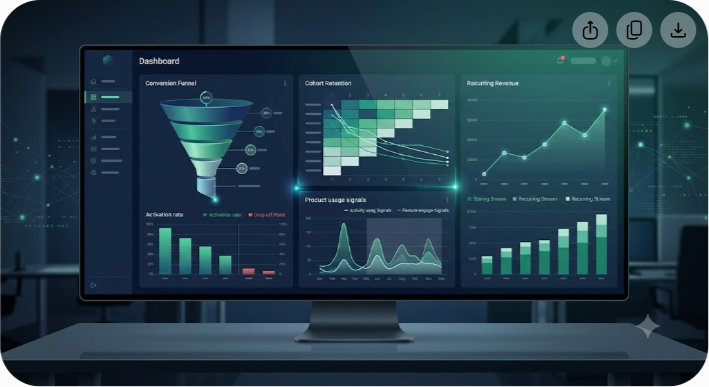
A useful PLG dashboard therefore separates visitors, signups, activated users, retained users, paying customers, and expanding accounts.
Mistake 4: Ignoring Product Telemetry
You can't manage a product-led funnel with anecdotal feedback alone. Instrument the important events in the customer journey and make sure the data is trustworthy.
Track events such as signup, onboarding completion, activation, invitations, core feature usage, plan-limit events, upgrades, downgrades, and churn-related behavior. Then connect those events to accounts and revenue where appropriate.
Good telemetry doesn't mean tracking everything. It means tracking the behaviors that help you answer specific product and revenue questions.
Mistake 5: Copying Another Company's Pricing Model
A pricing structure that works for one SaaS company may be completely wrong for another. Seat-based pricing can work beautifully for collaboration software and create frustration for a product where one person produces enormous amounts of value.
Start with how customers experience value. Then test whether your pricing metric grows naturally with that value.
Mistake 6: Contacting PQLs Too Early
A user who signs up, clicks around, and never completes the core workflow isn't necessarily a sales opportunity. Reaching out too soon can make a self-serve experience feel like a traditional sales funnel.
Use behavioral thresholds that indicate genuine intent. Give users room to explore, then offer human help when their activity suggests that assistance could accelerate adoption or expansion.
The PLG Technology Stack
A product-led growth stack doesn't need dozens of tools. It needs reliable data flowing between the systems that understand product behavior, customer identity, billing, and revenue activity.
Product Analytics
Tools such as Amplitude, Mixpanel, and Heap can help teams analyze feature usage, funnels, cohorts, and user paths. The important part is not the vendor name. It's whether your analytics implementation can answer questions about activation and retention without requiring manual data work every time.
In-App Onboarding
Platforms such as Appcues, Userflow, and Chameleon can support checklists, tooltips, contextual guidance, and onboarding flows. These tools are useful when product teams need to iterate quickly, but they shouldn't become a substitute for fixing confusing product design.
PQL and Product-Led Sales Tools
Products such as Pocus, Koala, and similar platforms can help revenue teams turn product activity into account signals. Before adopting one, make sure your underlying event data and account identity model are reliable.
Billing and Usage Metering
Stripe Billing, Chargebee, Orb, and similar systems can support subscription management and usage-based billing. Your choice should reflect the complexity of your pricing model, billing requirements, reporting needs, and existing infrastructure.
Customer Data Infrastructure
Platforms such as Segment and RudderStack can help route product events to analytics, marketing, sales, and other systems. A clean identity model is critical. If the same customer appears as five disconnected users across your tools, your PQL and expansion signals will be unreliable.
The right PLG tech stack is therefore less about having the most tools and more about having trustworthy data, clear event definitions, and a product team that actually uses the information.
A Practical PLG Operating Model
Once the initial funnel is working, PLG becomes a cross-functional operating model rather than a one-time product initiative.
Product teams own activation, usability, and core workflows. Growth teams may focus on acquisition, experimentation, and conversion. Marketing brings qualified demand into the funnel. Sales works product signals into account expansion. Customer success helps customers build durable workflows and identifies risks that product behavior alone can't explain.
These teams should share a small number of definitions. What counts as activation? What makes an account PQL-qualified? What event represents expansion intent? Which customer segments are expected to self-serve?
Without shared definitions, every team can report a different version of growth.
A useful operating rhythm is straightforward:
- Review acquisition and activation cohorts.
- Identify the largest drop-off in the funnel.
- Form a hypothesis about why it happens.
- Run a focused product, onboarding, pricing, or messaging experiment.
- Measure the effect on activation, retention, or revenue rather than clicks alone.
- Roll out successful changes and document what was learned.
This keeps PLG grounded in customer behavior instead of turning it into a collection of growth tactics.
Product-Led Growth Strategy Takeaways
A strong SaaS product-led growth strategy doesn't begin with a freemium plan, a product tour, or a new analytics platform. It begins with a clear understanding of how customers receive value.
From there, the work is systematic:
- Define the activation event around a real customer outcome.
- Reduce the time between signup and that outcome.
- Build onboarding around actions rather than feature explanations.
- Use product behavior to identify genuine buying intent.
- Align pricing with the way customers receive value.
- Measure retention at both user and account level where appropriate.
- Design expansion around successful usage rather than artificial pressure.
- Combine self-serve product adoption with sales assistance when the account needs it.
- Keep your data definitions consistent across product, marketing, sales, and customer success.
PLG is not a shortcut around product quality or sales execution. If the product doesn't solve a meaningful problem, a free trial won't fix it. If users can't reach value quickly, more acquisition will simply produce more inactive accounts.
The strongest product-led companies make the product easier to try, easier to understand, and harder to outgrow once it becomes useful. That's the foundation of a sustainable SaaS growth model.