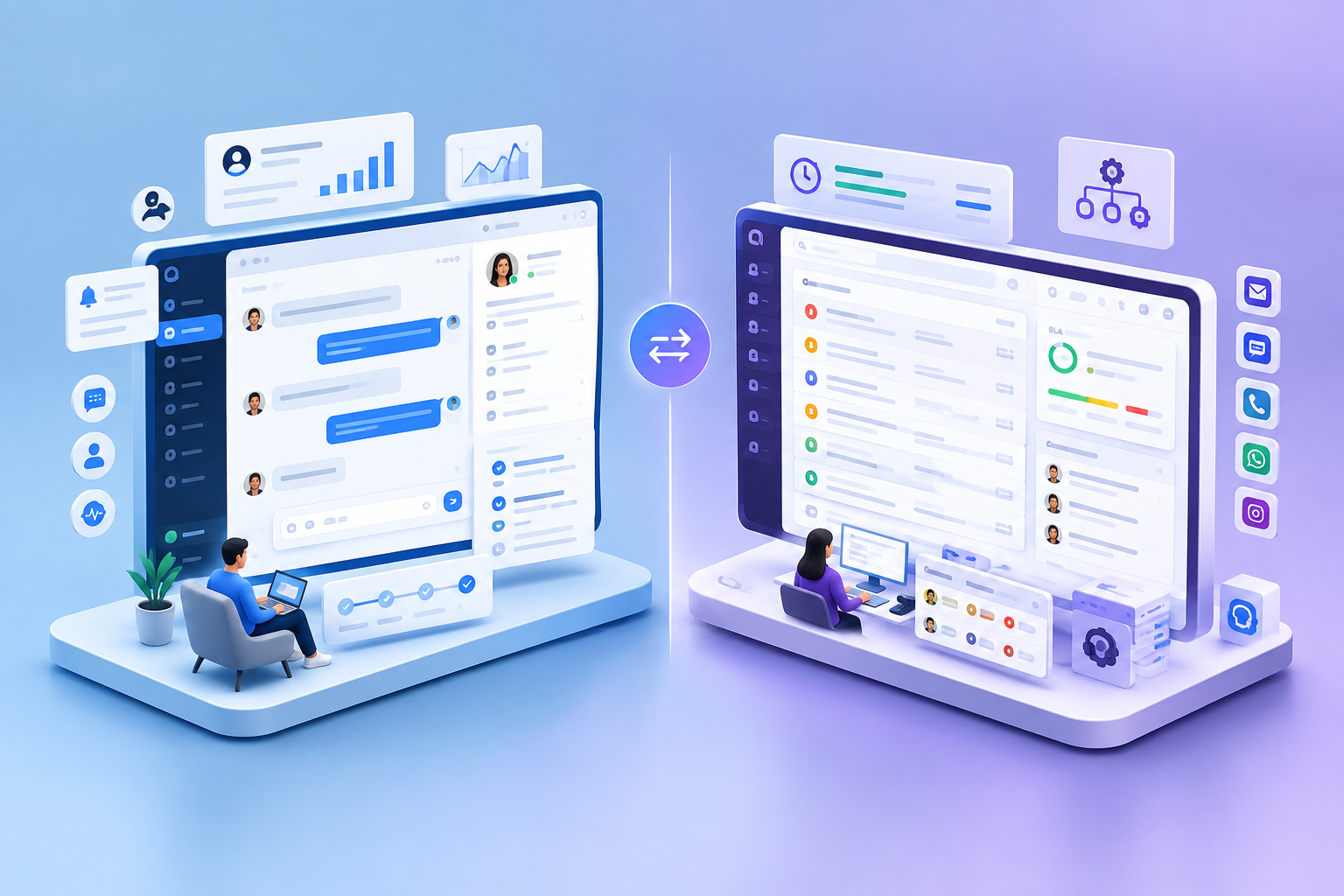
Shared Email Inbox vs. Dedicated Customer Desk: When Is It Time to Switch?

The Death of support@company.com
You know the exact afternoon the panic sets in. It is usually a Tuesday. Your product launch went slightly better than expected, your marketing team is celebrating a spike in sign-ups, and your primary support inbox is a complete disaster area.
Three different team members reply to the exact same customer query about an authentication bug. Meanwhile, an enterprise prospect asking about annual billing sits buried under forty-two automated notification emails from Stripe and GitHub. Nobody knows who is handling what. Messages are marked as unread just to keep track of them, which only causes more confusion.
For a long time, managing support through a shared inbox like support@ or hello@ feels like a brilliant shortcut. It is free, familiar, and requires zero setup. You and your co-founders or early employees can log in, divvy up the emails, and fire off quick replies. Everyone stays on the same page because you sit six feet away from each other.
Then your team grows. You hire remote contractors. Customer volume doubles, then triples. Suddenly, that cozy shared inbox turns into a digital black hole where requests vanish, accountability dissolves, and customer satisfaction quietly plummets.
At Saasbonus, we spend our time evaluating the software stack that keeps modern companies running. We see businesses cling to shared inboxes long after they have outgrown them, losing thousands of dollars in churned customers simply because a single email fell through the cracks.
Let us break down exactly when your team needs to graduate from a shared email inbox to a dedicated customer support desk, how to spot the hidden warning signs, and what the transition actually looks like in practice.
Why the Shared Inbox Feels So Good at the Beginning
There is nothing inherently wrong with starting your company on Google Workspace or Outlook. In fact, you should not use anything else during your earliest days.
When you are validating an idea or pushing through your initial pre-seed phase, speed and simplicity are your only metrics that matter. Setting up a dedicated help desk platform when you have three customers and ten support tickets a week is pure vanity. It adds unnecessary overhead, forces you to learn a new tool interface, and costs money you could spend elsewhere.
Shared inboxes win early on for three clear reasons:
- Zero Friction: Everyone already knows how to use email. There is no onboarding curve, no documentation to read, and no software license to buy.
- Absolute Flexibility: You can forward receipts, loop in developers, draft internal notes, and tag emails into folders without configuring complex automation rules.
- Total Authenticity: Early customers love talking directly to the founders. Sending an email from a standard Gmail address feels personal, raw, and human in a way that automated ticket confirmations never do.
This setup works wonderfully until it hits a hard ceiling. That ceiling usually arrives right around the time you transition from a handful of friendly early adopters to a paying customer base that expects real SLAs and consistent follow-through.
The Silent Warning Signs That Your Shared Inbox Is Breaking

Unlike an outright server crash or a billing failure, the collapse of a shared inbox happens quietly. You do not wake up to a flashing red light on your dashboard. Instead, you notice subtle fractures in your daily operations.
Here are the five unmistakable signals that your team has outgrown standard email.
1. The Collision Reply
You open an email from an angry user complaining about a broken export feature. You spend ten minutes writing a thoughtful, empathetic response, click send, and immediately look at your sent folder to discover that your product manager replied to the exact same customer eight minutes earlier with completely different instructions. Now your customer is confused, your team looks disorganized, and you have wasted valuable time.
2. The Blame Game
A critical bug report sits unanswered for twenty-four hours. When management asks what happened, the finger-pointing begins. One person thought another person marked it as important. Another assumed it was just an automated notification. Without clear ownership, accountability evaporates.
3. Context Blindness
A long-time customer writes in with a billing question. Because your shared inbox lacks a unified customer history view, whoever answers has no idea that this user submitted four technical support tickets last week and threatened to cancel their subscription. The agent treats them like a brand-new lead, triggering immediate frustration.
4. The Notification Avalanche
Your support inbox is not just receiving customer emails. It is drowning in automated alerts from your project management software, error logging tools, payment processors, and marketing automation platforms. Important customer questions drown in a sea of robotic noise.
5. Zero Metrics
Someone asks you what your average first-response time is, or how many tickets your team closes per week, and you have to stare blankly at the wall. You cannot improve what you cannot measure, and a shared inbox offers zero insight into your support volume, peak hours, or recurring customer pain points.
Shared Email Inbox vs. Dedicated Customer Desk: A Head-to-Head Comparison
To understand why these pain points occur, let us look at how both systems handle core support workflows.
| Feature | Shared Email Inbox (Gmail, Outlook) | Dedicated Customer Desk (Help Scout, Zendesk, Intercom) |
|---|---|---|
| Ticket Ownership | None. Anyone can read, reply, or delete any message. | Explicit assignment. Every ticket has one clear owner. |
| Internal Collaboration | Forwarding threads or using external chat tools. | Built-in private notes directly attached to the customer thread. |
| Customer History | Scattered across individual search queries and past threads. | Unified timeline showing every past interaction, purchase, and detail. |
| Automation | Basic filters and labels. | Advanced routing, auto-responders, tagging, and SLA triggers. |
| Reporting | Non-existent or manual data crunching. | Real-time analytics on volume, response time, and CSAT scores. |
| Channel Integration | Email only (unless using clunky add-ons). | Omnichannel support (Email, Live Chat, Social Media, Voice). |
Looking at this breakdown, the distinction becomes clear. A shared inbox is built for personal communication. A dedicated customer desk is built for operational scale and team coordination.
The Cost of Waiting Too Long to Switch
Many founders resist moving to a dedicated help desk because they want to avoid another subscription fee or the hassle of migrating their team. But staying in a broken shared inbox carries a hidden financial cost that far outweighs any software license.

Consider what happens when enterprise deals are on the line. When a mid-market buyer evaluates your software, they look closely at your support infrastructure. If their initial questions about security compliance or custom invoicing sit unanswered for two days in a clogged support@ inbox, they assume your entire operation is disorganized. They quietly walk away to a competitor.
Furthermore, employee burnout spikes rapidly in a chaotic shared inbox. Support agents and team members waste up to thirty percent of their day just organizing threads, checking if someone else already replied, and searching through messy archives. That is hours of productive human capital wasted on digital housekeeping.
Switching to a dedicated desk is not about adding bureaucracy; it is about removing friction so your team can focus on solving human problems.
How to Choose the Right Time to Make the Switch
So, when should you pull the trigger? You do not need to wait for a specific employee headcount, though crossing the five-person support mark is a strong indicator. Instead, look for these operational milestones:
- You regularly miss SLAs: If customer inquiries are taking longer than twelve hours to receive a human reply simply because they get buried, you are losing retention.
- Support is no longer just the founders: Once you hire dedicated customer success or support personnel, forcing them to share a single personal or generic login creates security and accountability risks.
- You need multichannel consistency: If customers are messaging you via live chat, social media, and email, managing those conversations across disconnected apps becomes unsustainable.
If two or more of these conditions describe your current reality, the spreadsheet is dead, the shared inbox is broken, and it is time to build a proper customer desk.
Step-by-Step Guide: Transitioning Without Disrupting Your Customers
Moving away from a shared inbox sounds terrifying to many teams. You worry about missed emails, broken workflows, and confused users. If you follow a structured migration plan, the transition is seamless.
Step 1: Audit Your Current Inbound Volume
Before choosing software, spend a week categorizing every email that hits your shared inbox. How many are actual customer support questions? How many are automated notifications? How many are sales inquiries? This data tells you what routing rules and canned responses you will need to set up on day one.
Step 2: Select Your Tool Based on Team Maturity
Do not automatically buy the most complex enterprise help desk on the market. If you are a lean SaaS startup or agency, lightweight tools like Help Scout, Front, or Groove offer robust ticketing without overwhelming configuration. If you manage complex enterprise workflows with deep CRM integrations, platforms like Zendesk or Intercom might fit better.
Step 3: Set Up Shared Access and Canned Responses
Migrate your most common email templates into the new platform as saved replies or macros. Invite your team, assign roles, and establish clear internal guidelines on who handles specific categories of tickets.
Step 4: Run a Dual-Inbox Period for One Week
Keep your original support@ email connected while routing new incoming mail into your new help desk. This safety net ensures that if a legacy thread pops up in your personal client, you won't drop the ball. Use this week to train your team on private notes, collision detection, and tagging.
Step 5: Cut the Cord and Monitor CSAT
Once the team feels comfortable, transition fully to the new desk. Turn on basic customer satisfaction (CSAT) surveys so you can immediately gauge whether your users notice and appreciate the faster, more organized responses.
Final Thoughts
Growing a business requires letting go of the scrappy habits that got you off the ground. While using a shared email inbox feels comforting and effortless in the early days, holding onto it too long turns customer support into a liability.
By recognizing the warning signs of collision replies, lost context, and mounting stress, you can make the switch to a dedicated customer desk right when your business needs it most. Your customers will notice the difference, your team will breathe a sigh of relief, and your support operations will finally scale alongside your growth.