Supabase vs PlanetScale: Best Database for SaaS in 2026
Nearly 80% of early-stage software startups that choose a Backend-as-a-Service end up refactoring their database architecture within 24 months as scaling bottlenecks emerge.
Choosing between Supabase and PlanetScale in 2026 isn't a simple battle between two identical database hosts competing for the exact same job. It is a fundamental architecture decision: Do you want an all-in-one Backend-as-a-Service (BaaS) built on PostgreSQL, or a dedicated, hyper-scalable relational database with Git-like schema branching?
If you pick the wrong tool early, you will either waste months recreating boilerplate backend code (authentication, file storage, row-level security) or get stuck rewriting complex SQL queries when your scaling demands outgrow a monolithic BaaS setup.
Below, we break down how Supabase and PlanetScale compare across architecture, performance, developer experience, AI readiness, and long-term pricing so you can pick the right database for your SaaS product on the first try.
The Core Difference: BaaS vs. Dedicated Database Engine
To make an informed decision, you first need to understand what each platform actually supplies under the hood. They approach application infrastructure from entirely different angles.
Supabase Architecture Workflow
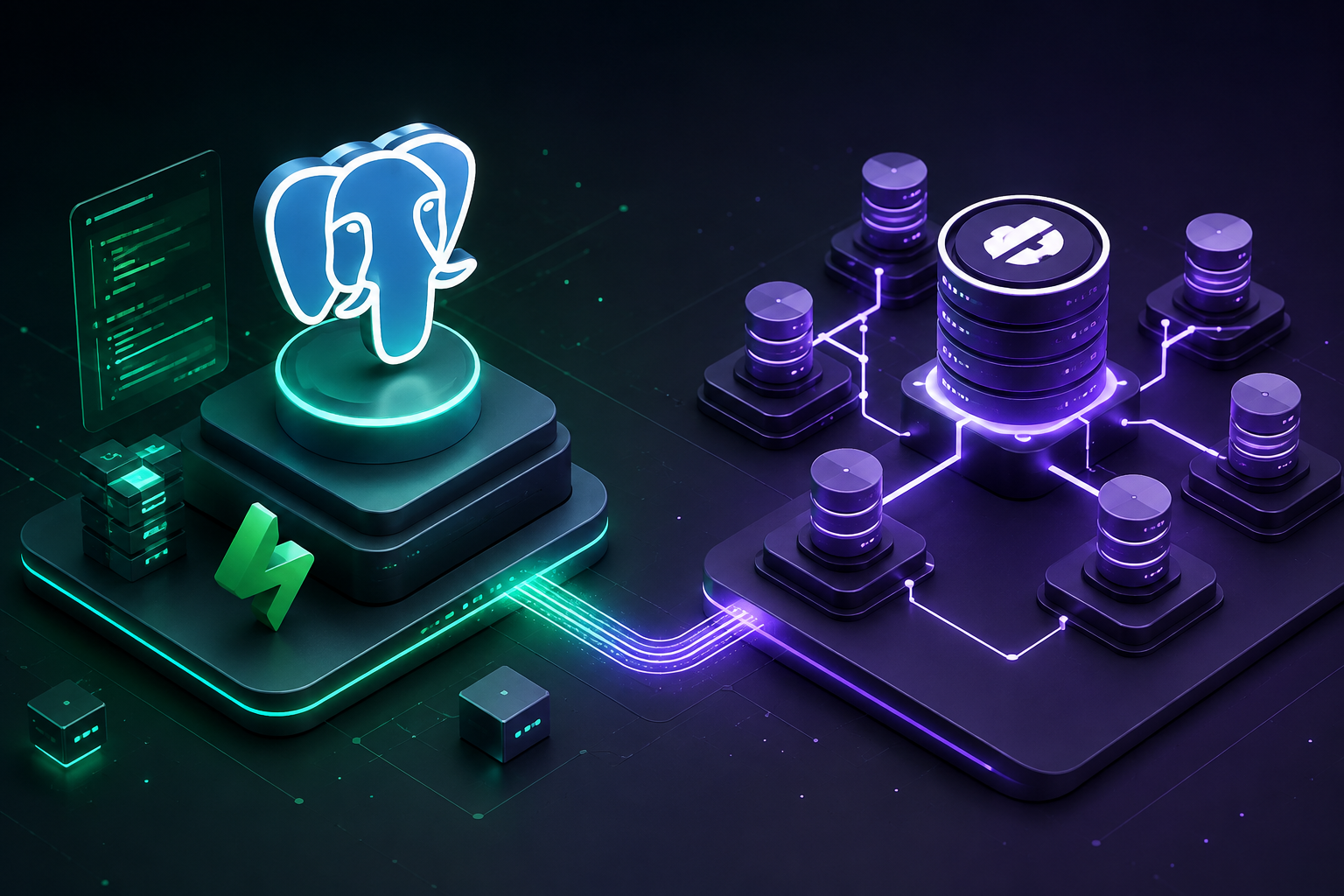
In a standard Supabase application, your client app connects directly through auto-generated REST or GraphQL APIs. Security is enforced at the database level using Row Level Security (RLS) policies. PostgreSQL sits at the core, tightly coupled with native authentication, S3-compatible file storage, and vector extensions.
PlanetScale Architecture Workflow
In a PlanetScale application, your client app communicates with your custom API server or ORM (such as Prisma or Drizzle). Your server then routes queries to PlanetScale's high-performance database engine—powered by Vitess for MySQL workloads or dedicated PlanetScale Metal for PostgreSQL.
What is Supabase?
Supabase is an open-source Firebase alternative built on PostgreSQL. Rather than just hosting your data, Supabase gives you an entire serverless backend ecosystem out of the box:
- Instant APIs: Automatically generates RESTful and GraphQL endpoints directly from your PostgreSQL schema via PostGREST.
- Built-in Authentication: Handles email/password, magic links, social OAuth, and Row Level Security (RLS) policies natively.
- File Storage: S3-compatible object storage integrated with database permission rules.
- Realtime & Edge Functions: Subscribes to database changes over WebSockets and runs serverless TypeScript functions globally.
What is PlanetScale?
PlanetScale is a high-performance database platform engineered around reliability, schema safety, and massive horizontal scaling. Built historically on Vitess (the open-source database clustering technology developed to scale YouTube), PlanetScale treats your database as a pure, dedicated query layer:
- Git-like Database Branching: Create development branches of your schema, apply migrations safely, and open Merge Requests.
- Zero-Downtime Migrations: Non-blocking schema updates execute in the background without locking production tables or dropping performance.
- Flexible Engine Support: While famous for MySQL-compatible Vitess horizontal sharding, PlanetScale also offers high-performance PostgreSQL options and raw NVMe Metal infrastructure.
- Pure Database Focus: It does not provide auth, file storage, or client-side APIs. You build your own backend API layer using your favorite ORM (Prisma, Drizzle, Kysely, or TypeORM).
Architectural Deep-Dive: PostgreSQL vs. MySQL & Vitess
The core engine driving your database affects how you model data, write queries, and run analytics.
Supabase: Pure PostgreSQL Power
Supabase provides a complete PostgreSQL instance. You get access to the full standard SQL dialect, complex table joins, stored procedures, JSONB query operators, and Postgres extensions:

- `pgvector`: Store high-dimensional vector embeddings for AI semantic search directly beside your relational data.
- `PostGIS`: Industry-standard geospatial indexing and queries.
- Row Level Security (RLS): Write security logic inside the database engine so client applications can query data safely without a middleware backend.
PlanetScale: Scale-First Engine
PlanetScale was engineered to solve the hardest problem in relational databases: schema migrations at scale without downtime.
- Non-Blocking Schema Changes: In traditional MySQL or Postgres setups, running an `ALTER TABLE` statement on a table with 50 million rows locks the table, degrading or crashing production. PlanetScale executes these schema changes asynchronously in the background.
- Horizontal Sharding: When using their Vitess engine, PlanetScale transparently shards data across multiple underlying nodes. Your application connects to a single proxy endpoint while Vitess handles query routing and data distribution.
- Foreign Key Trade-offs: Historically, Vitess disabled native database foreign key constraints to make multi-node sharding efficient (requiring applications to handle referential integrity). While PlanetScale re-introduced foreign key enforcement for many workloads, teams building heavy relational data models need to evaluate whether application-level constraints suit their architecture.
Head-to-Head Feature Comparison
Here is how Supabase and PlanetScale compare across critical engineering dimensions for a modern SaaS product in 2026:
| Feature / Dimension | Supabase | PlanetScale |
|---|---|---|
| Primary Underlying Engine | PostgreSQL | MySQL (Vitess) / PlanetScale Postgres |
| Product Category | Backend-as-a-Service (BaaS) | Managed Database Platform |
| Schema Migration Model | Standard SQL Migrations / CLI | Git-Like Schema Branching & Deploy Requests |
| Zero-Downtime Migrations | Requires careful migration scripts | Native non-blocking background migrations |
| Built-in Authentication | Yes (OAuth, JWT, RLS) | No (Requires Clerk, Lucia, NextAuth, etc.) |
| Object File Storage | Yes (Integrated with DB permissions) | No (Requires AWS S3, Cloudflare R2, UploadThing) |
| Realtime WebSockets | Yes (Built-in postgres_changes) | No (Requires Pusher, Ably, or Socket.io) |
| AI / Vector Search | Native `pgvector` support | Supported via Postgres options / 3rd party |
| Horizontal Scaling | Read Replicas / Vertical Compute Tiers | Vitess Auto-Sharding (MySQL) / Metal Postgres |
| Free Tier Available | Yes (Generous tier for MVPs) | Limited / Entry paid plans ($5–$39/mo) |
Developer Experience & Migration Workflows
The daily workflow for developers differs radically between these two platforms.
The Supabase Workflow: Fast Prototyping
With Supabase, rapid prototyping is unmatched. You can design your schema visually inside the web dashboard or use the local Supabase CLI powered by Docker.
Once your schema is set, Supabase auto-generates TypeScript types directly from your tables. Because APIs and authentication are bundled together, a front-end developer using Next.js, Remix, or SvelteKit can query the database directly from the browser securely using Row Level Security policies:
```typescript // Supabase Client-Side Fetch with RLS const { data: teamProjects, error } = await supabase .from('projects') .select('*') .eq('organization_id', orgId); ```
The friction point with Supabase arises as your engineering team grows. Managing complex RLS policies in SQL can become tricky to test and audit, and running schema migrations in fast-moving teams requires discipline using migration scripts.
The PlanetScale Workflow: Continuous Delivery Safety
PlanetScale brings DevOps rigor directly into developer branches. Its workflow mimics Git:
- You create a feature branch of your database schema: `pscale branch create my-feature`.
- You run local development against this isolated branch without affecting production data.
- You push your schema changes to GitHub and open a Deploy Request in PlanetScale.
- PlanetScale checks for schema conflicts, validates backward compatibility, and applies the change to production asynchronously without table locks.
```bash
PlanetScale CLI Workflow
pscale branch create dev-add-stripe-customer-id pscale deploy-request create dev-add-stripe-customer-id ```
This workflow eliminates deployment anxiety entirely for engineering teams shipping multiple production updates per day.
AI Features & Vector Search Capabilities
In 2026, almost every B2B SaaS requires vector embeddings for features like RAG (Retrieval-Augmented Generation), semantic search, or automated lead routing.
Supabase for AI Products
Supabase has emerged as a premier database platform for AI-native startups. Because PostgreSQL natively supports the `pgvector` extension, you can store 1536-dimensional OpenAI embeddings directly in the same table as your core application data:
```sql -- Creating a vector table in Supabase CREATE TABLE document_chunks ( id UUID PRIMARY KEY DEFAULT gen_random_uuid(), content TEXT, embedding VECTOR(1536) );
-- Cosine similarity search in standard SQL SELECT content FROM document_chunks ORDER BY embedding <=> '[0.012, -0.024, ...]' LIMIT 5; ```
This setup keeps your architecture simple: you do not need to pay for or sync data to an external vector database like Pinecone or Qdrant.

PlanetScale for AI Products
While PlanetScale's core Vitess/MySQL engine does not feature native vector search indexing, PlanetScale has introduced PostgreSQL instances on its high-performance Metal infrastructure that support `pgvector`. However, if you choose PlanetScale's primary MySQL/Vitess engine, you will need to sync embeddings out to a dedicated vector store via background workers.
Pricing Models Breakdown: What Will You Pay at Scale?
Understanding database pricing models prevents expensive billing surprises as your SaaS scales up.
Supabase Pricing Structure
Supabase uses a predictable tier-plus-usage pricing model:
- Free Tier: Includes 500 MB database storage, 1 GB file storage, and up to 50,000 monthly active users (MAUs) for auth. Great for side projects and early validation.
- Pro Tier ($25/month): Includes 8 GB database storage, 100 GB file storage, 100,000 MAUs, and 250 GB bandwidth. Compute auto-scales via dedicated add-ons starting at $10–$50/month.
- Team / Enterprise Tiers: SOC2 compliance, custom SLA, and isolated compute nodes.
Because Supabase bundles storage, auth, edge functions, and database hosting, it significantly reduces your overall SaaS tool subscription bill early on.
PlanetScale Pricing Structure
PlanetScale transitioned away from its legacy free tier to focus on production workloads:
- Entry / Postgres Starter Tiers: Single-node Postgres instances start around $5 per month for lightweight workloads.
- Scaler / Developer Plans ($39/month): Includes 10 GB storage, 1 production branch, and 1 development branch.
- Usage-Based Compute: Billing scales based on storage overages, row reads/writes, or dedicated compute instance sizes (e.g., PS-10 to PS-160 instances ranging from $15 to $300+/month based on CPU/RAM).
While PlanetScale costs more out of the gate for hobbyists, its pricing is exceptionally linear for high-throughput, write-heavy enterprise workloads where schema reliability is paramount.
4 Real-World SaaS Architecture Scenarios
To decide which option fits your engineering goals, look at where these platforms excel in real production setups.
Scenario 1: The Fast-Moving Solo Founder or Small MVP Team
- Recommendation: Supabase
- Why: You need to launch an MVP in three weeks. Having authentication, database schema, user row permissions, and file uploads managed under one dashboard with TypeScript generation cuts development time by half.
Scenario 2: High-Velocity Engineering Team with Daily CI/CD Deploys
- Recommendation: PlanetScale
- Why: If you have 5+ developers pushing code daily and modifying database schemas frequently, PlanetScale's zero-downtime branching prevents production migration lockups and eliminates developer friction.
Scenario 3: AI-First SaaS Application (RAG, Chatbots, Semantic Search)
- Recommendation: Supabase
- Why: Storing relational user data alongside vector embeddings in PostgreSQL using `pgvector` keeps your tech stack streamlined and reduces infrastructure overhead.
Scenario 4: High-Throughput E-Commerce or High-Volume Transaction Engine
- Recommendation: PlanetScale (Vitess Engine)
- Why: E-commerce carts, analytics ingestion, or high-frequency event trackers generating millions of writes per hour benefit immensely from Vitess horizontal auto-sharding and memory-optimized pooling.
Common Pitfalls to Avoid
Avoid these frequent architectural mistakes when picking your database platform:
- Forgetting Client-Side Security in Supabase: If you query Supabase directly from the front end, you must configure PostgreSQL Row Level Security (RLS) on every table. Missing an RLS policy can accidentally expose your raw database tables to the public internet.
- Coupling Business Logic to BaaS Utilities: Relying too heavily on proprietary BaaS features makes future database migrations harder. Keep core business rules inside your application code or standard SQL functions.
- Ignoring Foreign Key Rules in PlanetScale Vitess: If your data architecture relies heavily on strict, cascading foreign keys across relational tables, verify how your ORM handles application-level referential integrity on Vitess.
- Underestimating Connection Limits: Serverless edge functions (like Vercel or Netlify) open hundreds of ephemeral database connections. Ensure you utilize connection poolers like Supavisor (Supabase) or PlanetScale's built-in HTTP serverless drivers to prevent running out of database connections.
The Core Verdict: Which Should You Choose?
Both Supabase and PlanetScale are exceptional, modern database platforms, but they serve different engineering philosophies:
- Choose Supabase if: You are building a full-stack SaaS app, an AI product requiring vector search, or an MVP where having database, authentication, real-time sync, and storage under one hood accelerates your time-to-market.
- Choose PlanetScale if: You are building a dedicated API-first application, working with an established engineering team that demands Git-like schema safety, or scaling a high-throughput relational database where non-blocking zero-downtime migrations are non-negotiable.
Streamline Your SaaS Stack with Saasbonus
Picking the right database platform is only the first step in assembling a high-converting software business. From backend databases and authentication providers to marketing automation and lead generation engines, software costs scale quickly.
At Saasbonus, we help founders, engineering leads, and growth teams discover vetted software comparisons, technical teardowns, and exclusive savings on the best SaaS tools on the market. Explore our latest hands-on software reviews and claim verified software deals to extend your startup runway today.