v0 by Vercel Review: Is It Better Than Bolt.new in 2026?
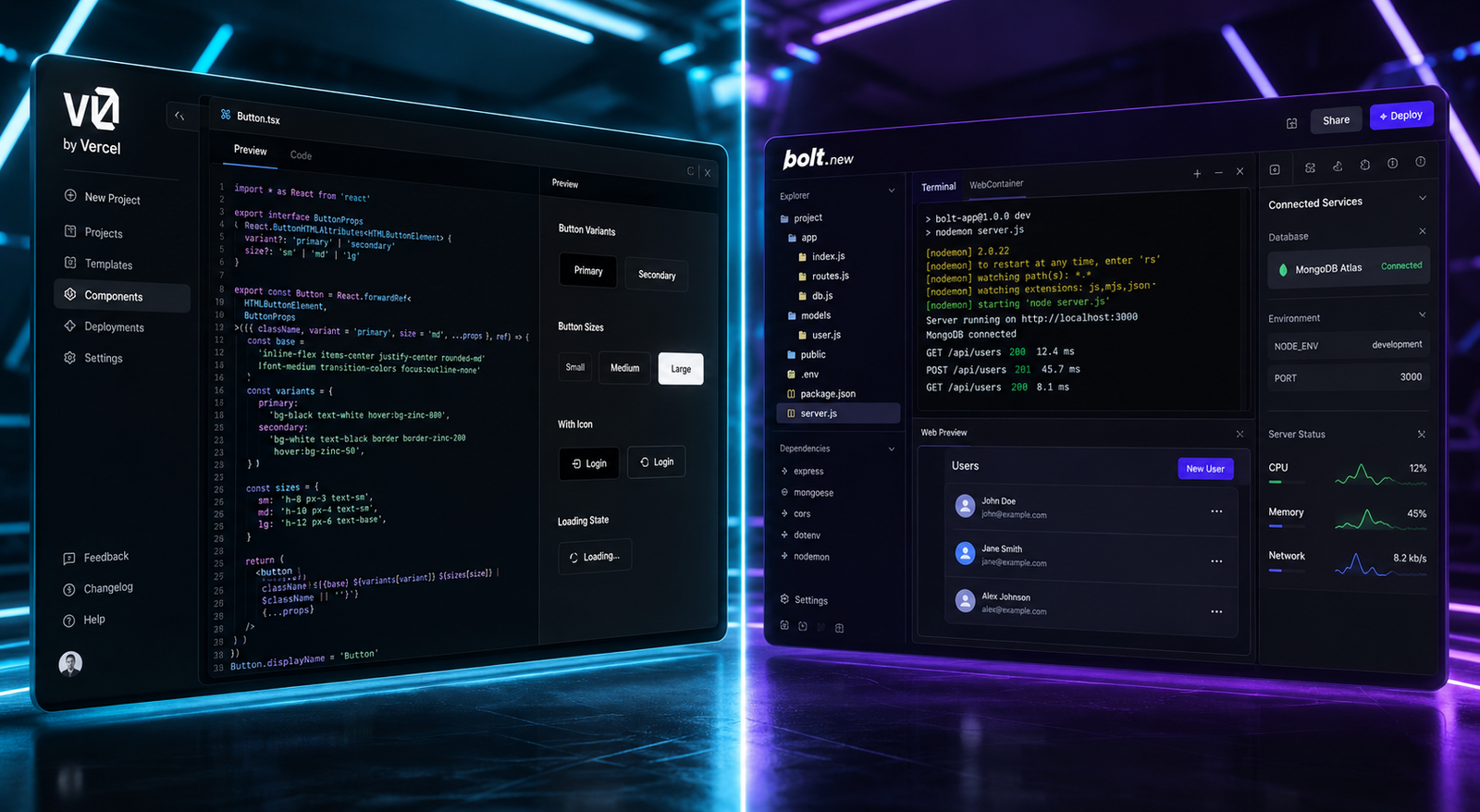
v0 by Vercel produces cleaner, more maintainable frontend code than Bolt.new, but Bolt.new generates an end-to-end working full-stack prototype faster from a single prompt.
Choosing between them comes down to architectural scope: v0 functions as an enterprise-grade UI factory and git-integrated development agent for Next.js and React codebases, while Bolt.new operates as an isolated, browser-based sandbox powered by WebContainers to execute full multi-framework Node.js applications.
The landscape of AI app building—often called vibe coding—has shifted dramatically. AI generation is no longer just about rendering a single isolated button or throwing together a throwaway demo. Platforms now run terminal commands, manage branch PRs, orchestrate cloud databases, and handle complex design systems.
If you are deciding where to spend your monthly AI software budget in 2026, this hands-on review compares v0 by Vercel and StackBlitz's Bolt.new across real-world developer benchmarks.
What Is v0 by Vercel?
v0 is Vercel's flagship AI development agent. Originally launched as a specialized text-to-UI generator for React, Tailwind CSS, and `shadcn/ui` components, v0 has evolved into a full development platform.
Operating on Vercel's custom model family and tier structure, v0 generates component libraries, executes terminal commands, resolves git merge conflicts, writes database queries, and manages direct pull requests against production repositories.
The v0 Development Workflow
- Input & Analysis: You provide a text prompt, wireframe screenshot, or design mock along with optional repository access.
- AI Agent Processing: The v0 engine parses the request against your design system and TypeScript conventions.
- Sandboxed Generation: Code is compiled inside a native Vercel runtime featuring Database Studio integration for services like Neon and Drizzle.
- Git Resolution: v0 resolves merge conflicts and submits a direct Pull Request to your connected GitHub repository.
Rather than locking code inside an isolated sandbox tab, v0 treats git workflows as first-class citizens. It lets designers, product managers, and software engineers generate polished, production-ready frontend interface layers and wire them into real databases (like Neon, Drizzle, and Snowflake) or headless services (like Shopify).
What Is Bolt.new?
Bolt.new is StackBlitz's in-browser AI app builder. Powered by WebContainers—StackBlitz's browser-based WebAssembly technology—Bolt executes a complete Node.js environment directly inside your web browser tab.
The Bolt.new Execution Workflow
- Prompt Specification: You define your application requirements, framework preferences, and feature specs in natural language.
- WebContainer Bootstrapping: Bolt spins up an isolated Node.js environment directly in your browser tab without external cloud servers.
- Package & Terminal Execution: The AI installs required npm packages, executes shell commands, and builds route handlers automatically.
- Deployment & Export: The live app renders instantly in the preview window and can be published to hosting platforms like Netlify or exported to GitHub.
When you enter a prompt into Bolt.new (such as "Build a SaaS analytics dashboard with client auth, dark mode, and Stripe payment webhooks"), the AI agent creates a full project directory, installs npm packages, spins up local development servers, configures client and server routes, and renders a live interactive app.
Bolt is framework-agnostic, supporting React, Next.js, Vue, Svelte, Astro, and Remix out of the box.
Direct Architectural Comparison: v0 vs Bolt.new
Understanding the difference between v0 and Bolt comes down to how each platform handles execution environments, state, and code generation.

| Feature | v0 by Vercel | Bolt.new (StackBlitz) |
|---|---|---|
| Primary Focus | Production UI design systems, Next.js apps, & repo PR integration | Instant full-stack prototypes, multi-framework web apps |
| Runtime Environment | Vercel cloud agent + sandboxed dev runtime | StackBlitz WebContainers (Node.js in browser tab) |
| Framework Support | React, Next.js (optimally tuned for Vercel ecosystem) | React, Next.js, Vue, Svelte, Astro, Remix, Vite |
| Component Stack | `shadcn/ui`, Tailwind CSS, Radix primitives | Unopinionated (Tailwind, Radix, Lucide, custom) |
| Database & Auth | Neon, Drizzle, Better Auth, Snowflake, Shopify integrations | Supabase integrations, custom API endpoints |
| Version Control | GitHub PR creation, branch management, merge conflict resolution | Download ZIP, push initial commit to GitHub |
| Code Quality Output | Modular, enterprise-grade, strict TypeScript standards | Functional, multi-file output; occasional context bloat |
| Terminal & NPM Access | Terminal command execution with permission prompts | Direct interactive terminal access inside browser |
5 Key Head-to-Head Testing Benchmarks
To evaluate v0 by Vercel against Bolt.new, we ran both platforms through five identical development benchmarks.
1. Code Architecture and Production Readiness
- v0 Benchmark Score: 9.5 / 10
- Bolt Benchmark Score: 7.5 / 10
When evaluating AI code output, raw speed matters less than maintainability. Drop messy, unorganized AI code into an existing corporate repository, and your engineering team will spend hours refactoring it.
- v0 by Vercel: v0 excels at generating clean code. It separates concerns into modular sub-components, strictly types props with TypeScript, utilizes semantic HTML5 elements, and follows modern `shadcn/ui` composition patterns. If you ask v0 to generate a data table with sorting, pagination, and multi-select filters, it produces clean files that look as if a principal frontend engineer wrote them.
- Bolt.new: Bolt prioritizes putting together a working application above all else. While its initial outputs work smoothly, the file structure can quickly grow verbose as the chat context lengthens. State management is often bundled inside oversized parent components, requiring manual cleanup before merging into a real production app.
Winner: v0 by Vercel. Its component architecture and code cleanliness set the standard for modern frontend standards.
2. Speed to Working Full-Stack MVP
- Bolt Benchmark Score: 9.5 / 10
- v0 Benchmark Score: 8.0 / 10
If your objective is going from a blank screen to a working web prototype in 15 minutes to demo for investors or stakeholders, speed-to-functionality is critical.
- Bolt.new: Bolt shines in rapid full-stack scaffolding. Because WebContainers allow the AI to install npm packages on the fly, run backend API routes, set up local mock databases, and render real-time UI previews in one tab, you get a fully clickable prototype in under three minutes.
- v0 by Vercel: While v0 scaffolds full Next.js projects with database ORMs like Drizzle and Neon, setting up complex backend logic can require around six minutes and more explicit multi-step prompts or existing project context.
| Platform | Time to First Working Demo | Scope Delivered |
|---|---|---|
| Bolt.new | ~3 Minutes | Full multi-page app bootstrapped in browser |
| v0 by Vercel | ~6 Minutes | Detailed production UI & structured DB schema |
Winner: Bolt.new. For zero-to-one prototyping where you need a working multi-page application with mock logic instantly, Bolt gets you there faster.
3. Git Integration and Enterprise Workflows
- v0 Benchmark Score: 10 / 10
- Bolt Benchmark Score: 6.0 / 10
How easily does the tool fit into how engineering teams actually build software?
- v0 by Vercel: This is where v0 leaves most AI app builders behind. v0 doesn't treat your app as a temporary sandbox. You can import any existing GitHub repository directly into a v0 workspace. v0 reads your existing project files, adopts your internal design system, uses your existing environment variables, generates new features on isolated git branches, handles merge conflicts, and submits clean Pull Requests back to GitHub.
- Bolt.new: Bolt works predominantly as an isolated environment. You start a project, build inside StackBlitz, and export to GitHub or Netlify. Re-importing a massive multi-thousand-line existing production codebase into Bolt for minor iterative feature work can lead to browser memory bloat or high token consumption.
Winner: v0 by Vercel. Its native git branch management, PR generation, and merge conflict resolution make it a true enterprise engineering tool.
4. Design Precision, Image-to-Code, and Visual Editing
- v0 Benchmark Score: 9.8 / 10
- Bolt Benchmark Score: 7.0 / 10
Converting Figma mocks, screenshots, or visual prompts into pixel-perfect code is an essential test for modern generative tools.
| Design Feature | v0 by Vercel | Bolt.new |
|---|---|---|
| Image-to-Code Accuracy | 9.8 / 10 | 7.2 / 10 |
| Visual Element Inspector | Dedicated Design Mode | Basic element selection |
| Spacing & Measurement Overlay | Native visual overlay | None |
| Design System Enforcement | Automatic via `shadcn/ui` | Prompt-dependent |
- v0 by Vercel: v0 provides precision visual control. Its Design Mode features floating toolbars, visual element pickers, layer hierarchy views, and measurement overlays. You can click directly on any heading, margin, or component in the live preview and tell v0 to adjust padding, update colors, or swap icons without altering surrounding layout logic. Its image-to-code vision capabilities transform design screenshots into matching JSX markup with near-perfect fidelity.
- Bolt.new: Bolt accepts image uploads and converts visual descriptions into layout code. However, it lacks granular visual inspection tooling. Fine-tuning visual design usually requires text prompts, which can alter non-target elements if the model refactors CSS classes broadly.
Winner: v0 by Vercel.

5. Multi-Framework Flexibility
- Bolt Benchmark Score: 10 / 10
- v0 Benchmark Score: 6.0 / 10
Not every frontend project is built on Next.js or React.
- Bolt.new: Bolt runs on StackBlitz WebContainers, allowing it to execute any framework supported by Node.js. Whether your stack is Vue 3, Nuxt, SvelteKit, Astro, SolidJS, or traditional React with Vite, Bolt scaffolds, runs, and deploys it effortlessly.
- v0 by Vercel: While v0 has expanded backend integrations and sandbox features, its core focus remains optimized around React, Next.js, `shadcn/ui`, and the broader Vercel cloud platform. Attempting to use v0 for Vue or Svelte projects produces inconsistent results compared to its React capabilities.
Winner: Bolt.new.
Pricing Models and Token Economics
Understanding subscription cost structures prevents surprise billing when iterating heavily on complex builds.
| Pricing Aspect | v0 by Vercel | Bolt.new (StackBlitz) |
|---|---|---|
| Free Tier Structure | Credit-based monthly generation allocation | Daily token limits for basic testing |
| Paid Tier Structure | Model Tiers (Mini, Pro, Team plans) | Pro Tier with large monthly token allocations |
| Unused Resource Handling | Monthly unused credits roll over | Fixed monthly window refreshes |
| Token Consumption Risks | Predictable per-generation credit cost | Sends entire file tree context during chat edits |
v0 by Vercel Pricing Structure
v0 operates on a tiered model system integrated into Vercel user and team workspaces:
- Free Tier: Includes monthly credits suitable for testing UI generation and building small components.
- Pro & Team Plans: Unlocks access to advanced agent models, including the v0 Composite Model family and high-performance model tiers.
- Credit Rollover: Unused generation credits roll over to subsequent billing cycles, preventing lost value during slower development sprints.
Bolt.new Pricing Structure
Bolt uses a token-consumption framework based on LLM context windows:
- Free Tier: Offers initial daily tokens to create basic web applications.
- Pro Tier: Provides dedicated monthly token pools (e.g., 10,000,000+ tokens) without daily caps.
- Token Usage Note: Because Bolt sends your application file tree back into context during deep iterative chat sessions, large projects can consume tokens quickly when performing minor bug fixes.
Practical Decision Matrix: Which Builder Should You Choose?
| Development Goal | Recommended Platform | Primary Advantage |
|---|---|---|
| Building production Next.js / React apps | v0 by Vercel | Modular TypeScript code & native GitHub PR workflows |
| Scaffolding a 0-to-1 full-stack MVP | Bolt.new | Boots Node.js apps with terminal & packages in 3 minutes |
| Working outside React (Vue, Svelte, Astro) | Bolt.new | Unopinionated WebContainer runtime supporting all Node frameworks |
| Collaborating with designers & PMs | v0 by Vercel | Visual element inspector, design mode, & branch conflict resolution |
Choose v0 by Vercel if:
- You build in the React / Next.js ecosystem: You rely on Tailwind CSS, TypeScript, `shadcn/ui`, and Vercel infrastructure.
- You need production code, not disposable prototypes: You want modular components that seamlessly blend into enterprise repositories.
- You work within an established team git workflow: You want non-engineers (PMs, designers) to open real GitHub pull requests and resolve merge conflicts safely.
- You require pixel-perfect visual editing: You depend on visual element inspection, design overlays, and screenshot-to-code accuracy.
Choose Bolt.new if:
- You need a working MVP in minutes: You want an instantly interactive web application complete with routing and API logic without configuring local dev environments.
- You work outside React: Your stack uses Vue, Svelte, Astro, Remix, or vanilla JavaScript.
- You are a non-technical founder testing ideas: You want a web agent that manages terminal installations, node servers, and previews in one browser tab.
- You are building hackathon or client demo projects: You need quick proof-of-concept builds deployed directly to Netlify or custom domains.
Common Mistakes Developers Make with AI App Builders
Using AI coding agents effectively requires adjusting your development process. Avoid these four operational traps:
- Prompting giant multi-feature requests at once: Asking either v0 or Bolt to "Build a complete Airbnb clone with payments, user profiles, maps, messaging, and reviews" in a single prompt causes context degradation. Break requests down into modular steps: scaffold layout first, build data models second, attach UI state third, and wire backend logic last.
- Ignoring code review on generated logic: While v0 and Bolt write functional code, automated implementations of authentication or payment processing require security auditing before launching to real users. Always verify API access controls, secret key handling, and database permissions.
- Letting token contexts grow too large without committing: In Bolt, long chat threads lead to massive token consumption on simple edits. Export your code to GitHub regularly, reset your chat session, and re-anchor the model to clear context clutter.
- Copy-pasting code manually instead of using Git workflows: Manually copying raw code blocks out of AI web chats into local IDEs wastes time and introduces subtle syntax errors. Leverage v0's native GitHub branch PR integration or Bolt's Git export features to streamline deployment pipelines.
Final Verdict
Both v0 by Vercel and Bolt.new represent impressive achievements in generative software engineering, but they serve distinct developer needs.
v0 by Vercel is the clear winner for frontend software engineers, product design teams, and production development. Its code quality, git integration, visual element inspectors, and deep Vercel platform ecosystem make it an essential developer tool for building scalable web apps.
Bolt.new remains a top choice for rapid zero-to-one prototyping, multi-framework flexibility, and building quick web applications inside a browser sandbox.
To optimize your AI software tooling budget, review hands-on software teardowns, feature breakdowns, and pricing guides on Saasbonus to ensure you pick the right developer tools every time.