Vapi vs Bland AI: Best AI Voice Agent for SaaS Inbound?
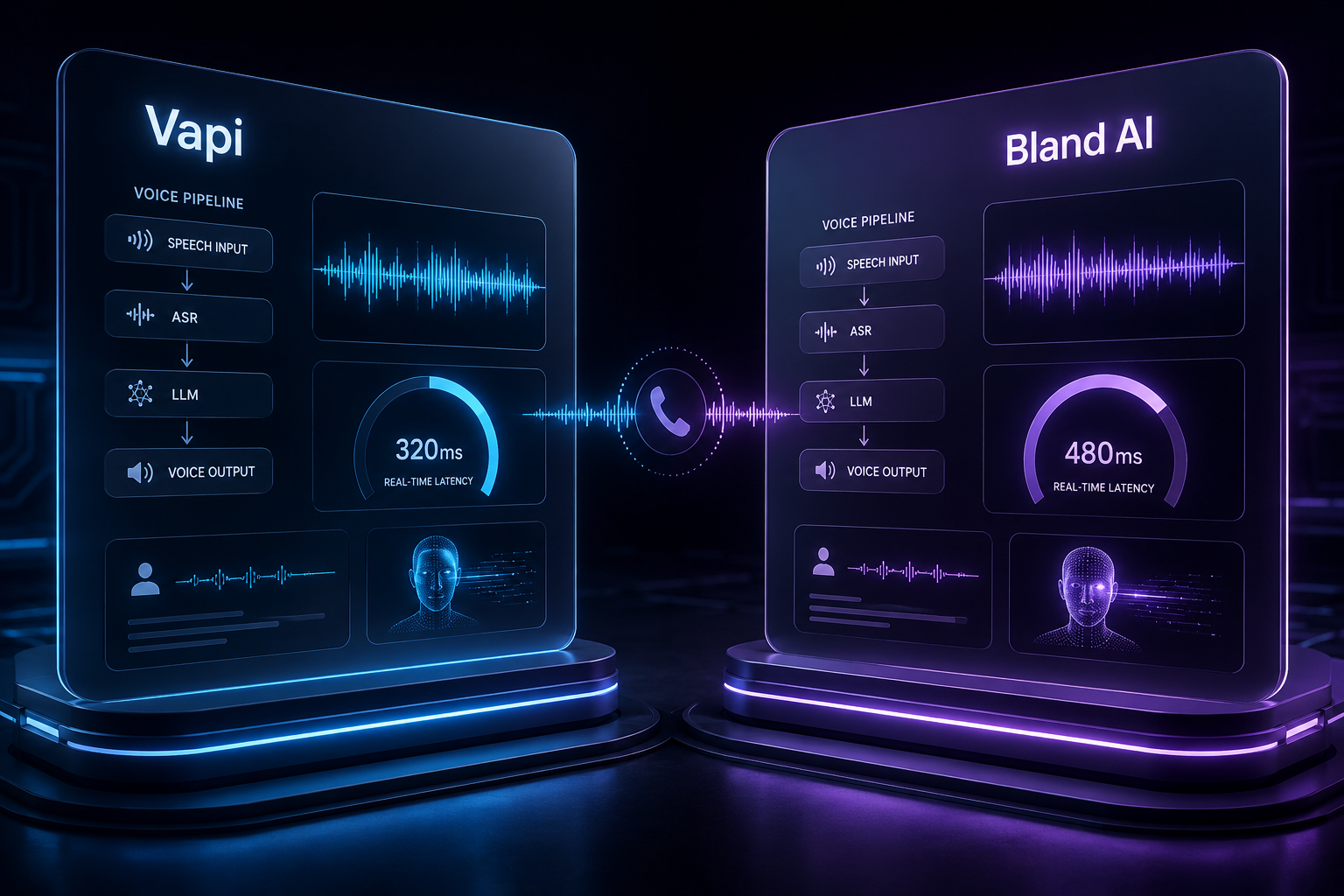
Replacing a human sales representative or an automated booking widget with an AI voice agent comes down to one non-negotiable metric: conversation latency. If a prospect asks, 'Can this integrate with my HubSpot enterprise portal?' and your AI voice bot pauses for 1.8 seconds before answering, the lead hangs up.
When evaluating Vapi vs Bland AI to qualify inbound SaaS traffic, book live demos, and answer product questions, the right choice depends on how your team builds software.
If you have dedicated engineers who want granular control over your large language model (LLM), speech-to-text (STT), text-to-speech (TTS), and custom webhooks, Vapi is the superior engine. If you want a vertically integrated, all-inclusive solution with deterministic dialog pathways that non-technical growth leads can configure in an afternoon, Bland AI takes the lead.
The Core Architectural Difference: Modular Orchestration vs. Vertical Integration
Before diving into pricing matrices and latency benchmarks, you need to understand the fundamental architectural divergence between these two platforms.
Architectural Approach Comparison
| Platform | Core Architecture | Component Control | Infrastructure Model |
|---|---|---|---|
| Vapi | Modular Orchestrator | Full selection of STT, LLM, and TTS vendors | Bring Your Own Stack / API Keys |
| Bland AI | Vertically Integrated Engine | Single managed pipeline with native endpoints | All-Inclusive Managed Infrastructure |
What is Vapi?
Vapi (Voice AI Platform Infrastructure) acts as an orchestration middleware layer. It provides developer-first APIs, WebRTC connections, and software development kits (SDKs) that hook into third-party providers. You choose your preferred STT (such as Deepgram), your preferred LLM (such as Claude 3.5 Sonnet or OpenAI's GPT-4o), your TTS engine (such as ElevenLabs, PlayHT, or Cartesia), and your telephony stack (Twilio or Bring Your Own Carrier). Vapi stitches these parts together and charges a flat platform fee per minute on top of raw infrastructure costs.
What is Bland AI?
Bland AI is a closed-loop, vertically integrated voice agent platform. Rather than forcing you to maintain separate API keys across five vendor dashboards, Bland operates its own self-hosted models, voice pipelines, and telephony infrastructure. You pay one flat rate per minute that covers transcription, reasoning, voice synthesis, and call routing in a single invoice.
Architectural & Feature Comparison
| Feature or Metric | Vapi | Bland AI |
|---|---|---|
| Primary Architecture | Modular Orchestrator (Bring Your Own Stack) | Vertically Integrated Engine |
| Base Pricing | $0.05 / min platform fee + provider costs at cost | $0.11 - $0.14 / min all-inclusive (tier dependent) |
| Average End-to-End Latency | 450 ms - 700 ms (depends heavily on chosen models) | 550 ms - 850 ms (depends on pathway complexity) |
| Voice Provider Flexibility | High (ElevenLabs, PlayHT, Cartesia, Azure, OpenAI) | Moderate (Native self-hosted voices + select integrations) |
| LLM Support | Any model (OpenAI, Anthropic, Groq, custom fine-tunes) | Integrated model runtime / managed endpoints |
| Conversation Design Tool | Code, JSON schema, or visual dashboard | Visual Conversational Pathways Builder |
| CRM Function Calling | Advanced native webhooks & dynamic function schema | Webhook nodes within dialog pathways |
| HIPAA / SOC 2 Compliance | Available (HIPAA add-on or Enterprise tier) | SOC 2, HIPAA, and custom VPC options available |
| Setup Complexity | Moderate to High (Requires engineering resources) | Low to Moderate (Faster time-to-market) |
Inbound SaaS Use Cases: How They Perform in the Field
Inbound SaaS calls differ significantly from cold outbound dialing. When a high-intent prospect clicks 'Call Sales Now' or dials a phone number after viewing your pricing page, they expect instant answers to technical questions, immediate calendar availability checks, and a smooth transfer to an account executive if qualified.

Here is how both platforms fare under real inbound SaaS conditions.
1. Lead Qualification & Real-Time CRM Lookup
Consider an inbound lead calling and asking: 'We have 40 seats on HubSpot Professional and want to know if your API supports bidirectional custom object syncing.'
- With Vapi: Your agent sends a function call event to your backend within 200 milliseconds. Your API queries your product documentation vector database or CRM via a tool call, injects the result into the LLM context (for example, Claude 3.5 Sonnet on Groq or OpenAI Realtime API), and outputs the exact answer in a realistic ElevenLabs or Cartesia voice. Because you control every layer, you can fine-tune latency by swapping your LLM host to a fast inference provider if latency spikes.
- With Bland AI: You map this interaction inside Conversational Pathways. You create a node that triggers an external HTTP request to your middleware webhook. While reliable, if your backend takes 600ms to return data, Bland's pipeline can experience audio gaps unless you configure explicit filler sounds ('Let me check our integration matrix for you...') inside the node configuration.
2. Live Demo Booking & Scheduling
When an inbound prospect qualifies for a demo, the voice agent must fetch available slots from Cal.com or Calendly, speak those slots naturally, and lock in the booking without double-booking the calendar.
- Vapi: Handles complex, multi-turn tool calling exceptionally well. If a user says, 'No, Thursday morning doesn't work, what about Friday after 2 PM EST?', Vapi passes the updated parameters cleanly back to your booking handler.
- Bland AI: Bland makes basic calendar booking easy via pre-built pathway templates. However, if the prospect interrupts midway through the booking confirmation to ask a side question about billing terms, Bland's deterministic pathways can sometimes loop or require deliberate prompt guardrails to regain script context.
3. Human Handoff & Warm Transfer
If an inbound enterprise lead hits a high-value threshold (such as declaring 500 or more employee seats), the AI voice agent should instantly transfer the call to an on-call Account Executive over Session Initiation Protocol (SIP) or WebRTC.
- Vapi: Offers fine-grained control over Twilio, Plivo, or SIP trunking transfer logic. You can execute a warm transfer where the agent briefs the rep on the lead's details before bridging the prospect onto the line.
- Bland AI: Supports direct phone number transfers seamlessly within its pathway builder. It adds a predictable $0.03 to $0.05 per transferred minute depending on your plan tier, keeping billing straightforward.
Real-World Cost Analysis: 1,000 vs. 10,000 Minutes
Software pricing comparisons often break down because platforms charge using different billing models. Bland AI uses a consolidated per-minute model. Vapi uses an unbundled platform fee where you pay separate vendors for STT, LLM tokens, TTS characters, and telephony.
Let's break down the realistic monthly costs for an inbound SaaS operation running 1,000 minutes (a small pilot) versus 10,000 minutes (a scaled inbound operation).
Stack Assumptions for Vapi (Standard Stack):
- Vapi Platform Fee: $0.05 / minute
- STT (Deepgram Nova-2): ~$0.0043 / minute
- LLM (GPT-4o mini or Claude 3.5 Haiku): ~$0.015 / minute (varies based on prompt size)
- TTS (Cartesia or ElevenLabs Turbo): ~$0.03 - $0.06 / minute
- Telephony (Twilio Inbound): ~$0.0085 / minute
- Total Estimated Vapi Cost per Minute: $0.107 to $0.138 / min
Stack Assumptions for Bland AI (Build Tier at $299/mo):
- Monthly Platform Base: $299 / month
- Included Rate per Minute: $0.12 / minute
- Total Estimated Bland Cost per Minute: $0.12 / min + $299 fixed fee
Monthly Expenditure Comparison
| Monthly Usage Volume | Vapi Total Cost Estimate | Bland AI Total Cost Estimate | Winning Platform for Cost |
|---|---|---|---|
| 1,000 Minutes | $110 - $140 | $120 - $140 | Tie (Vapi edges on low usage, Bland simplifies stack) |
| 10,000 Minutes | $1,070 - $1,380 | $1,499 ($299 base + $1,200 usage) | Vapi (Saves $119 - $429 per month) |
Scenario A: 1,000 Inbound Minutes / Month
- Vapi Cost: ~$110 to $140 total (no monthly subscription required to start).
- Bland AI Cost: ~$120 (on pay-as-you-go Start tier at $0.14/min) = $140 total.
- Winner at 1,000 mins: Tie. Vapi is slightly cheaper if using low-cost voice providers, but Bland on pay-as-you-go requires zero stack assembly.
Scenario B: 10,000 Inbound Minutes / Month
- Vapi Cost: ~$1,070 to $1,380 total. If you swap to a cheaper TTS provider or use an open-source LLM endpoint, your costs drop instantly without renegotiating contracts.
- Bland AI Cost: $299 platform fee + (10,000 x $0.12) = $1,499 total.
- Winner at 10,000 mins: Vapi. Vapi gives growth teams direct financial levers. Optimizing prompt length or choosing faster, cheaper inference directly reduces your per-minute rate.

Latency and Conversation Flow: Why Sub-600ms Matters
Human conversation operates on an unspoken timing window:
- 0 - 300 ms: Feels like an instant, natural human response.
- 300 - 600 ms: Normal conversational pause; feels natural and attentive.
- 600 - 1000 ms: Noticeable hesitation; callers start wondering if the line disconnected.
- > 1000 ms: Frequent interruptions, double-talking, and high call drop rates.
Real-World Latency Benchmarks
- Human Benchmark (0–300ms): Target response window in natural spoken conversation.
- Vapi Tuned Stack (450–600ms): Achieved using Deepgram Nova-2, Groq inference, and Cartesia TTS.
- Bland AI Managed Engine (550–850ms): Standard performance using native unified voice pipelines.
- Unoptimized Custom Stack (1,000ms+): Result of chaining slow LLMs with unbuffered TTS endpoints.
Vapi's Latency Advantage
Vapi's architecture lets engineers tune every millisecond of the audio pipeline. If latency spikes on ElevenLabs, you can re-route your agent to Cartesia or PlayHT within minutes. By pairing Deepgram Nova-2 with ultra-fast LLM inference engines, production Vapi builds routinely achieve end-to-end response times between 450ms and 600ms.
Bland AI's Latency Trade-Off
Bland AI operates a robust managed infrastructure that insulates you from vendor management. However, because the underlying voice synthesis and model processing run through Bland's unified pipeline, you have fewer direct levers to optimize individual pipeline components. Average latency for complex conversational nodes sits between 550ms and 850ms. While perfectly acceptable for structured lead capture, fast-paced inbound sales discovery calls can occasionally experience slight delays.
Technical Setup & Developer Experience
To choose between these tools, look closely at your engineering roadmap.
Building on Vapi
Setting up an inbound agent on Vapi feels like writing modern TypeScript or Python software. You define tools using standard OpenAI JSON schemas, register webhooks for call state changes, and manage assistant configuration as code.
json { "name": "qualify_inbound_lead", "description": "Checks seat requirement and updates CRM record during live inbound call", "parameters": { "type": "object", "properties": { "seat_count": { "type": "integer", "description": "Number of seats requested" }, "crm_id": { "type": "string", "description": "Lead CRM ID" } }, "required": ["seat_count"] } }
This flexibility allows your team to integrate custom retrieval-augmented generation (RAG) pipelines, run vector database checks mid-call, and maintain precise control over conversation state.
Building on Bland AI
Bland AI prioritizes operational speed. Its Conversational Pathways interface lets non-developers drag and drop prompt nodes, define conditional branches (for example, if seat count is greater than 50, transition to Node B), and insert HTTP request triggers without writing orchestration logic.
If your growth operations team wants to build, test, and iterate on voice call flows without opening a ticket for your core engineering team, Bland AI delivers a much shorter time-to-market.
5 Common Implementation Mistakes to Avoid
- Over-engineering the initial prompt: Don't feed your AI agent a 2,000-word prompt containing your entire product manual. Large prompts increase LLM time-to-first-token (TTFT), directly causing context latency spikes during live calls.
- Ignoring interruption handling (barge-in): Inbound callers interrupt constantly when asking questions. Ensure your chosen platform is configured to cancel text-to-speech output instantly when user speech is detected.
- Failing to implement fallback webhook timeouts: If your internal API takes more than 1.5 seconds to return data during a function call, your voice agent will pause awkwardly. Always configure immediate fallback responses (such as 'Let me pull up those details while we keep talking...').
- Using ultra-high-fidelity voices for fast-paced Q&A: Premium, highly expressive voice models sound stunning in static demos, but often add 150ms to 300ms of generation latency. For fast-paced inbound lead qualification, prioritize fast-streaming voice models like Cartesia or ElevenLabs Turbo.
- Neglecting compliance and consent recordings: If your inbound voice agent records calls for quality or CRM logging, ensure your initial greeting includes explicit call recording disclosures where legally required.
Step-by-Step Selection Guide: How to Choose in 10 Minutes
- Audit your development bandwidth: If you have software engineers available, consider Vapi. If you lack engineering resources to write webhooks and manage API keys, choose Bland AI for faster, code-free setup.
- Evaluate your voice customization needs: If you require specific synthetic voices (such as custom ElevenLabs clones or Cartesia models) or want to test custom fine-tuned LLMs, select Vapi for maximum control.
- Measure your conversation complexity: If your inbound call flow requires fetching dynamic data from internal microservices mid-call, Vapi's developer tools give you stronger control. For simpler, structured outbound or script-bound inbound calls, Bland AI is well suited.
- Compare billing structure preferences: If you prefer one predictable monthly invoice without tracking separate vendor bills, choose Bland AI. If you want granular cost-optimization levers across your stack, choose Vapi.
Final Verdict: Which AI Voice Agent Wins for SaaS Inbound?
- Choose Vapi if: You are a software company with engineering resources building a highly customized, low-latency inbound voice agent. Vapi's modular platform gives you full control over your models, voice synthesis, and infrastructure costs, making it the top choice for product-driven teams who want to own their stack.
- Choose Bland AI if: You are a growth, sales, or operations team that wants to launch functional voice agents quickly without heavy engineering overhead. Bland's all-inclusive per-minute pricing, visual dialog builder, and managed infrastructure make it ideal for fast deployment and predictable operational budgets.
Choosing the right software stack early saves months of re-engineering. Explore independent software breakdowns and hands-on reviews on Saasbonus to make informed tooling decisions for your growth stack.