8 Best AI Code Review Tools for Security & Compliance
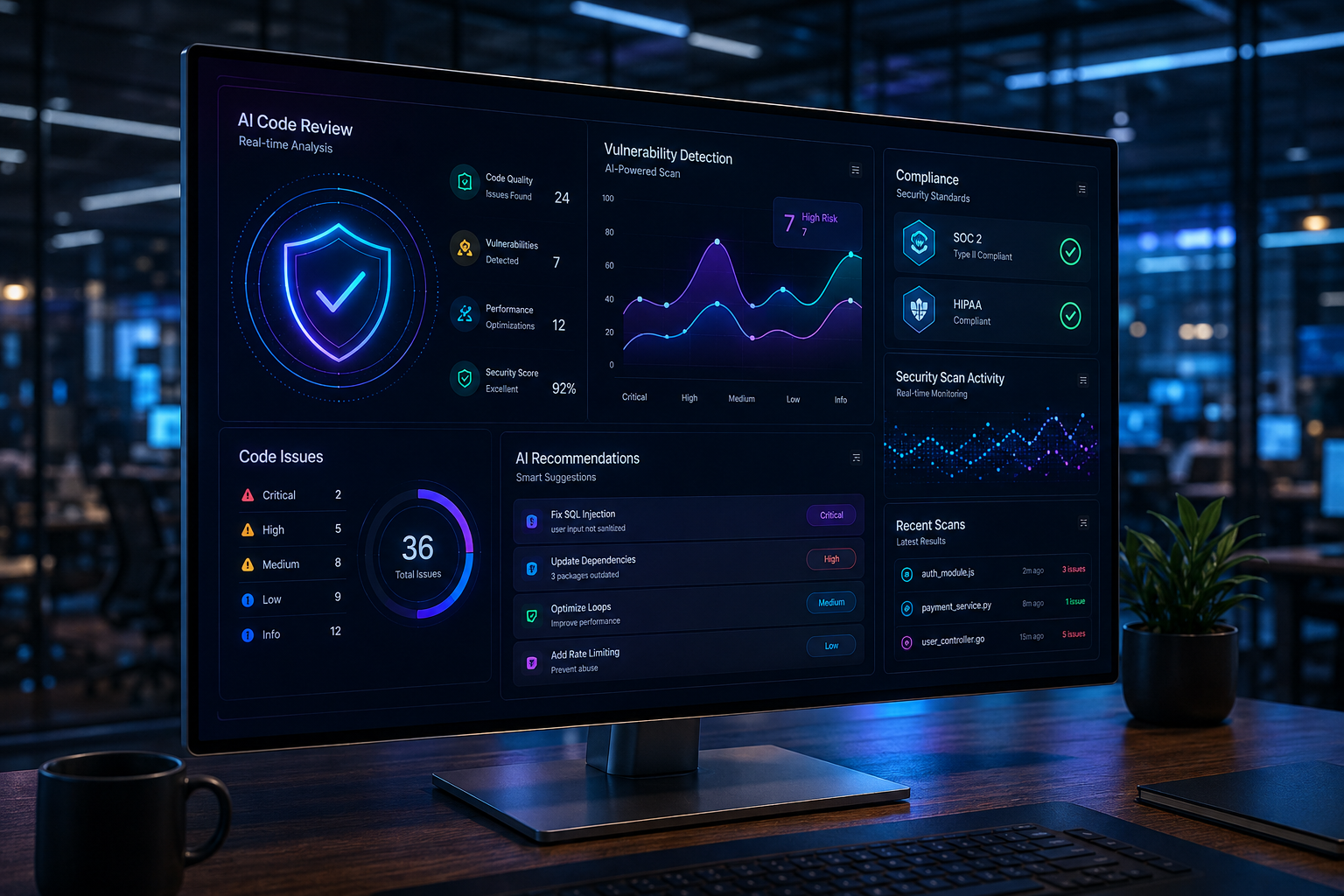
Veracode research indicates that AI coding assistants generate security flaws in nearly 48% of generated code outputs. While tools like GitHub Copilot, Cursor, and Claude Code have multiplied engineering velocity, they have simultaneously flooded pull requests with unvetted dependencies, logic flaws, and exposed credentials. Standard static application security testing (SAST) engines struggle under this volume, burying security teams under thousands of false positives.
To ship software quickly without failing your next SOC 2, ISO 27001, or HIPAA audit, you need AI-native code review platforms. These tools do not just scan syntax after the fact; they analyze contextual reachability, generate automated pull request fixes, and enforce enterprise governance guardrails directly inside the developer loop.
Here is our definitive verdict on the 8 best AI code review tools for security and compliance available today.
Quick Comparison: Top AI Code Review Tools
| Tool | Best For | Primary Security Engine | Key Compliance Frameworks | Deployment Options |
|---|---|---|---|---|
| GitHub Copilot + GHAS | GitHub-Native DevSecOps | CodeQL + Copilot Autofix | SOC 2, ISO 27001 | Cloud, Dedicated Server |
| Snyk | Developer-First SAST & SCA | DeepCode Hybrid AI | SOC 2, HIPAA, PCI DSS | Cloud, Hybrid, Private Cloud |
| Cycode | ASPM & Guardrails | Context Intelligence Graph | SOC 2, ISO 27001, FedRAMP | Cloud, Hybrid |
| Semgrep | Custom Rules & Low Noise | Dataflow Reachability + AI | SOC 2, HIPAA | Cloud, Self-Hosted CLI |
| SonarQube | Code Quality & Hotspots | Clean Code SAST + AI CodeFix | SOC 2, PCI DSS, NIST SSDF | Cloud, Self-Hosted |
| Veracode | Enterprise Multi-Language | Veracode Fix Engine | HIPAA, PCI DSS, FedRAMP | SaaS, Hybrid |
| Aikido Security | Fast-Growing SaaS Teams | Unified All-in-One AST | SOC 2, ISO 27001, HIPAA | Cloud SaaS |
| Checkmarx One | Governance & Agentic AI | Fusion Engine + AI Assist | SOC 2, PCI DSS, FedRAMP | Cloud, On-Prem Air-Gapped |
Why Traditional SAST Fails in the Age of AI-Generated Code
Legacy application security testing tools were engineered for a human development cadence. When human engineers wrote a few hundred lines of code per day, security teams could handle manual triage, investigate flagged warnings, and hold weekly review meetings. Generative AI tools have altered that operational model.
When AI agents and coding assistants generate thousands of lines of code in minutes, traditional security tools fail in three distinct ways:
- The Alert Fatigue Avalanche: Legacy SAST tools rely on rigid pattern matching. When applied to AI-generated code, they produce massive volumes of false positives. Security engineers spend hours auditing non-exploitable warnings rather than addressing critical risks.
- Context Blindness Across Repositories: AI assistants frequently write functions that look secure in isolation but introduce severe vulnerabilities when interacting with multi-repository microservice architectures or specific cloud infrastructure setups.
- Hallucinated Packages and Supply Chain Risks: Generative AI models regularly import non-existent or deprecated third-party libraries. Attackers exploit this habit through package typo-squatting, creating malicious libraries with identical names to hallucinated packages.
Modern AI code review tools overcome these bottlenecks by deploying semantic understanding, dataflow reachability analysis, and automated remediation agents.
Key Evaluation Criteria for AI Security & Compliance Tools
When evaluating AI-driven code review platforms for enterprise production environments, we assess five foundational requirements:
- Dataflow Reachability Analysis: Does the platform verify whether vulnerable code or third-party dependencies are actually reachable by an external attacker, or does it alert on dormant code? Reachability filtering routinely eliminates up to 95% of dependency noise.
- In-IDE and In-PR Remediation: Can the tool auto-generate contextual pull request fixes that developers can accept with a single click, or does it merely post a wall of text?
- Compliance Audit Automation: Does the tool map findings directly to control frameworks like SOC 2 Type II, ISO 27001, HIPAA, and PCI DSS v4.0, generating exportable evidence reports for auditors?
- Model Governance & Privacy Controls: Does the vendor train its public models on your private codebase? Enterprise platforms must guarantee zero data retention and offer VPC or air-gapped deployments.
- Unified Application Security Coverage: Does the platform combine Static Application Security Testing (SAST), Software Composition Analysis (SCA), Secret Detection, and Infrastructure as Code (IaC) scanning into a unified risk score?
The 8 Best AI Code Review Tools for Security & Compliance
1. GitHub Copilot + Advanced Security (GHAS)
Best for: GitHub-native engineering organizations wanting seamless, integrated DevSecOps.
GitHub Copilot paired with GitHub Advanced Security (GHAS) forms a tightly integrated ecosystem for secure AI-driven development. While Copilot assists in generating code, GHAS operates in tandem using CodeQL—GitHub's semantic code analysis engine—and Copilot Autofix to detect and repair vulnerabilities before code ever reaches the main branch.
When CodeQL identifies a vulnerability (such as a SQL injection or cross-site scripting vulnerability), Copilot Autofix analyzes the surrounding codebase context and automatically drafts an inline code fix directly within the pull request conversation.
Security & Compliance Features
- CodeQL Engine: Uses semantic code analysis to query code as if it were a database, identifying deep flow vulnerabilities across multi-file pull requests.
- Push Protection for Secrets: Intercepts committed API keys, tokens, and private credentials before they leave the developer's local machine.
- Dependabot SCA: Automatically generates PRs to update vulnerable dependencies mapped against the GitHub Advisory Database.
- Compliance Mapping: Out-of-the-box security policies aligned with OWASP Top 10, CWE Top 25, and SOC 2 Trust Services Criteria.
Pros & Cons
- Pro: Zero workflow friction for teams already using GitHub Enterprise; developers never leave their existing pull request interface.
- Pro: Copilot Autofix resolves up to 60% of common code flaws without requiring security team intervention.
- Con: Pricing gets expensive quickly when licensing both GitHub Enterprise, Copilot, and GHAS seats across large organizations.
- Con: Less effective for non-GitHub git hosts like GitLab or Bitbucket.
Pricing: GHAS requires a GitHub Enterprise license ($21/user/month) plus Advanced Security add-on pricing ($49/active committer/month).

2. Snyk (Powered by DeepCode AI)
Best for: Fast-moving engineering teams needing developer-first SAST, SCA, and container security.
Snyk has reinvented its scanning technology with DeepCode AI, a hybrid engine that combines symbolic AI logic with generative models. Unlike generic LLMs that guess code fixes based on statistical patterns, DeepCode AI relies on curated security rules verified by human AppSec researchers. This yields exceptionally high accuracy and low false-positive rates.
Snyk inspects source code, open-source dependencies, container images, and IaC templates in a single scan pass, highlighting exact line items that present real exploitable risk.
Security & Compliance Features
- DeepCode AI Engine: Scans code faster than traditional static tools, providing real-time linting feedback directly in VS Code, JetBrains, and Eclipse.
- Transitive Reachability: Evaluates whether a vulnerable sub-dependency is called by your execution path, cutting dependency alert noise by over 70%.
- Snyk Container & IaC: Scans Dockerfiles, Kubernetes manifests, Terraform, and CloudFormation files alongside application code.
- Compliance Reporting: Built-in reporting modules for PCI DSS, HIPAA, ISO 27001, and SOC 2.
Pros & Cons
- Pro: Superior developer experience with instant IDE feedback and actionable auto-fix suggestions.
- Pro: Comprehensive coverage spanning code, dependencies, containers, and cloud infrastructure.
- Con: Advanced reachability and enterprise compliance reporting require top-tier Enterprise pricing.
Pricing: Free tier available for small projects. Team plans start at $25/user/month; Enterprise plans are custom-quoted.
3. Cycode
Best for: Enterprises requiring unified Application Security Posture Management (ASPM) and strict AI guardrails.
Cycode provides an end-to-end ASPM platform equipped with a dedicated AI security layer. Rather than treating code review as an isolated event, Cycode connects your entire Software Development Life Cycle (SDLC)—from developer IDEs and source control to CI/CD pipelines and cloud environments—using its Context Intelligence Graph.
Cycode specifically targets risks introduced by AI agents. It tracks shadow AI coding tools, audits AI Bill of Materials (AIBOM), and uses its AI Exploitability Agent to filter out up to 94% of false positives.
Security & Compliance Features
- Context Intelligence Graph: Links code vulnerabilities directly to running cloud assets to determine true business risk.
- Real-Time AI Guardrails: Intercepts secrets, credentials, and non-compliant code directly inside the IDE before commits occur.
- Governance & AIBOM: Generates AI Bill of Materials and enforces model control policies across multi-repository environments.
- Compliance Automation: Automated evidence collection for SOC 2, ISO 27001, NIST SSDF, and FedRAMP.
Pros & Cons
- Pro: Unmatched visibility across code, supply chain, and cloud infrastructure.
- Pro: Exceptional false-positive reduction using graph-based risk contextualization.
- Con: Can be complex for early-stage startups that just need simple PR linting.
Pricing: Enterprise custom pricing based on the number of active developers and monitored repositories.
4. Semgrep
Best for: Engineering teams seeking lightweight, high-speed code scanning with custom security policy enforcement.
Semgrep has become the industry standard for fast, customizable static code analysis. Semgrep uses simple, intuitive rule syntax that looks like standard code, allowing security engineers to write custom rules in minutes rather than learning complex query languages.
Semgrep's AI assistant uses semantic dataflow analysis to track untrusted user input across functions. By verifying whether tainted data reaches dangerous sinks, Semgrep cuts false positives by up to 98%.
Security & Compliance Features
- Semantic Dataflow SAST: Tracks data flows across variables, functions, and imports to detect actual attack paths.
- Semgrep Supply Chain: SCA engine that focuses strictly on reachable vulnerabilities in third-party libraries.
- Custom Policy Rules: Write company-specific compliance rules (e.g., enforcing custom authorization decorators or encryption wrappers) in seconds.
- Private Engine Execution: Can run entirely locally in CLI or within local CI runners, keeping code private.
Pros & Cons
- Pro: Fast scan times (often completing in under 30 seconds per PR).
- Pro: Open-source core with complete flexibility for custom rule authoring.
- Con: Out-of-the-box compliance dashboards are less feature-rich than legacy enterprise platforms.
Pricing: Open-source CLI is free. Semgrep Cloud Platform offers a generous free tier for up to 10 devs; paid plans start at $30/user/month.
5. SonarQube (by Sonar)
Best for: Regulated enterprises wanting combined code quality, technical debt tracking, and compliance enforcement.
SonarQube sits at the intersection of code quality and security analysis. It scans code for bugs, logic vulnerabilities, technical debt, and security hotspots in a single automated pass. With its built-in AI CodeFix feature, SonarQube suggests contextual code refactoring to fix vulnerabilities while maintaining clean architecture standards.
SonarQube is famous for its "Quality Gates"—strict pass/fail conditions enforced during CI/CD execution. If an AI tool generates code that breaches security coverage or introduces high-severity vulnerabilities, the Quality Gate blocks the merge automatically.
Security & Compliance Features
- Quality Gate Enforcement: Prevents non-compliant code from advancing to production branches.
- AI CodeFix Engine: Automatically suggests refactored, secure code snippets in developer pull requests.
- Security Hotspot Analysis: Highlights sensitive logic areas (like cryptographic implementations or auth handlers) for mandatory human review.
- Built-in Compliance Reports: Automated executive summaries for SOC 2, PCI DSS v4.0, OWASP Top 10, and CWE Top 25.
Pros & Cons
- Pro: Dual focus on structural code quality and deep security analysis.
- Pro: Self-hosted enterprise deployment allows full control over data residency.
- Con: Deep security analysis engines can slow down CI pipeline builds on multi-million-line monorepos.

Pricing: Community Edition is free (self-hosted). Developer Edition starts at $150/year; Enterprise Edition starts at $20,000/year.
6. Veracode (Veracode Fix)
Best for: Enterprise security teams managing multi-language codebases under strict regulatory frameworks.
Veracode is an established leader in application security that has fully integrated AI automation. Its AI-driven remediation engine, Veracode Fix, uses curated LLMs trained on Veracode's proprietary database of audited secure code. Rather than generating code fixes from random internet repositories, Veracode Fix generates tested patches for identified vulnerabilities across 100+ languages.
Veracode provides unified SAST, SCA, DAST, and container security, backed by a proactive Package Firewall that blocks malicious dependencies before they reach developer environments.
Security & Compliance Features
- Veracode Fix: Delivers enterprise-grade AI patch suggestions in the IDE and CI/CD pipeline.
- Package Firewall: Uses AI behavioral analysis to detect and quarantine malware-infected supply chain packages.
- Policy Enforcement Engine: Enforces centralized enterprise security policies across thousands of repositories.
- Compliance Certification: Detailed audit packages for HIPAA, PCI DSS, NIST SSDF, and FedRAMP compliance.
Pros & Cons
- Pro: High level of confidence for enterprise regulatory compliance and audit trails.
- Pro: Curated AI model eliminates hallucinated code fixes.
- Con: Heavier enterprise UI and longer setup time compared to modern cloud-native startups.
Pricing: Custom enterprise tiering based on application count, developer seats, and scan types.
7. Aikido Security
Best for: Scaling SaaS companies and mid-market teams looking for simple, predictable security scanning.
Aikido Security was built to eliminate the setup pain and heavy pricing of legacy security tools. Rated 4.9/5 on Gartner Peer Insights, Aikido combines SAST, SCA, secrets detection, IaC scanning, cloud posture management, and malware detection into one unified platform.
Aikido uses AI to learn your team's coding conventions, automatically filtering out non-critical alerts and presenting findings in plain language. Its one-click AI Autofix capability allows engineers to resolve vulnerabilities straight from GitHub PRs or Slack alerts.
Security & Compliance Features
- Unified Security Scanner: Single engine covering code, dependencies, containers, cloud infrastructure, and domain health.
- Autofix Engine: Generates clean PR patches for outdated packages and SAST findings.
- Noise Reduction Filters: Filters out over 90% of false positives out of the box.
- Compliance Dashboards: One-click evidence generation for SOC 2 Type II, ISO 27001, and HIPAA audits.
Pros & Cons
- Pro: Fast setup (agentless deployment takes less than 15 minutes).
- Pro: Transparent, developer-friendly pricing without hidden seat fees.
- Con: Lacks the deep custom query customization offered by Semgrep or CodeQL.
Pricing: Free tier for up to 2 users. Paid plans start at a flat $300/month for up to 10 users.
8. Checkmarx One
Best for: Global enterprises requiring agentic AI security workflows and complex multi-tenant governance.
Checkmarx One is an enterprise application security testing platform powered by autonomous agentic AI assistants. It unifies SAST, SCA, DAST, API security, and supply chain security into a single management console.
Its AI agent conducts deep threat modeling across complex monorepos, tracing execution flows from front-end microservices down to database queries. When vulnerabilities are detected, Checkmarx ranks findings based on business impact and orchestrates multi-repository patch workflows automatically.
Security & Compliance Features
- Agentic AI Security Assistants: Autonomous threat modeling and multi-stage patch validation pipelines.
- Fusion Engine: Correlates SAST, SCA, and API security findings to show real-world attack vectors.
- Air-Gapped & On-Prem Deployment: Complete support for defense, healthcare, and finance environments requiring total isolation.
- Global Compliance Standards: Native auditing templates for FedRAMP, SOC 2, HIPAA, PCI DSS, and GDPR.
Pros & Cons
- Pro: Deep analysis capabilities for multi-million-line corporate codebases.
- Pro: Fully supports air-gapped and hybrid enterprise deployments.
- Con: Significant resource footprint and high enterprise cost.
Pricing: Custom enterprise tiering based on codebase volume and module selection.
How to Deploy AI Code Review Tools in CI/CD Without Slowing Down Developers
Implementing security gates often causes friction between AppSec and engineering teams. If security tools add 15 minutes to every build pipeline, developers will bypass controls.
To balance rapid delivery with tight security, follow this staged rollout strategy:
- Shift Right First (Baseline Audit): Run an initial async scan across all primary branches without blocking merges. Create a baseline of existing technical debt and classify issues by severity.
- Enable In-IDE Guardrails (Pre-Commit): Deploy IDE extensions (e.g., Snyk Code, SonarLint, Cycode) to catch secrets and high-severity flaws before code is committed.
- Set Smart CI Quality Gates (PR Level): Configure pull request checks to block merges only for new Critical and High vulnerabilities. Do not break builds over minor code formatting issues or non-reachable warnings.
- Automate One-Click Remediation: Enable AI autofix features (like Copilot Autofix or Veracode Fix) so developers can accept suggested remedies directly within PR comments.
- Automate Auditor Dashboards: Connect your security platform to compliance management software (like Vanta or Drata) to continuously export SOC 2 and ISO evidence.
Common Pitfalls When Relying on AI Security Tools
While AI-driven security tools accelerate code reviews, engineering leaders must guard against three primary failure modes:
- Blindly Trusting AI Autofixes: Generative models can introduce secondary vulnerabilities while fixing primary bugs. Require human developer sign-off on all AI-generated code patches before pushing to production.
- Ignoring Hallucinated Dependencies: AI coding assistants occasionally import fake packages. Ensure your security scanner includes real-time supply chain firewall protection to verify package authenticity.
- Overlooking Unreachable Vulnerabilities: Scanning without reachability analysis leads to severe alert fatigue. Prioritize platforms like Semgrep or Snyk that verify dataflow paths.
Accelerate Your SaaS Stack with Saasbonus
Choosing the right AI code review tool is just one piece of building a secure, scalable SaaS application. At Saasbonus, we publish independent, hands-on software comparisons, architectural teardowns, and deep technical reviews to help engineering leaders choose the right infrastructure, database, and security tools the first time.
Whether you are evaluating database options like Neon vs Supabase, comparing inference engines like Groq vs Together AI, or optimizing your B2B SaaS tech stack, explore our expert reviews at Saasbonus to make confident, data-backed decisions.