Intercom vs Zendesk: Best SaaS Support Tool in 2026

Intercom vs Zendesk: The Short Answer
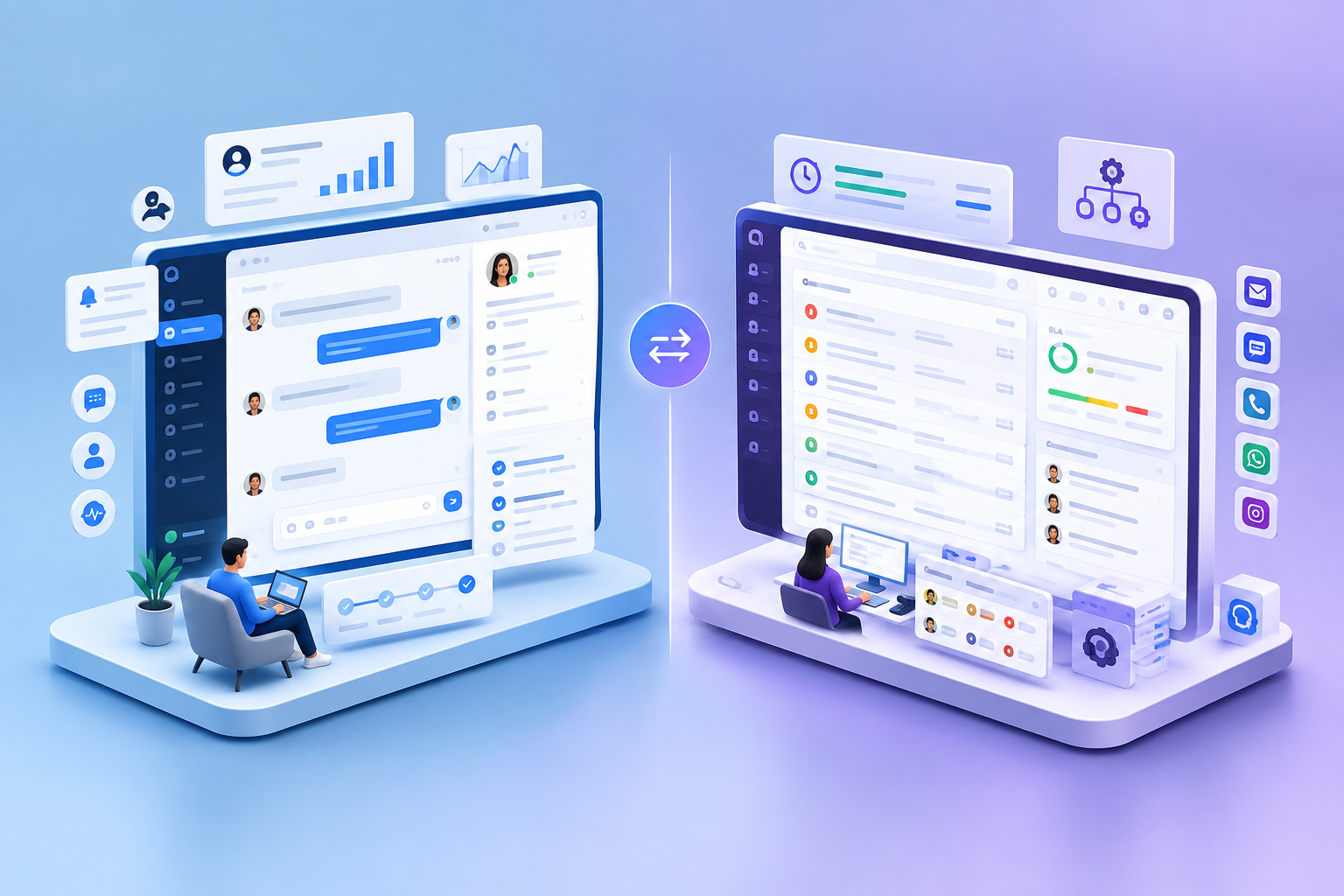
Intercom and Zendesk solve the same broad problem, but they approach customer support from different starting points. Intercom is the stronger choice for SaaS companies that want in-app, conversational support closely tied to product usage. Zendesk is the stronger choice for teams that need structured ticketing, sophisticated routing, multiple support channels, and mature SLA management.
That distinction matters more than a feature checklist. Both platforms now offer AI agents, knowledge bases, messaging, automation, reporting, and integrations. The better question is how your support organization actually works.
If customers mostly ask for help while using your product, and you want support, onboarding, and proactive messaging in the same experience, Intercom has a natural advantage. If requests arrive through email, web forms, phone, messaging, or several channels and then move through Tier 1, Tier 2, engineering, billing, or other teams, Zendesk's ticketing model is usually easier to govern.
Here is the practical rule of thumb:
- Choose Intercom when product-led growth, in-app support, proactive engagement, and conversational AI are central to your customer experience.
- Choose Zendesk when ticket volume, multi-channel operations, detailed routing, SLAs, reporting, and support-team governance matter most.
- Consider both only when you have a clear reason to separate conversational product support from a more formal service operation. Running two systems without a defined ownership model can create duplicate work and fragmented customer history.
The rest of this guide looks at the differences that actually affect implementation, agent productivity, customer experience, and total cost.
Intercom vs Zendesk: The Core Difference
The easiest way to understand the two platforms is to look at the object around which each system is organized.
Intercom is centered on the customer conversation. A user can open the messenger inside a SaaS product, read help content, interact with an AI agent, start a conversation with support, and receive proactive messages without leaving the application. Customer attributes and product context can sit alongside that conversation.
Zendesk is centered on the support ticket and service workflow. A request becomes part of a structured queue that can be categorized, prioritized, assigned, escalated, measured against an SLA, and reported on. Zendesk supports email, messaging, voice, and other channels within its broader customer service platform.
Neither model is inherently better. The right choice depends on what happens after a customer asks for help.
If most questions can be answered by one agent in a few minutes, a conversational inbox is appealing. If a request may need several teams, formal escalation rules, approval steps, or strict response targets, a structured ticketing system becomes more valuable.
Intercom's Approach: Support Inside the Product
Intercom is particularly well suited to SaaS products where the application itself is the main place customers interact with the company.
Its messenger can live directly inside a web or mobile experience, giving customers a low-friction way to ask questions. Support teams can combine that conversational layer with help content, automated workflows, targeted messages, and customer data.
For example, a SaaS company could use a customer's plan, lifecycle stage, product activity, or other attributes to determine what support content or messaging they see. An agent can also use customer context while handling a conversation instead of starting with a blank ticket containing only a name and email address.
That makes Intercom attractive for Product-Led Growth companies. Support can become part of the product experience rather than a separate destination customers have to find.
The trade-off is operational discipline. As volume grows, teams need clear assignment rules, conversation tags, routing logic, ownership standards, and escalation processes. A shared inbox that feels wonderfully simple with six agents can become harder to manage with dozens of agents and several specialized teams.
Zendesk's Approach: Structured Customer Service
Zendesk starts from a more formal service-management model. Its ticketing system gives each request a defined record, status, priority, assignment, history, and set of business rules.
That structure is useful when support is less conversational and more operational. Consider an enterprise customer reporting a production problem. The request may need to move from Tier 1 support to a technical team, trigger an escalation, collect information from engineering, and remain subject to a contractual response target. Zendesk is designed for that kind of process.
Zendesk also brings multiple support channels into a unified service environment. Its current Suite plans include ticketing, messaging, email, voice, live chat, analytics, and AI-powered capabilities, with features varying by plan. Zendesk +1
The downside is that good Zendesk deployments require planning. Groups, views, triggers, automations, macros, fields, permissions, routing, and SLA policies all need to fit together. That effort pays off for complex teams, but it can be unnecessary overhead for a small SaaS company whose customers mainly want quick answers inside the product.
Head-to-Head Feature Comparison
1. In-App Messaging and Live Chat
Intercom has the clearer advantage when the support experience needs to feel native to the product. Its messenger is designed around ongoing conversations rather than a traditional support form. Customers can access help content, interact with automation, and communicate with support without leaving the application.
This becomes especially useful when support and product engagement overlap. A SaaS company can use the same customer context to deliver onboarding messages, announce features, provide contextual help, and respond to support questions.
Zendesk also supports messaging and live chat through its Suite platform. The difference is less about whether Zendesk can provide chat and more about what role chat plays in the overall system. Zendesk treats messaging as one part of a broader customer service operation, while Intercom makes the conversational experience a central part of the product.
Best fit: Intercom for product-led, in-app support; Zendesk for teams that need chat as one channel within a larger service operation.
2. Ticketing, Routing, and Workflow Automation
Zendesk has the stronger model for structured ticket operations.
Teams can build rules that assign tickets to groups, change priorities, apply tags, trigger notifications, and escalate work based on ticket conditions. That becomes increasingly useful when support involves several specialized queues.
A typical workflow might route billing questions to finance support, technical issues to Tier 2, and enterprise customers to a dedicated team. The important point is not that Intercom cannot automate these processes. It can. The difference is that Zendesk's architecture is particularly well suited to organizations where these rules are the backbone of daily support operations.
Intercom's Workflows are better suited to conversational routing, automation, customer messaging, and AI-assisted support journeys. For a smaller team, that can mean less administrative overhead. For a large operation with complicated ticket dependencies, Zendesk generally gives administrators more formal control.
Best fit: Zendesk for complex queues and routing; Intercom for streamlined conversational workflows.
3. SLA Management
SLA management is one of the clearest reasons to choose Zendesk over Intercom.
Zendesk supports formal SLA policies that can track targets such as first response time and resolution time. Higher-tier plans add capabilities intended for teams that need more advanced routing and operational reporting. Zendesk's current Suite Professional plan includes SLA management alongside skills-based routing and advanced reporting capabilities. Zendesk +1
Intercom also supports SLA capabilities, but its current plan structure places SLAs on the Expert plan rather than treating them as a core feature of every tier. Intercom
For a small SaaS team that simply wants to answer customers quickly, that difference may not matter. For a support organization with contractual response targets, regional schedules, multiple customer tiers, and formal escalation processes, it can be decisive.
Best fit: Zendesk.
4. AI Agents: Intercom Fin vs. Zendesk AI
AI is no longer a meaningful differentiator simply because one platform has it and the other does not. Both Intercom and Zendesk now include AI-powered support capabilities. The more useful comparison is how they charge for AI and how deeply AI fits into the support workflow.

Intercom Fin AI Agent
Fin is Intercom's AI agent and is included across current Intercom plans. Intercom prices Fin primarily by outcome rather than charging a separate seat for the AI agent. Its published pricing starts at $0.99 per Fin outcome. An outcome can include a successful resolution, certain procedure handoffs, or other defined outcomes; not every unsuccessful escalation is billable. Intercom +1
That last detail matters. The simple claim that you always pay $0.99 whenever Fin touches a conversation is inaccurate. Intercom states that customers are charged at most once per conversation for a billable outcome, while unsuccessful attempts and certain default escalations do not generate a charge. Intercom
Fin can use your support content and configured procedures to answer questions and perform actions. It can also hand conversations to human agents when automation cannot complete the request.
For a SaaS business with a strong knowledge base and a large number of repetitive questions, outcome-based pricing can be attractive because AI costs rise with successful automation rather than simply with the number of AI-enabled seats.
Zendesk AI Agents
Zendesk takes a different packaging approach. Its current customer service pricing page says AI agents are included across Suite and Support plans, with pricing based on the successful outcomes they deliver. The exact economics depend on the plan, usage, and commercial terms, so buyers should model their expected AI volume rather than assuming a fixed monthly AI bill. Zendesk
Zendesk also integrates AI into the wider service operation. Depending on the plan, capabilities include AI agents, intelligent triage, writing tools, quick reports, and other AI-assisted features. Zendesk
Best fit: Intercom for a conversational AI-first experience; Zendesk for organizations that want AI embedded across a mature ticketing and service workflow.
5. Reporting and Analytics
Zendesk is usually the better choice when support analytics become an operational discipline rather than a simple dashboard.
A mature support organization may want to compare first-response times by customer tier, resolution times by queue, SLA performance by region, ticket volume by product area, and agent performance across different teams. Zendesk's reporting capabilities are built around that kind of operational analysis, with more advanced reporting available on higher-tier plans. Zendesk +1
Intercom's reporting is easier to consume for many SaaS teams. Its metrics are closely tied to conversations, response times, customer satisfaction, automation, and support activity. That is often enough for an early-stage company.
The question is how much custom analysis you expect to do. If your support leader needs a sophisticated reporting model, Zendesk generally has the stronger foundation. If your team primarily wants to know what customers are asking, how quickly agents respond, and how much AI is resolving, Intercom's simpler approach may be preferable.
6. Knowledge Base and Self-Service
Both platforms provide knowledge-base capabilities, but they serve slightly different operating models.
Intercom's Help Center fits naturally into its conversational experience. Articles can support customers before they contact an agent and provide source material for Fin. That makes documentation an active part of the support conversation rather than a separate website that customers visit only when they are stuck.
Zendesk Guide is better suited to organizations that need a more formal knowledge-management environment. Depending on the plan and configuration, Zendesk can support multiple help centers, structured publishing workflows, localization, and broader service operations.
For a small SaaS team with one product and one support experience, Intercom is often easier to manage. For a larger organization with multiple brands, products, audiences, or publishing requirements, Zendesk's broader structure can be more useful.
7. Customer and Product Context
Intercom has a natural advantage when product behavior is central to the support experience. SaaS teams can pass customer attributes and events into Intercom so agents can understand account context while handling conversations.
That might include plan level, account status, product activity, onboarding progress, or other information that helps explain why a customer is asking for help.
Zendesk can also be enriched with customer and business data through integrations, APIs, custom fields, apps, and connected systems. Zendesk's platform supports customer data and integrations, but teams may need more deliberate configuration to present application-specific context in the agent workspace.
For example, a support agent might need to know whether an account is on an enterprise contract, whether a payment recently failed, or whether a particular feature was used before a bug was reported. Neither platform should be evaluated in isolation from the systems that hold this information.
Best practice: map the data an agent needs before choosing the tool. A support platform without useful account context forces agents to become human integration layers.
Intercom vs Zendesk Comparison Table
| Feature | Intercom | Zendesk |
|---|---|---|
| Core model | Conversational support and customer engagement | Structured ticketing and customer service |
| Strongest use case | Product-led SaaS and in-app support | Multi-channel and operationally complex support |
| In-app messaging | Excellent | Strong |
| Ticket management | Strong | Excellent |
| Workflow automation | Strong for conversations and customer journeys | Excellent for structured service workflows |
| SLA management | Available on higher plan tiers | Strong, with advanced capabilities on higher tiers |
| AI agent | Fin AI Agent | Zendesk AI agents |
| AI pricing model | Outcome-based | Outcome-based, with plan and usage considerations |
| Knowledge base | Integrated, conversational approach | More structured knowledge-management capabilities |
| Reporting | Clear, support-focused reporting | Deeper operational reporting and analytics |
| Proactive engagement | Strong | Available, but less central to the platform model |
| Voice support | Available with usage-based pricing | Available across Suite plans, with plan-specific capabilities and usage considerations |
| Implementation | Usually simpler for conversational SaaS support | More configuration for complex service operations |
| Best for small PLG teams | Often the better fit | Can be more infrastructure than needed |
| Best for enterprise support | Capable, especially on higher plans | Usually the stronger fit |
Intercom vs Zendesk Pricing in 2026
Pricing deserves its own section because the advertised seat price isn't the same thing as total support cost.
Both vendors have moved toward a combination of seat-based pricing and usage-based AI or communication charges. Your actual bill depends on team size, plan level, channels, AI usage, and optional capabilities.
Intercom Pricing
Intercom's current annual pricing lists the following seat prices:
- Essential: $29 per seat per month
- Advanced: $85 per seat per month
- Expert: $132 per seat per month
Intercom also lists monthly billing at higher rates. Fin is available across these plans and starts at $0.99 per outcome. Advanced includes 20 Lite seats, while Expert includes 50. SLA functionality is listed on Expert. Intercom +1
Intercom also offers optional add-ons. Its current pricing page lists Proactive Support Plus at $99 per month and Copilot at $29 per agent per month when billed annually for unlimited usage. Usage-based charges can also apply to channels such as phone, SMS, WhatsApp, and email campaigns. Intercom
That means a realistic Intercom budget should include four questions:
- How many full seats do you need?
- How many Fin outcomes do you expect each month?
- Do you need Proactive Support Plus or other add-ons?
- Will you use paid channels such as phone, SMS, or WhatsApp?
Zendesk Pricing
Zendesk's current customer-service pricing page lists Support Team at $19 per agent per month when paid annually, Suite Team at $55, and Suite Professional at $115. Higher enterprise requirements are handled through sales. Zendesk
Suite Team adds capabilities such as AI agents, a knowledge base, action builder, omnichannel routing, messaging, live chat, and telephony. Suite Professional adds capabilities including skills-based routing, IVR phone trees, and additional AI and reporting features. Zendesk
Zendesk also sells add-ons such as Copilot, Contact Center, Workforce Engagement, and other products. Current pricing should therefore be checked against the exact Suite configuration you need rather than compared using a single headline number. Zendesk
Why You Shouldn't Compare the Cheapest Plans
Comparing Intercom Essential with Zendesk Support Team may look attractive because both are relatively inexpensive starting points. But the comparison can be misleading if your requirements include AI, omnichannel support, advanced routing, SLAs, or detailed reporting.
A better approach is to list the capabilities your team actually needs and then compare the lowest plan on each platform that provides those capabilities.
For example, if your SaaS company requires formal SLA management, don't compare a plan without SLA support against a plan that includes it. If you need phone support, include the expected usage costs. If AI is expected to resolve thousands of conversations every month, include outcome charges in the model.
A Better Way to Calculate Total Cost
Use this simple framework:
Total monthly support software cost = seat costs + AI usage + channel usage + add-ons + implementation or administration costs.
Then estimate the cost per resolved customer request rather than looking only at the software invoice.
For example, suppose one platform costs $2,000 per month and another costs $2,500, but the first requires significantly more manual work to maintain and causes agents to spend more time switching between systems. The cheaper invoice isn't necessarily the cheaper operation.
A Practical Cost Scenario for a 10-Agent SaaS Team
Consider a SaaS company with 10 full-time support agents and 5,000 monthly customer conversations. Do not assume that a particular AI resolution rate or Zendesk AI overage will apply to every business. Instead, model several scenarios.
For Intercom Advanced, the annual-billing seat component would be:
- 10 seats x $85 = $850 per month
- Fin usage is then added based on billable outcomes.
- If Fin produced 1,000 billable outcomes in a month, the Fin component would be $990.
- The combined seat and Fin cost would therefore be $1,840 before any other paid usage or add-ons.
The calculation changes immediately if your Fin volume doubles or if you add paid channels and optional products. Intercom's official pricing calculator is designed for exactly this kind of scenario planning. Intercom +1
For Zendesk Suite Professional, the annual-billing seat component would be:
- 10 agents x $115 = $1,150 per month
- AI and other usage should be modeled from the current commercial terms for your account.
- Add any required products or add-ons, such as Copilot or Contact Center, if they are part of your support design.
The important lesson is simple: don't use an invented AI overage estimate to declare one platform cheaper. Get your expected volume, required features, and commercial terms into the same spreadsheet before making the decision.
Which Is Better for Product-Led Growth SaaS?
Intercom generally has the edge for Product-Led Growth companies because the product and support experience can live together.
Imagine a new user who reaches a confusing integration screen. Instead of leaving the application to search a help center, the user can open the messenger, read relevant guidance, interact with AI, or contact support. The same environment can be used for onboarding and proactive communication.
That matters when activation and retention depend on removing friction quickly.

Zendesk can certainly support a PLG business, particularly when its customer base and support volume become more complex. But if your primary goal is to make support feel like part of the product, Intercom's architecture is usually the more natural fit.
Which Is Better for Enterprise B2B SaaS?
Zendesk generally becomes more attractive as the support organization grows more formal.
Enterprise B2B SaaS teams often have several support tiers, dedicated account teams, contractual response targets, multiple channels, and detailed reporting requirements. A single customer issue may involve support, engineering, finance, security, and an account manager.
Zendesk's ticket-centric model is well suited to that environment because every request can move through defined states and ownership rules.
Intercom can support larger organizations too, particularly when conversational support remains central. But once the support organization behaves more like a service operation than a product conversation, Zendesk's structure tends to become an advantage rather than a burden.
Five Decision Factors for SaaS Support Leaders
1. Where Do Customers Ask for Help?
Start with your actual support data, not your preferred interface.
Look at the last 90 days and calculate the percentage of requests that came from in-app messaging, email, web forms, phone, and other channels.
If the overwhelming majority comes from inside the product, Intercom deserves serious consideration. If customers rely heavily on email, phone, and structured service queues, Zendesk may be the better foundation.
2. How Complicated Are Your Escalations?
Count the number of teams involved in a typical difficult request.
If one agent can solve most issues, conversational support works well. If a request routinely passes through Tier 1, Tier 2, engineering, finance, and an account manager, prioritize ticket routing, ownership, SLA controls, and auditability.
3. How Important Is Proactive Engagement?
Support isn't always reactive. SaaS companies often need to help customers before they submit a ticket.
Examples include onboarding reminders, contextual product education, feature announcements, and prompts for users who appear stuck during setup.
Intercom is particularly strong when these activities are part of the same customer communication strategy as support.
4. What Reporting Will Leadership Require?
Ask your support leader what the monthly operating review should contain.
If the answer is basic ticket volume, response time, CSAT, and resolution trends, either platform may work. If leadership expects detailed analysis across queues, SLAs, customer segments, routing rules, and operational performance, Zendesk is likely to provide the stronger foundation.
5. Who Will Administer the Platform?
This is easy to overlook.
A platform with hundreds of powerful configuration options is valuable only if someone owns that configuration. Zendesk can require more deliberate administration because its workflows, routing, views, triggers, fields, and reporting structure need to remain coherent as the organization grows.
Intercom can be faster to deploy for a smaller SaaS team, but it still needs ownership once workflows, automation, AI, and customer segmentation become important.
Ask one practical question before buying: Who will own this system six months after implementation?
Common Mistakes to Avoid
Mistake 1: Choosing the Platform With the Most Features
A longer feature list doesn't automatically produce better support.
A five-person SaaS team may gain little from an elaborate enterprise workflow system if most customers simply need quick answers in the product. Conversely, an enterprise support organization can outgrow a simple shared inbox surprisingly quickly.
Buy for the operating model you have and the next stage you can reasonably predict.
Mistake 2: Treating AI as a Replacement for Documentation
AI doesn't repair poor support content.
Before deploying Fin or Zendesk AI, review your knowledge base. Remove contradictory articles, update outdated instructions, clarify product terminology, and document policies that agents currently keep in their heads.
A well-trained AI agent can reduce repetitive work. An AI agent trained on confusing documentation can spread confusion faster.
Mistake 3: Ignoring the Escalation Path
Test difficult cases, not just easy ones.
Take a billing problem, a technical bug, an enterprise escalation, and a security-related request. Follow each one from the initial customer message through final resolution.
Look for the points where ownership becomes unclear. That's where your support platform either earns its cost or creates more work.
Mistake 4: Comparing Prices Without Comparing Plans
A $19 support seat and a $115 full Suite seat are not substitutes. Neither is a $29 Intercom Essential seat and a $132 Expert seat.
Build a requirements matrix first. Then compare the plans that meet those requirements.
Mistake 5: Running Two Systems Without a Clear Boundary
Using Intercom and Zendesk together can make sense in specific organizations. For example, Intercom might handle product conversations while Zendesk manages formal technical cases.
But the boundary needs to be explicit. Decide where a conversation becomes a ticket, which system owns the customer record, where agents should search for history, and how escalations are synchronized.
Without those rules, customers can end up repeating themselves while agents work across duplicate records.
How to Decide: A Simple Evaluation Process
If you're still unsure, use a short structured evaluation instead of relying on demos.
Step 1: Export Your Real Support Categories
Take recent support data and group requests into categories such as billing, bugs, account access, integrations, product education, feature requests, and cancellations.
Step 2: Measure Channel Mix
Record where each request started. This tells you whether your organization is fundamentally conversational, email-driven, phone-heavy, or genuinely omnichannel.
Step 3: Map the Hardest Workflows
Document what happens when a ticket cannot be solved by the first agent. Include every handoff and approval.
Step 4: Define Your SLA Requirements
Write down the response and resolution targets that actually matter. Don't assume every support request needs the same target.
Step 5: Model AI Usage
Estimate how many conversations AI could realistically resolve. Run conservative, expected, and optimistic scenarios instead of assuming a vendor's headline automation figure.
Step 6: Test With Real Tickets
During the trial, give both platforms the same sample of real or anonymized support cases. Test simple questions, complex technical requests, escalations, duplicate requests, and angry customers.
Step 7: Calculate Operational Cost
Compare more than subscription price. Include agent time, administration, implementation, integrations, AI usage, paid channels, and the cost of maintaining duplicate systems.
This process usually produces a much clearer answer than a generic feature comparison.
Final Verdict: Intercom or Zendesk?
Intercom is the better fit for SaaS companies that want support to feel like part of the product. Zendesk is the better fit for organizations that need a formal, multi-channel service operation with structured ticketing, routing, SLAs, and deeper operational controls.
Choose Intercom when:
- Your customers primarily need help inside the product.
- Product-led growth and onboarding are important to your support strategy.
- You want conversational support and proactive engagement in the same platform.
- You expect AI to handle a meaningful share of repetitive conversations.
- Your support team values fast setup and a simpler conversational workflow.
Choose Zendesk when:
- Email, phone, messaging, and other channels all matter.
- Tickets regularly move between specialized teams.
- SLA tracking is a core operational requirement.
- Support leadership needs detailed reporting and governance.
- You have, or expect to have, dedicated administration for the support platform.
If you're a small or mid-sized PLG SaaS company, I'd start with Intercom unless you already know that your support operation requires Zendesk's deeper ticketing structure. If you're running a larger B2B support organization with formal escalation paths and service commitments, Zendesk is the safer default.
The best choice isn't the platform with the longest feature list. It's the one that matches how your customers ask for help, how your agents resolve problems, and how your support organization expects to operate as volume grows.